

Generative Engine Optimization (GEO): How to Get Your Brand Cited by AI in 2026
 By Popmati Samson
11 min readUpdated 2026
By Popmati Samson
11 min readUpdated 2026Let me start with the answer, because that's exactly what this whole article is about.
Generative Engine Optimization (GEO) is the practice of structuring your content so AI engines like ChatGPT, Perplexity, Gemini, and Google AI Overviews cite your brand as a source when they answer people's questions. Traditional SEO optimizes for clicks on a results page. GEO optimizes for citations inside an AI's answer. SEO gets you ranked. GEO gets you named.
Here's why you should care, right now.
A potential customer opens ChatGPT and asks a question that sits dead center in your area of expertise. The AI gives a confident, helpful answer and names a few brands as sources. And it's your competitor that gets named, not you. That exact scenario is playing out millions of times a day in 2026, and no amount of traditional SEO fixes it on its own.
I'm Popmati Samson, founder of Shakeworld Digital. I build content and SEO systems for a living, and GEO is the single biggest shift I've had to adapt to in years. This guide is the practical playbook I use. Let's get into it.
- What GEO Actually Is (And Why It's Not Just SEO)
- How AI Engines Actually Choose Who to Cite
- The Core GEO Playbook: 7 Things That Work
- Platform by Platform: ChatGPT, Perplexity & Gemini
- The Brand Authority Layer (The Part Most People Skip)
- How to Measure GEO
- The Mistakes That Keep You Uncited
- Your 12-Week GEO Action Plan
1What GEO Actually Is (And Why It's Not Just SEO)
You'll hear GEO called a few different names: AEO, LLMO, AI SEO, generative search optimization. The industry hasn't fully settled on one term yet. But they all point at the same goal: get your content cited by AI.
Here's the cleanest way I can frame where GEO sits. There are three layers to modern search, and I cover all of them in my complete guide to modern SEO:
- SEO earns you a ranking in the results.
- AEO (answer engine optimization) earns you the answer box inside a search engine.
- GEO earns you a citation inside a generative AI's answer.
The most important thing to understand: GEO does not replace SEO. It builds on top of it. In most cases, the AI is pulling from content that already ranks and already has authority. So GEO isn't a different sport, it's a new position in the same game.
And the shift is not small. AI search engines now handle an estimated 12 to 18% of English-language informational queries as of early 2026, up from under 2% a year earlier. ChatGPT alone serves hundreds of millions of weekly users asking exactly the kind of conversational, "what's the best X for Y" questions where brands want to be named.
Here's the hook I want you to remember:
In the old game you optimized to be clicked. In the GEO game you optimize to be quoted.
2How AI Engines Actually Choose Who to Cite
You can't win a game you don't understand. So let me explain what actually happens when someone asks an AI a question, because it's very different from a Google search.
It starts with query fan-out. The AI doesn't just paste your question into a search box. It breaks your question into a bunch of smaller sub-questions, searches each one, then synthesizes everything into a single answer. That means your content can get pulled in for a narrow sub-point even if it doesn't rank for the big head term.
That leads to one of the most freeing facts about GEO: a page can get cited for a single great statistic or a single clear sentence, even if 90% of that page has nothing to do with the query. You don't need to own the whole topic. You need to own the quotable piece.
So what makes content "quotable" to a machine? From everything I've seen and tested, it comes down to a few things the AI is hunting for:
- A clear, direct answer it can lift without rewriting your whole page.
- Facts, numbers, and specifics it can trust and repeat.
- Authority signals that tell it you're a credible source (this is the E-E-A-T layer).
- Structure it can parse cleanly: headings, lists, tables, schema.
- Freshness, because AI engines, especially Perplexity, lean toward recently updated content.
Get those right and you make yourself the easiest, safest source for the machine to quote. That's the whole game.
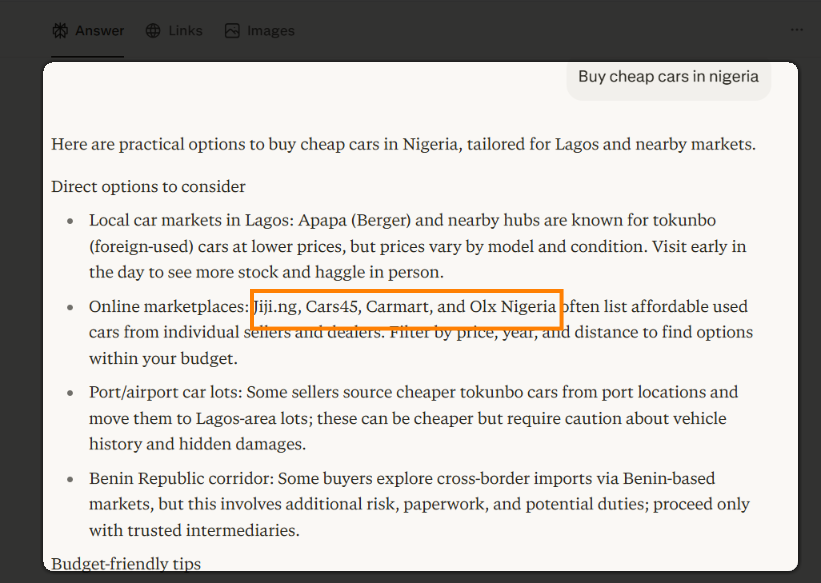
Getting left out of the AI answer?
Find out exactly where your competitors are getting cited and you are not. Get a free audit and we will map your AI visibility gaps.
Get My Free SEO Audit →3The Core GEO Playbook: 7 Things That Work
This is the practical part. These are the seven moves that actually drive citations in 2026. None of them are complicated. Most people just don't do them.
1. Answer first, in the first 40 to 60 words
AI engines scan the top of your page first when building an answer. So lead every page with a 2 to 4 sentence direct answer to the main question, before any throat-clearing intro. This inverted-pyramid structure (conclusion first, detail after) is the single highest-leverage change you can make. Notice I opened this very article that way.
2. Pack in the facts
Vague content doesn't get cited. Specific content does. A good rule I follow: include a concrete fact, statistic, or data point roughly every 150 to 200 words. Numbers, dates, named examples, and original data are citation magnets, because they're exactly what an AI wants to repeat with confidence.
3. Write original data nobody else has
This is the strongest GEO move there is. If you publish a statistic, a survey result, or a finding that exists nowhere else, you become the only possible source for it. The AI has to cite you. I talk more about this in the E-E-A-T guide, because original research is the ultimate proof of experience.
4. Structure for machines
Use clear H2 and H3 headings phrased as the questions people actually ask. Use bullet lists and comparison tables, because those are the formats AI engines cite most often. Clean structure isn't decoration, it's how the machine reads you.
5. Add schema markup
Structured data tells the machine exactly what your content is. Article schema, FAQ schema, and author schema all make you more parseable and citation-eligible. I cover the full setup in schema and structured data for AI search.
6. Keep it fresh
AI engines, and Perplexity in particular, weight recency heavily. An article updated last month beats an identical one frozen three years ago. For your most important pages, schedule a quarterly refresh: add new data, fix outdated figures, and update the "last modified" date. This is the same content pruning and refreshing discipline that keeps your whole site healthy.
7. Let the AI crawlers in
This one's technical but critical. If you block the AI crawlers, you can't be cited, full stop. Make sure bots like GPTBot are allowed in your robots.txt, and use the new llms.txt file to point them at your best content.
4Platform by Platform: ChatGPT, Perplexity & Gemini
Each AI engine pulls its information a little differently. Here's what matters for the big three, in plain terms.
| Engine | Where it gets sources | What to prioritize |
|---|---|---|
| ChatGPT | Web search runs largely on Bing's index | Submit your sitemap to Bing Webmaster Tools, allow GPTBot, strengthen E-E-A-T |
| Perplexity | Live web, citation-forward, recency-heavy | Keep content fresh, lead with direct answers, earn authority |
| Gemini / AI Overviews | Google's index + Knowledge Graph | Rank well in Google, build entity signals, use schema |
The single most overlooked tactic here: Bing Webmaster Tools. Everyone obsesses over Google and forgets that ChatGPT's web search leans on Bing's index. If you're not indexed in Bing, you're invisible to a huge slice of AI search. It takes ten minutes to set up. Do it today.
One more reality to plan around: there's typically a 4 to 8 week lag before fresh content shows up in AI answers. GEO is not an overnight tactic. It compounds, which is exactly why starting now, while most of your competitors are still asleep on this, is the whole opportunity.
5The Brand Authority Layer (The Part Most People Skip)
Here's where most GEO advice stops at on-page tactics and misses the bigger lever. Getting cited isn't only about how you structure a page. It's about whether the AI trusts your brand in the first place.
I covered this in depth in the pillar, but it bears repeating here because it's the heart of GEO: AI models pull from sources they already trust. So your job is to exist, clearly and consistently, in those trusted places.
That means building out your presence where the machines look: a Crunchbase profile, a Wikipedia entity if you're notable enough, profiles on the trusted platforms in your industry, and above all, brand mentions across publications the AI already reads. Industry analysis has found that brand mentions correlate with AI visibility far more strongly than backlinks do.
This is why I tell every client the same thing: think like a billboard, not like a click. You're building visibility and trust so that when the AI goes looking, your name is everywhere it checks. The full strategy is in my guide to digital PR and brand mentions, and the deeper mechanics of how models pick sources are in LLM optimization.
The brands that get cited by AI aren't the ones shouting the loudest. They're the ones the machine has seen vouched for, again and again, in the places it trusts.
Want to be the brand AI recommends?
Building AI visibility takes the right content, structure, and authority working together. We run the full GEO system for businesses every day.
Work With Shakeworld →6How to Measure GEO
You can't improve what you don't track. The challenge is that GEO doesn't show up cleanly in your normal analytics, an AI can cite you and send zero clicks, yet still win you the customer. So measurement shifts.
Here's what to actually track:
- Citation share. Run your most important queries through ChatGPT, Perplexity, Gemini, and Claude. Note where you get named and where competitors do. That's your baseline.
- AI referral traffic. Some users do click through. Watch for referral traffic from AI domains in your analytics, it's been climbing fast.
- Brand demand. When AI names you, people search your brand afterward. Rising branded search is a strong signal your GEO is working.
I go deep on the full framework in measuring modern SEO. The mindset shift is the main thing: you're tracking mentions and demand, not just clicks.
7The Mistakes That Keep You Uncited
Quick hit list of what kills GEO. Avoid these.
- Blocking AI crawlers. If GPTBot can't read you, you can't be cited. Check your robots.txt.
- Burying your answer. If the direct answer isn't near the top, the AI won't dig for it.
- Vague, fact-free content. No specifics, no citation. Generic content is invisible to AI.
- Ignoring Bing. No Bing index, no ChatGPT citations.
- Set-and-forget content. Stale pages lose to fresh ones. Refresh your best work.
- All tactics, no authority. Perfect formatting won't save a brand the AI has never heard of. You need the authority layer too.
The summary line: stop trying to trick the machine into citing you, and start being the most trustworthy, quotable source on your topic.
Frequently Asked Questions
Generative Engine Optimization (GEO) is the practice of structuring your content so AI engines like ChatGPT, Perplexity, Gemini, and Google AI Overviews cite your brand as a source when answering questions. Unlike traditional SEO, which optimizes for clicks on a results page, GEO optimizes for citations inside AI-generated answers.
Yes, but they work together. SEO earns you rankings in search results, while GEO earns you citations inside AI answers. GEO does not replace SEO, it builds on top of it, because AI engines mostly pull from content that already ranks and already has authority. Optimizing for one increasingly helps the other.
To get cited by ChatGPT: submit your sitemap to Bing Webmaster Tools (ChatGPT web search uses Bing's index), allow the GPTBot crawler in your robots.txt, lead your pages with a direct answer in the first 40 to 60 words, include specific facts and data, add schema markup, and build brand authority through mentions on trusted publications.
Expect a 4 to 8 week lag before fresh content surfaces in AI answers, with citation gains typically becoming measurable around weeks 8 to 10 and compounding after that. GEO is not an overnight tactic, it is a compounding system, which is why starting early while competition is low is a major advantage.
Measure GEO by tracking citation share (run your key queries through ChatGPT, Perplexity, Gemini, and Claude and note where you are named), AI referral traffic in your analytics, and branded search demand. The focus shifts from clicks to mentions and brand demand, since an AI can cite you and win the customer without sending a click.
8Your 12-Week GEO Action Plan
Let me leave you with the exact sequence I'd run. Don't do everything at once. Work it in order.
Weeks 1 to 2: Baseline. Run your 30 most important queries through ChatGPT, Perplexity, Gemini, and Claude. Document where you're cited and where competitors are. Set up Bing Webmaster Tools and submit your sitemap. Confirm GPTBot is allowed.
Weeks 3 to 6: On-page. Optimize your top 20 pages. Add answer-first openings and TL;DR summaries. Restructure into clear claims backed by evidence. Add data tables and Q&A sections. Make author, date, and update-date visible. Add schema.
Weeks 7 to 10: Authority. Identify 5 to 10 trusted publications where your brand should appear. Pitch founder bylines, guest articles, and expert commentary. Build the profiles and brand mentions that make the machine trust you.
Weeks 11 to 12: Measure and iterate. Re-run your 30 baseline queries. Document what changed. Prioritize your next batch of pages based on what's working.
Run that, and you've turned GEO from a buzzword into a system, exactly the kind of system that keeps producing results long after the work is done.
This is one piece of the bigger picture. GEO works best when it sits on a solid foundation, so if you haven't yet, start with the complete guide to modern SEO, then pair this with answer engine optimization and LLM optimization to cover every AI surface.
And if you'd rather have a team that does this every day build your AI visibility for you, that's exactly what we do at Shakeworld Digital. Get a free SEO audit and let's find out where you're getting left out of the answer.
Written by Popmati Samson, Founder of Shakeworld Digital, systems builder, and AI entrepreneur. I build content and SEO systems that keep producing results long after the work is done. Last updated: June - 2026.
Ready to get cited by AI?
You have the playbook. If you would rather have a team that lives and breathes this build your AI visibility for you, that is exactly what we do at Shakeworld Digital.
Get Your Free SEO Audit →