
The Complete Guide to Modern SEO: How to Rank on Google and Get Cited by AI in 2026
 By Popmati Samson
26 min readUpdated 2026
By Popmati Samson
26 min readUpdated 2026
Here's the truth most SEO guides won't tell you in 2026:
You can rank #1 on Google and still be invisible.
I know that sounds impossible. For 25 years, ranking #1 was the game. You climbed to the top of the results, you got the clicks, you won. Simple.
That game is over.
Today, an AI answer sits above your #1 ranking, summarizes the entire topic, and sends the user on their way before they ever scroll down to your link. The user got their answer. You got nothing.
So modern SEO is no longer one job. It's two:
- Ranking so search engines find you (the old game, still alive)
- Getting cited so AI recommends you (the new game, the one that's exploding)
This guide covers both, end to end. It's long, because this subject is big and I didn't want to leave gaps. By the end, you'll understand exactly how search works now, what's changed, what still matters, what's dead, and the exact order to do things in.
I'm Popmati Samson. I'm a self-taught digital marketer and systems builder, and I've spent thousands of hours in the trenches of SEO, content systems, and AI, building the kind of infrastructure that keeps producing results long after the work is done. This is the guide I wish I'd had when everything started changing.
Let's get into it.
- What Is SEO? (And What It Really Means in 2026)
- Why SEO Matters More Than Ever
- What Actually Changed: Search Stopped Being a Search Engine
- The Zero-Click Reality (And Why SEO Still Matters More Than Ever)
- The Three Disciplines: SEO, AEO & GEO
- Authority Is the New Currency
- Optimize for Impressions, Not Just Clicks
- E-E-A-T and the War on AI Slop
- Content That Wins in 2026
- Technical SEO: The Non-Negotiable Floor
- The Five Places Search Now Lives
- What Stopped Working (The Kill List)
- How to Actually Measure Modern SEO
- Your Modern SEO Roadmap
1What Is SEO? (And What It Really Means in 2026)
Let me start with the basics, because you can't master the new game without understanding the old one.
SEO, or Search Engine Optimization, is the practice of getting free, organic traffic to your website from search engines like Google. When someone searches for something related to your business and you show up near the top without paying for an ad, that's SEO working.
That's the textbook definition. Here's the real one.
SEO is the art and science of making search engines (and now AI) trust you enough to put you in front of the right people at the exact moment they're looking. It's about being the answer when someone has a question.
For most of its history, SEO had three pillars, and these still matter today:
On-page SEO. Everything on your actual page: your content, your keywords, your headings, your titles, your internal links. It's making each page clearly about what it's about, for both readers and machines.
Off-page SEO. Everything that happens away from your site that builds your reputation: backlinks, brand mentions, digital PR. It's the internet vouching for you.
Technical SEO. The plumbing: site speed, mobile-friendliness, crawlability, structured data. It's making sure machines can actually access and understand your site.
Here's the key difference between SEO and paid ads, and why I love it so much. With ads, the traffic stops the second you stop paying. With SEO, you do the work once, and a well-ranked page can bring in visitors month after month, for free, for years. That's not a cost. That's an asset that compounds.
But here's what changed in 2026, and why this guide exists: SEO is no longer only about your website. It's about being visible and trusted everywhere people and AI look for answers. We'll get deep into that. First, let me convince you why it's worth the effort.
2Why SEO Matters More Than Ever
You might be thinking: "If AI is eating the clicks, why bother with SEO at all?"
Fair question. Here's my answer, backed by how people actually behave.
Search is still where intent lives. When someone types a question into Google or asks an AI, they want something right now. That's the highest-intent moment in all of marketing. No other channel catches people at the exact second they're looking for what you offer. Social media interrupts people who are scrolling for fun. Search meets people who are actively hunting for a solution. That difference is everything.
The traffic is "free," and that changes the math. Let me put it in money terms. Say a keyword related to your business gets 10,000 searches a month, and the top result captures around a quarter of the clicks. That's 2,500 visitors a month to one page. If you bought those same clicks through ads at even $1 each, that's $2,500 every single month, forever. Rank that page organically, and you get that traffic without paying per click. One good page can be worth more than a full-time salesperson.
It compounds while you sleep. This is the part that fits everything I believe about building systems. A paid ad is a faucet, money in, traffic out, turn it off and it stops. SEO is an asset you build once that keeps producing. Publish a genuinely great guide, earn the authority, and it works for you at 3am, on weekends, while you're on holiday. Success isn't about working harder. It's about building systems that keep producing results long after the work is done, and SEO is one of the purest examples of that principle I know.
And in the AI era, visibility is survival. Here's the new reason SEO matters, the one most people haven't grasped yet. When someone asks ChatGPT or Google's AI "what's the best [your service] company," the AI names a handful of brands. If you're not one of them, you don't exist in that conversation. SEO is now what determines whether the machines know you, trust you, and recommend you. That's not optional anymore. That's whether your business gets found at all.
So no, SEO isn't dead. It changed shape, and it matters more now than at any point in the 25 years it's existed. Let me show you exactly how it changed.
3What Actually Changed: Search Stopped Being a Search Engine
Let me give you the single most important shift in plain words.
Search used to be a librarian. You asked a question, it pointed you to the books, you went and read them. Google's whole job was handing you a list of links.
Now search is an answer machine. You ask a question, and it reads the books for you, writes you a summary, and you never touch the shelf.
This isn't a prediction. It already happened. On May 19, 2026, Google announced the biggest changes to Search in 25 years at Google I/O. AI Mode became the global default, the search box was rebuilt for conversational prompts, and persistent background "information agents" began rolling out.
And the scale is staggering. AI Mode, built on Gemini 3.5 Flash, crossed one billion monthly users in its first year, with queries doubling every quarter. This is not a side experiment. It's the front door now.
Here's the line I want you to tattoo on your brain:
Ranking is about being found. Citation is about being chosen. In 2026, you need both.
Because here's the kicker that catches most business owners off guard: ranking number one in Google no longer means you appear in the answer. The AI decides who gets named. And if it doesn't name you, you don't exist for that search, no matter where you "rank."
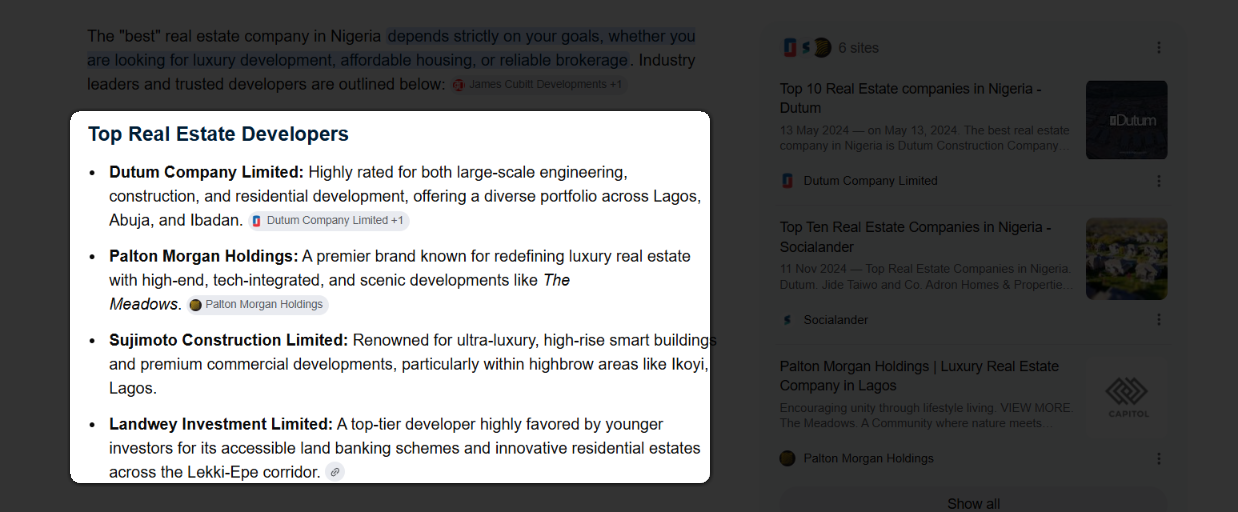
Look at this. A real Google AI result naming the top brands in an industry, with citations. The brands it names get chosen. Everyone below gets ignored. This is exactly what we're optimizing for.
4The Zero-Click Reality (And Why SEO Still Matters More Than Ever)
Now let's talk about the scary part. Then I'll talk you off the ledge.
The scary part has a name: zero-click search. That's a search that ends without the user clicking through to any website. They got everything they needed right there on the results page.
The numbers are real and they're brutal. A randomized field study run from January to February 2026 found that AI Overviews reduced outbound organic clicks by 38% on triggered queries, and zero-click searches rose from 54% to 72% in those sessions. Removing the AI Overview nearly doubled the clicks. So the AI summary is directly eating the traffic.
And for some sites, it's been a bloodbath. Some sites have lost 20 to 60% of their traffic as AI Overviews expanded.
If you stopped reading here, you'd panic. Don't.
SEO isn't dying. It's splitting. The traffic that's disappearing is mostly low-value, top-of-funnel, "what is X" informational traffic that rarely converted anyway. But, the new kid on the block is Citation
Look at what citation is worth. Research from Seer Interactive found brands cited inside an AI Overview earn 35% more clicks versus non-cited competitors on the same query, and Amsive found branded queries earn an 18% CTR lift under AI Overviews.
Think about what that means. When an AI names your brand as the answer, that's not a blue link competing with nine others. That's an endorsement. The machine vouched for you. No traditional ranking has ever carried that kind of trust.
So the businesses winning right now aren't fighting the AI. They're getting chosen by it. That's the whole game, and the rest of this guide is how you do it.
Losing traffic to AI answers?
Find out exactly where you stand. Get a free SEO audit and we will show you the gaps quietly costing you visibility, rankings, and AI citations.
Get My Free SEO Audit →5The Three Disciplines: SEO, AEO & GEO
Modern search has three layers, and you need a name for each. These are the three abbreviations I want you to remember, because the entire industry now runs on them:
SEO, Search Engine Optimization. The classic. Earning your spot in the organic results. Still alive, still the foundation.
AEO, Answer Engine Optimization. Structuring your content so it gets pulled into the AI answer itself, the AI Overviews, the featured snippets, the voice answers.
GEO, Generative Engine Optimization. Getting your brand cited and recommended by generative AI tools like ChatGPT, Perplexity, Gemini, and Claude.
Here's the simplest way I can frame the three:
SEO gets you ranked. AEO gets you into the answer. GEO gets you cited.
Now, the most common mistake I see people make: they think GEO replaces SEO. It doesn't. It sits on top of it.
You still have to rank to get cited, because the AI mostly pulls from pages that already rank well. But, recent study shows citations coming from the organic top ten dropped from 76% in mid-2025 to roughly 38% by early 2026. Ranking still helps you get cited, but it's no longer a guarantee
If you want to go deep on each Organic traffic optimization strategies, I've written dedicated guides on Generative Engine Optimization (GEO) and Answer Engine Optimization (AEO), because each one deserves its own playbook.
Here's how the three compare at a glance:
| SEO | AEO | GEO | |
|---|---|---|---|
| Goal | Rank in results | Win the AI answer box | Get cited by AI chatbots |
| Surface | Google organic | AI Overviews, snippets, voice | ChatGPT, Perplexity, Gemini |
| Wins by | Relevance + authority | Clear, structured answers | Brand authority + citations |
| Old metric | Rankings, traffic | Featured snippet share | (didn't exist) |
| New metric | Traffic + conversions | Answer inclusion | Citation share |
6Authority Is the New Currency
If tactics were king in old SEO, authority is king now. Both Google's AI and the chatbots are obsessed with one question: can I trust this source enough to put my name next to it?
Authority breaks into three pieces you need to build.
Entities, not keywords
Search engines stopped thinking in keywords and started thinking in entities, real-world things (people, brands, concepts) and the relationships between them. When Google understands that "Shakeworld Digital" is a real entity, an agency, run by a real person, connected to real topics, it can confidently surface and cite it.
This is why keyword stuffing is not just useless now, it's invisible. The machine isn't counting words. It's mapping meaning. I go deep on this in my guide to Entity SEO and the Knowledge Graph.
Topical authority over domain authority
Here's a shift that genuinely changed how I build content. Google now evaluates expertise by topic cluster, not by your whole domain. A site with deep, complete coverage of one subject will beat a bigger, "stronger" site that only covers it shallowly.
That's exactly why this guide exists with 20 supporting articles around it, that's a deliberate topical authority play. Depth signals expertise. Scattered posts signal nothing.
Brand mentions over backlinks
This is the stat that should change your strategy. Industry analysis found that brand mentions show a 0.664 correlation with AI Overview visibility, compared to just 0.218 for backlinks.
Read that again. Being talked about now predicts AI visibility roughly three times better than being linked to. This is the rise of digital PR and brand mentions as the new link building, and it's why the old link game is fading (more on that in the kill list).
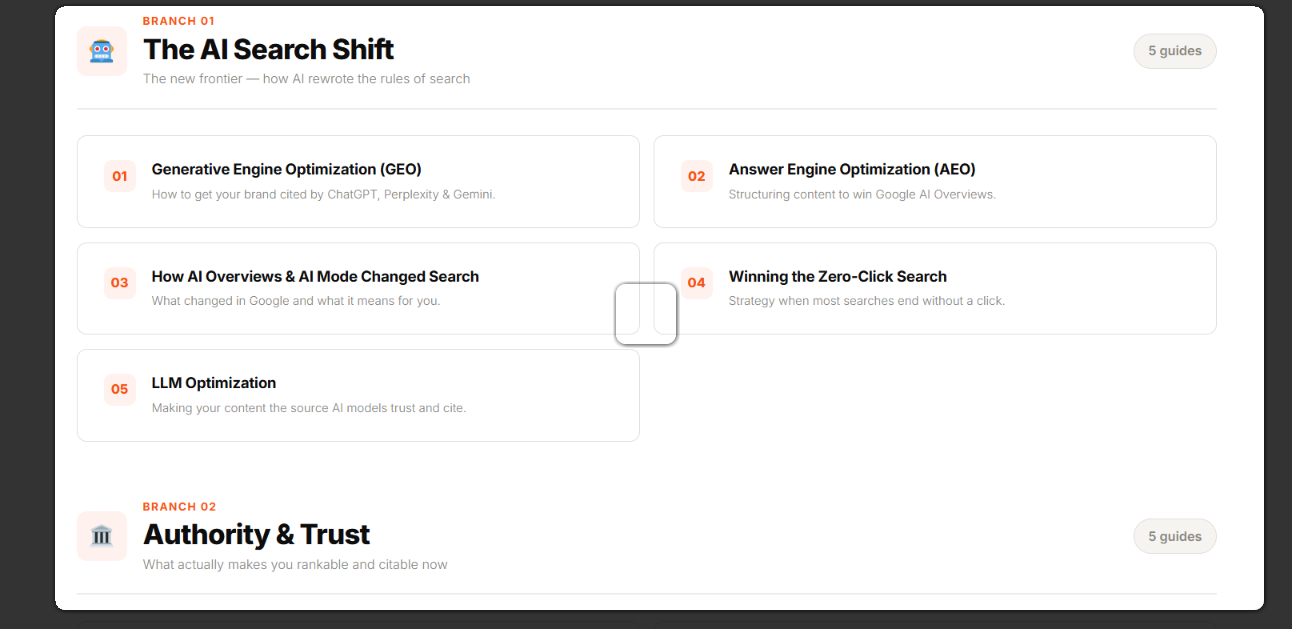
The exact cluster structure behind this guide: one pillar at the center, with branches of supporting articles covering every angle of the topic. This is topical authority built on purpose.
7Optimize for Impressions, Not Just Clicks
This is the single biggest shift in how I think about SEO now, and it's the part most people still haven't caught up to. So let me slow down here, because if you get this one idea, everything else clicks into place.
For years, SEO was obsessed with one thing: the click. Rank, get clicked, win. Every metric pointed at it.
But think about how the biggest brands in the world have always advertised. When a company pays for a billboard, a TV spot, or a radio ad, they're not paying for clicks. They're paying for impressions. They're paying to be seen. Nobody clicks a billboard. The brand shows up in front of you enough times, you start to trust it, and when you finally need that product, you already know who to choose.
Here's my core finding: the exact same thing is now happening in search.
In a world of AI answers and zero-click results, your job is no longer just to win the final click. Your job is to be seen, repeatedly, in every place your customer looks, so that when they're finally ready to choose, you're the name they already trust. You optimize for impressions and visibility first, and the clicks (the real, high-intent ones) follow at the end.
I say it like this: be everywhere they look, so you're the one they choose.
So how do you actually build that visibility? You go and plant your flag in the places AI and search engines trust to pull their information from. Let me walk you through exactly where, because this is the practical playbook I use.
Build profiles where the machines look
When a large language model (an LLM, the engine behind ChatGPT, Gemini, and the rest) decides which brands to trust and name, it leans heavily on a handful of high-authority sources. Your job is to make sure you exist, clearly and consistently, in those sources. Look at your network and your industry, and figure out the trusted platforms you should be on. Here are the ones I prioritize.
Wikipedia. This is the holy grail of entity trust. AI models and Google's Knowledge Graph treat Wikipedia as a primary source of truth. A clean, well-cited Wikipedia profile for your brand or yourself is one of the strongest entity signals you can own.
Now, the honest truth about Wikipedia: it's hard. You can't just write your own page and publish it, Wikipedia has strict notability rules, and self-promotional pages get removed fast. You generally need genuine notability (real press coverage, real significance) and proper third-party citations. For most businesses, the realistic route is to first earn the press coverage that makes you notable, then either work with an experienced Wikipedia editor or a reputable agency that does this properly. Be careful here, plenty of agencies overpromise, so vet them and make sure they build it the legitimate way, or it won't stick.
Crunchbase. Far easier than Wikipedia, and very high trust, especially for companies, startups, and founders. Crunchbase is widely scraped and referenced by both search engines and AI models as a source of company data. Creating a profile is straightforward: you sign up, claim or create your organization, and fill it out completely, your description, founders, location, funding (if any), and links.
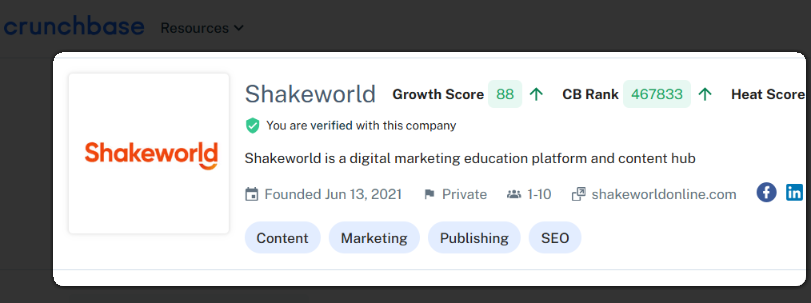
Our own Shakeworld profile on Crunchbase, a source both search engines and AI models trust and pull from. Setting this up is one of the simplest, highest-trust moves you can make.
Nairaland and niche community platforms. Don't overlook the big, trusted community platforms in your market. For Nigerian businesses, Nairaland is a giant with serious domain authority. Create a profile and publish a few genuinely educational posts related to your business, not spam, real value tied to your expertise. The same logic applies to Reddit, Medium, industry forums, anywhere with authority and an audience in your space. Each one is another trusted place where you show up when the machines (and people) go looking.
The principle behind all of it: every trusted profile you own is another impression, another vote that you're real, and another place an AI can find and cite you.
Brand activation: digital PR that puts you everywhere
The most powerful visibility lever, though, is genuine brand activation online, getting your name onto publications that both people and machines already trust. This is where digital PR earns its keep.
Here's a concrete example from my own market. For Nigerian tech businesses, you can run a PR campaign by paying a respected publication like TechPoint Africa to feature your brand. In my experience, a sponsored feature or brand press placement typically runs in the region of ₦250,000, and the exact figure depends on the package and publication. The big players do exactly this. Companies like OPay and Infinix have built much of their visibility through consistent publication features and PR coverage, you'll find a steady stream of articles about them across the major tech publications, and that's not an accident. That's strategy.
Let me give you the honest pros and cons, because PR isn't magic.
The pros: you get a trusted, third-party publication vouching for you, which is gold for both human trust and AI citation. The article often becomes an evergreen, permanently-hosted asset that keeps working for years. And it builds the brand mentions and entity signals we talked about, the stuff that now out-predicts backlinks for AI visibility.
The cons: it costs real money, and a single placement rarely moves the needle, brand building through PR is a repeated game, not a one-off. There's also a discipline question: paid features are paid, so they carry less editorial weight than coverage you earn purely on merit. The smart play is a mix of both, paid placements to establish presence, and genuinely newsworthy work to earn organic coverage over time.
I cover the full strategy in my guide to digital PR and brand mentions, but the mindset is what matters most here: you're not buying a click, you're buying an impression and a trust signal. Just like that billboard, except this billboard is one that AI reads.
8E-E-A-T and the War on AI Slop
Let me introduce the abbreviation that decides whether your content lives or dies: E-E-A-T.
It stands for Experience, Expertise, Authoritativeness, Trustworthiness. Google uses it as a quality filter, and in 2026 it matters more than it ever has. Here's why.
Generative AI made content free. Anyone can spin up a thousand articles in an afternoon. So the internet flooded with what I bluntly call AI slop, mass-produced, soulless, say-nothing content. Google's countermeasure, cemented across recent core updates, is a hyper-focus on E-E-A-T to separate helpful, human-verified content from AI-generated spam.
So how do you prove you're real? You show the one thing AI can't fake: first-hand experience.
That means real examples. Real screenshots. Real opinions and original takes. Real data you gathered yourself. In fact, original research has become a citation magnet, because AI Overviews preferentially cite proprietary statistics and original, data-driven content.
Here's my honest take from building content systems for a living: the irony of the AI era is that being unmistakably human is now your biggest competitive advantage. I use AI heavily in my own work, but as an engine for leverage, never as a replacement for genuine experience and judgment. The winners pair human insight with AI scale. The losers let the machine do the thinking. (I break down how to walk this line in E-E-A-T in the Age of AI Content.)
There's also a "who" attached to every piece of content now. Google increasingly cares about the author behind the words, which is why author authority and Person schema became a real ranking lever. The expert with a name, a face, and a track record beats the anonymous byline every time.
9Content That Wins in 2026
The structure of winning content changed. Let me give you the formula I now use on everything.
Answer first. Always.
Old content buried the answer at the bottom to keep you reading. Dead strategy. Modern content, and modern AI, rewards the opposite: the answer-first format.
Open with the direct answer in the first 100 words. Then expand. There's hard logic here, not just style: research indicates roughly 44.2% of AI citations come from the first 30% of the content, so leading with a clear, quotable answer dramatically raises your odds of being cited.
Notice I did exactly that at the top of this guide, the direct answer came before anything else. That wasn't an accident. That was AEO.
The pattern I recommend for every piece: open with a direct definition or answer, deliver a comparison table or structured breakdown in the middle, and close with a clear decision framework or next step. Clean, structured, extractable. That's what machines can lift and humans can scan. I go deeper in answer-first content writing.
Match the intent, not the keyword
The other half is search intent. It's no longer about cramming the keyword in, it's about nailing what the searcher actually wants. The keyword "best running shoes" and "why do my knees hurt when I run" might lead to the same product, but the intent is worlds apart. Modern keyword work is semantic, it maps meaning and intent, not just volume. That's the focus of my guide on search intent and semantic keyword research.
Keep it alive
One more thing most people miss: content isn't "publish and forget" anymore. Stale content decays. Refreshing and pruning your library, cutting dead weight, updating what's slipping, keeps the whole site healthy. That's the content pruning and refreshing discipline, and it's one of the highest-ROI activities in modern SEO.
And when you need to scale content across hundreds of pages without creating slop, that's where programmatic SEO comes in, done right, with quality, not spam.
This is a lot to handle alone.
Technical SEO, citable content, authority building, the full system. We run it for businesses every single day. Let us run yours.
Work With Shakeworld →10Technical SEO: The Non-Negotiable Floor
I'll be honest with you: technical SEO won't win you the game on its own. But it's the floor you stand on. If it's broken, nothing else you do matters, because the machines can't read you in the first place.
Think of it this way: technical SEO is the floor, not the ceiling. You have to clear it to play. Here's what makes up the floor in 2026.
Core Web Vitals and speed. Google measures how fast and stable your pages are, on mobile and desktop. Slow site, lost rankings. Simple.
Crawlability and architecture. If search engines (and now AI crawlers) can't move through your site cleanly, they can't index or cite you. Your site architecture and internal linking is what guides them, and what passes authority between your pages.
Structured data (schema). This is the big one for the AI era. Schema markup is how you spell out your content in a language machines read perfectly. Structured data like Product, Article, FAQ, and How-To schema improves AI parseability and has become essential for citation eligibility. I cover the full setup in schema and structured data for AI search.
The new frontier: controlling AI crawlers. There's a new file in town called llms.txt, alongside the classic robots.txt. It lets you direct AI crawlers to your best content and away from thin or duplicate pages. If you've never heard of it, you're not behind, almost nobody has implemented it yet, which is exactly why getting it right now is an edge. Full breakdown in llms.txt, robots.txt and AI crawlers.
For the complete technical checklist, see Technical SEO for 2026.
11The Five Places Search Now Lives
Here's a mental model that reframes everything. Search isn't one box anymore. Search now lives in five places at once: Google, AI Overviews, voice assistants, voice commerce, and AI agents acting on behalf of users.
Your customer might bounce through all five in a single day, ask Gemini a question, get an AI Overview, tell their voice assistant to reorder something, never typing a traditional search once. If you only show up in one of those places, you're losing the other four.
And the newest, strangest frontier is agentic search. An AI agent isn't a search engine that displays results, it's an autonomous system that browses, compares, books, and buys on behalf of a user who may never visit your website at all.
Sit with that. A user tells an agent "find me a reliable digital marketing agency and set up a call," and the agent does it, selects, evaluates, acts, without that human ever seeing a search result. The question that should drive your whole strategy: if an AI agent went looking for the best business in your category, would it find and choose you?
That's not science fiction for "someday." It's the direction everything is moving, and the brands building entity authority and citation presence now are the ones agents will trust later.
12What Stopped Working (The Kill List)
Let me save you time, money, and heartbreak. These tactics are dead or dying in 2026. Stop spending on them.
Buying backlinks at scale. This one's now actively dangerous. PBN links, directory submissions, and bulk "DA 50+ backlinks for $100" packages are now risky, because AI search systems aggressively filter manipulated link signals, a site with 500 PBN backlinks is less likely to get cited than a site with 50 editorial backlinks from real publishers. Quality crushed quantity.
Chasing keyword volume without intent. AI Overviews now answer most informational queries directly, so building content around high-volume informational keywords with no commercial intent earns you an AI citation at best and nothing at worst. Filter every keyword by intent before you write.
Keyword stuffing and keyword density. The machine maps meaning now, not word counts. Stuffing just signals low quality.
Thin, mass-produced content. The AI slop strategy. Google's core updates hit this hardest. Volume without value is a liability, not an asset.
Obsessing over rankings alone. A #1 ranking that sits below an AI answer can drive less traffic than a cited mention with no ranking at all. Which brings us to measurement.
Here's the one-line summary for this whole section: stop trying to trick the machine, and start trying to genuinely be the best answer. That's not a motivational line, it's the actual mechanics of how the systems now work.
Not sure what to measure?
Book a free strategy call and we will map the exact metrics that matter for your business, and the plan to move them.
Book a Free Strategy Call →13How to Actually Measure Modern SEO
This is where a lot of businesses get lost, because the old scoreboard broke.
For 20 years, SEO measurement meant: rankings, organic traffic, conversions. Clean and trackable. But here's the problem in 2026: information agents and agentic checkout create conversions with no session, no UTM, and no trackable click path. Someone can discover you inside an AI answer, never visit your site, and still become a customer. Your analytics will show nothing.
So the metrics evolved. Here's what to actually watch now:
Traffic and conversions still matter, they're the bedrock. The classic discipline of tracking organic traffic trends, keyword growth, and conversions from search isn't going anywhere; if anything, conversion quality matters more now that low-value traffic is drying up. (If you want the fundamentals done right, that's its own deep skill.)
Citation share. The new big one. How often does AI name your brand for the queries that matter to you? Ranking optimization and citation optimization are now separate disciplines that need separate tracking.
Brand demand. Branded search volume, direct traffic, mentions. In a zero-click world, when people don't click, they default to the brand they remember. Rising brand demand is a leading indicator that your authority is compounding.
Blended, directional reporting. Because perfect attribution is gone, you shift to trends and leading indicators: qualified leads, brand search growth, cohort performance, not chasing a perfect click path that no longer exists.
I cover the full measurement framework in Measuring Modern SEO, it's the difference between proving SEO works and shrugging when someone asks for ROI.
14Your Modern SEO Roadmap
Let me pull all of this into the exact order I'd tackle it. Don't try to do everything at once, that's how people freeze. Do it in this sequence.
Step 1: Fix the floor (Technical). Before anything else, make sure machines can read you. Core Web Vitals, crawlability, mobile, HTTPS, schema. Start with Technical SEO for 2026 and schema and structured data.
Step 2: Build your authority base (Entities + Topical). Establish your brand as a real entity and start building deep topical coverage. See Entity SEO and topical authority.
Step 3: Create citable content (Content + AEO). Write answer-first, intent-matched, genuinely expert content with original data. See answer-first content writing and search intent research.
Step 4: Earn authority signals (Digital PR + E-E-A-T). Get mentioned, build author authority, earn editorial trust. See digital PR and brand mentions and E-E-A-T in the age of AI.
Step 5: Optimize for AI surfaces (GEO + AEO). Now go win citations across AI Overviews, ChatGPT, Perplexity, and the rest. See GEO and the zero-click strategy.
Step 6: Measure what matters. Set up tracking for citations, brand demand, and conversions, not just rankings. See Measuring Modern SEO.
Work that order and you're not chasing tactics, you're building a system. And that's the whole philosophy behind how I work: success isn't about working harder, it's about building systems that keep producing results long after the work is done. SEO, done right, is exactly that kind of system. It compounds.
Frequently Asked Questions
Modern SEO is the practice of optimizing your online presence so both search engines and AI systems find, trust, and recommend you. In 2026 it goes beyond ranking on Google to also getting cited inside AI answers like Google AI Overviews, ChatGPT, Perplexity, and Gemini. It now has two jobs: ranking to be found, and getting cited to be chosen.
Yes, SEO is more valuable than ever in 2026. While AI Overviews reduce clicks on some informational queries, search is still where buying intent lives, and being cited by AI acts as a powerful endorsement. Research shows brands cited inside an AI Overview earn significantly more clicks than non-cited competitors. SEO did not die, it split into ranking and citation.
SEO (Search Engine Optimization) earns your spot in organic search results. AEO (Answer Engine Optimization) structures your content to win the AI answer box and featured snippets. GEO (Generative Engine Optimization) gets your brand cited and recommended by generative AI tools like ChatGPT and Perplexity. In short: SEO gets you ranked, AEO gets you into the answer, and GEO gets you cited.
To get cited by AI, build authority where AI systems pull their information: create profiles on trusted sources like Wikipedia and Crunchbase, earn brand mentions through digital PR, publish answer-first content with original data, and use structured data. Brand mentions now predict AI visibility far better than backlinks alone.
Backlinks still matter, but quality now massively outweighs quantity. Editorial links from real, relevant publishers help, while bulk or PBN links are risky because AI search systems filter manipulated link signals. In 2026, brand mentions and digital PR have become as important as traditional backlinks for visibility and AI citation.
SEO typically takes three to six months to show meaningful results, though some improvements appear sooner. It is a compounding system: a well-optimized page can keep producing free traffic and AI citations for years after the initial work. SEO rewards consistency over speed.
The Bottom Line
Search changed more in the last 18 months than in the previous 18 years. But strip away the noise and the new rules are simple:
Be the best, clearest, most trustworthy answer, and prove you're real while doing it.
Rank to be found. Get cited to be chosen. Build authority so the machines trust you. Stay unmistakably human so you stand out from the slop. Do those things in the right order, consistently, and you don't just survive the AI search era, you win it.
This guide is the map. The 20 in-depth guides branching off it are the deep dives, work through them in the order above and you'll have the complete system.
And if you'd rather have a team that does this every day handle it for you, that's exactly what we do at Shakeworld Digital. Get a free SEO audit and let's find out where your biggest opportunities are hiding.
The search era you knew is gone. The one replacing it rewards the businesses bold enough to adapt. Let's make sure that's you.
Written by Popmati Samson, Founder of Shakeworld Digital, systems builder, and AI entrepreneur. I build content and SEO systems that keep producing results long after the work is done. Last updated: June - 2026.
Ready to dominate your search results?
You now have the map. If you would rather have a team that lives and breathes this run it for you, that is exactly what we do at Shakeworld Digital. Let us find where your biggest opportunities are hiding.
Get Your Free SEO Audit →