

Media Buying: Turning Ad Money Into Profit
 By Popmati Samson
10 min readUpdated 2026
By Popmati Samson
10 min readUpdated 2026Media buying is the craft of spending advertising money well. Not on one platform, on all of them. It's the discipline that sits above Google, Meta, TikTok, YouTube, and whatever comes next, and decides whether your ad budget makes you money or quietly disappears.
Most people think media buying is button-pushing: set up a campaign, pick an audience, press go. It isn't. The buttons change every few months. The real skill is a way of thinking, a repeatable system for finding what works, killing what doesn't, and scaling what's left. Learn that system and you can buy ads profitably anywhere, no matter how the platforms evolve.
Let me show you that system, in plain terms.
What is Media Buying
Here's the cleanest way to think about it. Media buying is capital allocation. You have a pile of money, and your job is to turn it into more money by buying attention and converting that attention into customers, as efficiently as possible.
That's it. Everything else, the platforms, the targeting options, the bidding settings, is just machinery. The machinery changes constantly. But the job never does: put money in, get more money out, and understand exactly why.
This is why I separate "media buying" from running Google Ads or Meta Ads. Those are channels: specific places you buy. Media buying is the discipline that works across all of them. A good media buyer isn't loyal to a platform; they follow the profit, and they know that the same handful of levers decide success no matter where they're buying.
I'm Popmati Samson, founder of Shakeworld Digital. I've bought ads across platforms and budgets, from a few naira a day to serious monthly spend, and the lesson is always the same: the people who win aren't the ones who know the most buttons. They're the ones who think clearly, control what they can, and refuse to fool themselves with vanity numbers. Let me show you how they think.
Why Most Ad Spend Gets Wasted
Before the system, here are the mistakes that burn money fastest. Nearly every failed campaign is one of these.
Tinkering before the data is in. The most common beginner killer. You launch, get nervous, and start changing things, budget, audience, creative, every day. Every change resets the platform's learning and you never find out what actually works. Patience is a media-buying skill.
Spreading the budget too thin. Too many platforms, too many audiences, too many products at once. Each gets a sliver, none gets enough to learn from, and everything underperforms.
Optimising on broken or vague data. If your tracking is wrong or you're measuring the wrong thing, every decision after that is guessing dressed up as strategy. Optimising on bad data is worse than not optimising at all.
Confusing activity with progress. Cheap clicks and high click-through rates feel like winning. But impressions climbing while sales stay flat isn't momentum; it's wasted spend wearing a costume. Judge by money, not by motion.
Not sure where your ad spend is leaking?
Find out which lever is costing you, creative, funnel, or data, and what to fix first. Get a free audit and we will diagnose your ad spend end to end.
Get My Free SEO Audit →How to Buy Media Like a Pro
Here's the operating system. Follow it on any platform.
1. Master the Three Levers That Actually Move the Needle
Forget the hundred settings. On every platform, results come down to three things, and almost nothing else.
Creative gets the click. It's the single biggest lever you control, the video, image, hook, and angle that stops the scroll. The funnel (your landing page and offer) converts that click into a sale. Clean data tells the platform who to find more of. Get these three right and scaling becomes easy; get any one wrong and no amount of clever bidding will save you. Spend your time here, not fiddling with knobs that barely matter.
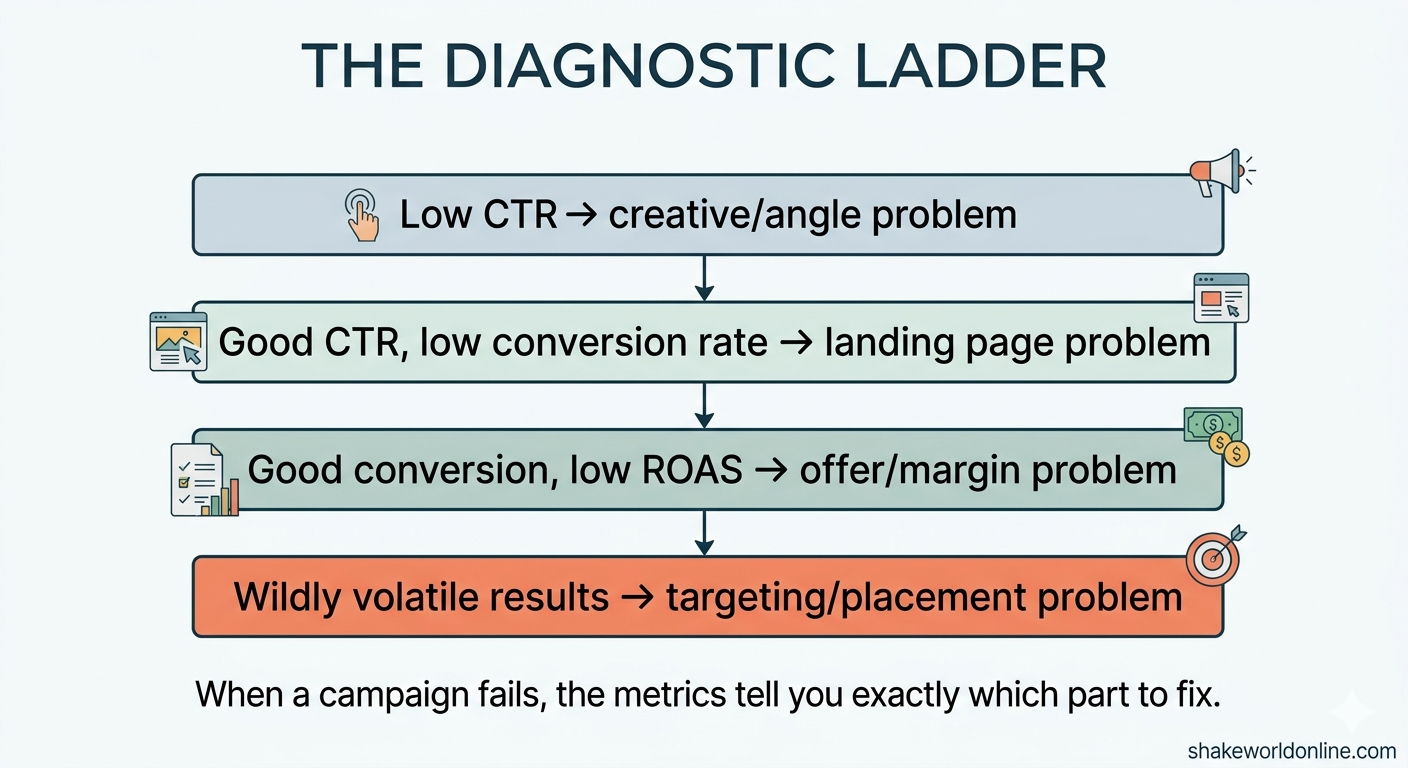
2. Use the Diagnostic Ladder to Find the Real Problem
This is the most valuable thinking tool in all of media buying. When a campaign isn't working, don't guess, diagnose. The numbers tell you exactly where the leak is.
Low click-through rate? Your creative or angle is the problem; people aren't compelled to click. Good click-through but low conversion rate? Your landing page is the problem; the click happens but the page doesn't deliver. Good conversion rate but poor return? Your offer or margins are the problem, not your ads. Wildly volatile, unpredictable results? Your targeting or placement is too loose. Each symptom points to a different fix. This ladder stops you from "fixing" your ads when the real problem is your landing page, which is how most budgets get wasted.
3. Get Your Tracking Right Before You Spend
Everything above depends on trustworthy data, so this comes first in practice. If you can't see clearly which spend produced which sale, you're flying blind, and so is the platform's automation.
Before you launch anything, make sure your conversion tracking actually works and counts real business outcomes, not junk. Feed the platform the best signals you can, which sales were real, which were valuable, so its automation hunts for people who look like your best customers rather than cheap clickers. In a world where precise targeting has gotten harder, clean first-party data is the edge. This is the foundation the whole system stands on, covered in depth in marketing analytics and attribution.
4. Start Narrow, Then Scale Deliberately
Don't try to conquer every platform at once. Master one platform and one funnel first. Get it genuinely profitable, then expand. A focused buyer beats a scattered one every time.
When you do scale, do it deliberately, not in a panic. There are two ways to grow a winner: spend more on the same proven setup (vertical), or replicate it into new audiences, platforms, or angles (horizontal). Push too hard, too fast and you'll watch your efficiency collapse as the platform reaches lower-quality attention to spend your money. Scaling is a discipline of its own: raise budgets in steps, watch the numbers hold, and know when to stop chasing more impressions because the next naira simply isn't worth it. This ties directly to your budget and channel mix.
5. Build a Creative Engine, Because Creative Always Burns Out
Since creative is your biggest lever and every ad eventually fatigues, your real long-term job is to keep fresh, varied creative flowing. The buyers who win aren't the ones with one perfect ad; they're the ones who never run out.
The smart way to do this is to repurpose, not start from scratch each time. Take one strong idea and spin it into many angles and formats: a customer story, a before-and-after, a myth-versus-fact, a behind-the-scenes, a quick tip. One good concept can fuel a dozen ads. Watch for the warning signs of fatigue, your costs creeping up and frequency rising, and have the next batch ready before the current one dies. A steady creative pipeline is what separates a campaign that scales from one that stalls. This is where your content engine and media buying meet.
6. Run It Like Structured Experiments, Not Guesswork
Good media buying is a series of controlled tests, not a gut-feel gamble. Change one thing at a time so you can actually learn from the result. Test one variable, give it enough budget and enough time to produce a real signal, then read it honestly.
Resist the urge to judge too early. A campaign needs time and data before its numbers mean anything, often a week or two before you should make real decisions, and longer before you trust the verdict. Set clear targets up front (what counts as a win?), then let the test run without meddling. Media buying is less like chess, where you plan every move, and more like a game where you can't see the whole board: you probe, you learn, you adjust. The discipline is in the structure, not in reacting to every wobble.
7. Measure What Matters, Not What Flatters
Finally, judge your buying by the numbers that connect to your bank account, not the ones that look pretty on a dashboard. Return on ad spend, cost to acquire a customer, and the lifetime value of that customer are what matter.
The vanity metrics, clicks, impressions, click-through rate, can be useful as early diagnostic signals (they help you climb the ladder above), but they are never the goal. Plenty of campaigns post gorgeous click-through rates and lose money. Always tie your decisions back to real business outcomes, and watch a couple of honest leading indicators too, like how often the same people are seeing your ads (rising frequency warns of fatigue) and whether your costs to reach people are climbing. Those tell you what's actually happening underneath the headline number.
Want ad spend that reliably returns a profit?
Profitable media buying takes strong creative, a tight funnel, and clean data working together. We buy media with this discipline for businesses every day.
Work With Shakeworld →A Few Honest Truths About Media Buying
Let me give you the balanced view, including where this is all heading.
The platforms automate more every year, and that's mostly fine. A lot of what media buyers used to do by hand, setting bids, picking placements, testing audiences, is now done by the platform's automation, often better than a human could. This scares people, but it shouldn't. It just moves the skill up a level. The machine handles the button-pushing; your job becomes the strategy it can't do: the offer, the creative, the clean data, and the judgment about what to test and when to stop. The manual labour is automating. The thinking is more valuable than ever.
You will make expensive mistakes, and that's the tuition. No one allocates perfectly from the start. Some of your budget will buy you lessons instead of customers. That's not failure; it's how the skill is learned. The goal isn't zero waste; it's learning fast and shifting money toward what works before the waste piles up.
Detach your emotions from the daily swings. Results will flip for reasons outside your control, a platform update, a competitor, a holiday. The buyers who last don't panic on a bad day or get cocky on a good one. They control the inputs they own, offer, creative, tracking, structure, manage expectations honestly, and let the system play out. Steady beats reactive.
There's no single "best" way to start, broad or narrow. Some swear by starting tightly targeted and expanding; others start broad and cut based on what they learn. Both can work, it depends on your business, your search volume, and your margins. What's universal isn't the starting tactic; it's the discipline of testing, reading the data honestly, and concentrating money on what proves itself.
Frequently Asked Questions
Media buying is the discipline of spending advertising money well across any platform, Google, Meta, TikTok, YouTube, and whatever comes next, to turn that spend into profit as efficiently as possible. The cleanest way to think about it is capital allocation: you put money in, get more money out, and understand exactly why. It is different from running ads on a single channel; those channels are specific places you buy, while media buying is the way of thinking that works across all of them. The platforms and their buttons change constantly, but the underlying job and the levers that decide success do not.
Creative, funnel, and clean data. Creative (the video, image, hook, and angle) gets the click and is the single biggest lever you control. The funnel (your landing page and offer) converts that click into a sale. Clean data (accurate conversion tracking) tells the platform who to find more of. Get these three right and scaling becomes easy; get any one wrong and no amount of clever bidding will save you. Most settings inside an ad platform barely matter by comparison, so a good media buyer spends their time on these three rather than fiddling with knobs.
Use the diagnostic ladder: the metrics tell you exactly where the leak is. A low click-through rate means your creative or angle is the problem, because people are not compelled to click. A good click-through rate but a low conversion rate means your landing page is the problem, the click happens but the page does not deliver. A good conversion rate but poor return means your offer or margins are the problem, not your ads. Wildly volatile results mean your targeting or placement is too loose. Each symptom points to a different fix, which stops you from changing your ads when the real problem is elsewhere.
Far less than your instincts will tell you. The most common money-wasting mistake is tinkering, changing budget, audience, or creative every day, because every change resets the platform's learning and you never discover what actually works. Run media buying as structured experiments: change one thing at a time, give it enough budget and time to produce a real signal (often a week or two before you make decisions), and judge it against targets you set in advance. It is less like chess, where you plan every move, and more like a game where you cannot see the whole board: you probe, learn, and adjust without panicking over daily swings.
The manual parts are automating, but the skill is becoming more valuable, not less. Platforms now handle much of what buyers used to do by hand, setting bids, picking placements, testing audiences, often better than a human could. That moves the skill up a level rather than eliminating it: the machine handles the button-pushing, while your job becomes the strategy it cannot do, the offer, the creative, the clean first-party data, and the judgment about what to test and when to stop scaling. So the future of media buying is strategic, creative, and technical, not manual bid management.
The Bottom Line
Media buying isn't button-pushing; it's the discipline of turning ad money into profit, reliably, across any platform. The buttons change constantly. The system doesn't.
Master the three levers that matter: creative, funnel, and clean data. Use the diagnostic ladder to fix the real problem instead of guessing. Get your tracking right before you spend. Start narrow and scale deliberately. Build a creative engine so you never run out of fresh angles. Run everything as structured experiments, and judge it all by the numbers tied to your bank account, not the ones that flatter your dashboard.
Do that, and you stop being at the mercy of any single platform or its latest update. You become the kind of buyer who can put money into almost any channel and pull more money back out, on purpose. That's the whole point.
This is one piece of the bigger picture. To see how it all fits together, start with the complete guide to online marketing, then pair this with Google Ads and PPC and Meta Ads (the channels you'll buy on), retargeting (often your highest-return spend), landing pages and conversion optimisation (where the click becomes a sale), your budget and channel mix (how much goes where), and marketing analytics and attribution (the data foundation it all rests on).
And if you'd rather have a team buy your media with this kind of discipline, that's exactly what we do at Shakeworld Digital. Get a free marketing audit and we'll show you where your ad spend is leaking and how to turn it into profit.
Written by Popmati Samson, Founder of Shakeworld Digital, systems builder, and AI entrepreneur. I help businesses turn ad spend into a reliable, profitable system instead of a gamble.
Ready to buy media on purpose?
You have the system. If you would rather have a team buy and scale your media with this discipline, that is what we do at Shakeworld Digital.
Get Your Free SEO Audit →