
The Complete Guide to Online Marketing: How to Turn Strangers Into Customers
 By Popmati Samson
29 min readUpdated 2026
By Popmati Samson
29 min readUpdated 2026Online marketing is how you use the internet to get the right people to notice your business, trust it, and buy from it, again and again.
That's the whole game. Everything else, the ads, the emails, the posts, the funnels, is just a tool in service of that one goal.
But here's the problem. Most people learning online marketing in 2026 are drowning. There are a hundred channels, a thousand "gurus," and ten thousand tools all shouting for attention. It's easy to feel like you need to do everything at once. You don't.
This guide is the map. By the end, you'll understand how every piece of online marketing fits together, which channels matter for your business, and how to build a system that brings in customers month after month, not just a lucky spike that fades.
I'm Popmati Samson, founder of Shakeworld Digital. I've built marketing systems for businesses across very different markets, and I've watched what actually works separate itself from what just sounds clever. This is everything I'd want a business owner to understand, explained plainly. Let's get into it.
First, The One Idea That Makes All Marketing Make Sense
Before we touch a single channel, you need the one idea that everything rests on. Get this wrong and no amount of ads or content will save you. Get it right and the rest gets much easier.
Here it is: people don't buy products. They buy solutions to problems they actually have.
Look around you right now. Almost everything you see was sold to someone, because it solved a problem. The chair solved "my back hurts when I sit on the floor." The phone solved "I need to reach people instantly." Every successful product is a solved problem with a price tag.
So most businesses market the wrong way. They say: "I have this product. It's the best. Buy it." Nobody cares. The customer is busy living their own life with their own problems.
The businesses that win flip it around. They say: "You have this problem. Here's the solution. Here's how it works." That tiny shift changes everything, your ads, your website, your emails, all of it.
And there's a second layer that catches even smart founders. People don't buy the best solution. They buy the one they understand and trust the fastest. I've watched businesses with genuinely better products lose to weaker competitors who simply explained themselves more clearly. So your job isn't only to solve a problem. It's to make the solution so clear and so trustworthy that choosing you feels obvious.
Clarity sounds simple. It's one of the most overlooked skills in all of marketing. We get so close to our own products that we forget what it's like not to already know what we know. Fight that. Explain it like you're talking to a smart friend who's never heard of you. Everything in this guide works better when your core message is clear.
Here's a quick exercise that forces this clarity. Finish these three sentences about your business, in plain words, with no jargon: "My customer struggles with ___." "I help them ___." "Unlike the alternatives, I ___." If you can't fill those blanks crisply, your marketing will struggle no matter how much you spend, because you'll be describing your product instead of their problem. If you can fill them clearly, you've already done what most of your competitors never bother to do. Write those three sentences down before you go further. They become the spine of your ads, your homepage, your emails, everything. The clearer they are, the less you'll have to spend convincing people, because the right people will recognize themselves instantly.
One more thing about this idea. Don't sell the features. Sell the result. Nobody wants a drill; they want a hole in the wall, and really, they want the shelf that hole lets them hang. Nobody wants your software's "advanced dashboard"; they want to stop worrying about their numbers. Always translate what your product does into what it gives the customer. Features tell. Benefits sell. The outcome is what people actually pay for.
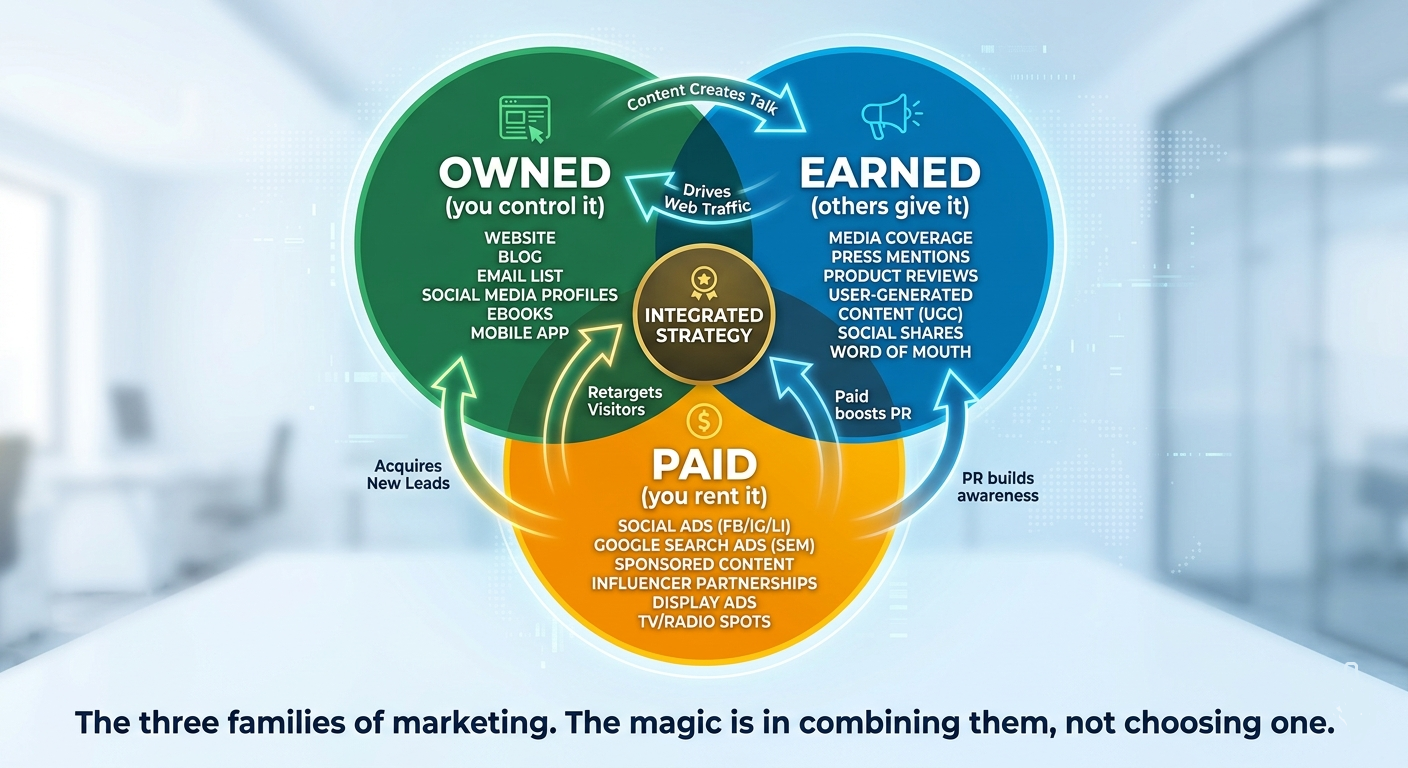
The Three Families of Marketing: Owned, Earned, and Paid
Every online marketing channel on earth falls into one of three families. Once you see these three buckets, the whole landscape stops feeling chaotic.
Owned media is everything you control. Your website, your blog, your email list, your WhatsApp contacts, your own social profiles. You don't pay for each person who sees it, and nobody can take it away. Owned media is slow to build but it's an asset you own forever.
Earned media is the attention other people give you for free. Word of mouth, customer reviews, press coverage, someone sharing your post, a creator mentioning you without being paid. Earned media is the most trusted of the three, because it doesn't come from you. It's also the hardest to control.
Paid media is attention you rent. Google Ads, Meta ads, sponsored posts, paid influencers. You pay, you get seen, you stop paying, you stop being seen. Paid media is fast and predictable, but the moment the budget stops, so does the traffic.
Here's the simple way to hold it in your head: paid media is renting an audience, owned media is building one, and earned media is when your audience starts working for you.
The biggest mistake is treating these as either/or. The real magic is synergy. A paid ad drives someone to your owned landing page. That landing page is so good they tell a friend, and now you have earned media. A piece of earned press coverage gets repurposed into your email and your ads. Strong businesses weave all three together. Weak ones bet everything on one and pray.
A quick honest note on 2026. The cost of making content has dropped close to zero thanks to AI. That means the internet is flooded. So the hard part is no longer making something. It's getting the right people to see it and trust it. This is why distribution, owned audiences, and earned trust matter more now than they did even two years ago. Keep that in mind as we go.
The Marketing Funnel: How Strangers Become Customers
Now for the backbone of everything. The marketing funnel is just a simple way to describe the journey a person takes from "never heard of you" to "loyal customer who tells their friends."
It's called a funnel because lots of people enter at the top, and only some make it all the way down to a purchase. Your whole job is to gently move people from one stage to the next.
There are three stages everyone should know. (Marketers love fancy frameworks, but this is all you need to start.)
Top of the funnel: awareness. This is where someone first realizes they have a problem, or first hears about you. They're not ready to buy. They're just looking for help or answers. Your goal here isn't to sell. It's to be useful and memorable, so that when they are ready, you're the name they remember. Blog posts, social media, YouTube videos, and helpful guides live here.
Middle of the funnel: consideration. Now the person knows they have a problem and is weighing their options. They're comparing solutions, including yours. Your goal is to show why your solution fits them best. Email sequences, case studies, comparison pages, product demos, and webinars live here.
Bottom of the funnel: decision. The person is ready to buy. They just need a final nudge and a reason to choose you now. Your goal is to make buying easy and the decision safe. Sales pages, customer testimonials, free trials, special offers, and clear calls to action live here.
Here's what most beginners miss. People don't move through these stages in a neat line. Someone might find your YouTube video, forget about you for a month, see a friend mention you, then Google your brand and buy. The journey is messy. So you want content and presence at every stage, not just the "buy now" stage.
There's also a part of the funnel that businesses ignore at their peril: what happens after the sale. The smartest businesses obsess over retention (keeping customers happy so they buy again) and referral (happy customers bringing you new ones). It costs far less to keep a customer than to win a new one, and a referred customer arrives already trusting you. A leaky funnel where customers buy once and vanish will bleed you dry no matter how good your ads are.
Let me make this concrete with an example. Say you sell a home workout program.
At the top of the funnel, a person who feels unfit searches "easy home workouts for beginners" and finds your free YouTube video. They don't buy anything. They just get value and learn your name. That's awareness working.
In the middle, that same person later sees your post comparing home workouts to expensive gym memberships, and signs up for your free weekly tips by email. Now they're considering you. Your emails show real people who got fit with your program. Trust builds.
At the bottom, weeks later, you email a limited-time offer. They already know you, trust you, and feel the problem. They buy. Then, because the program actually works, they tell a friend, and that friend enters your funnel at the top. The loop closes.
Notice that no single piece "made the sale." The video, the post, the emails, and the offer all did their job in sequence. That's why trying to sell to everyone immediately fails, and why a full-funnel presence wins.
Understanding the funnel is the single most useful mental model in marketing, so I've made it the first deep-dive in this hub. Read the marketing funnel guide once you finish here.
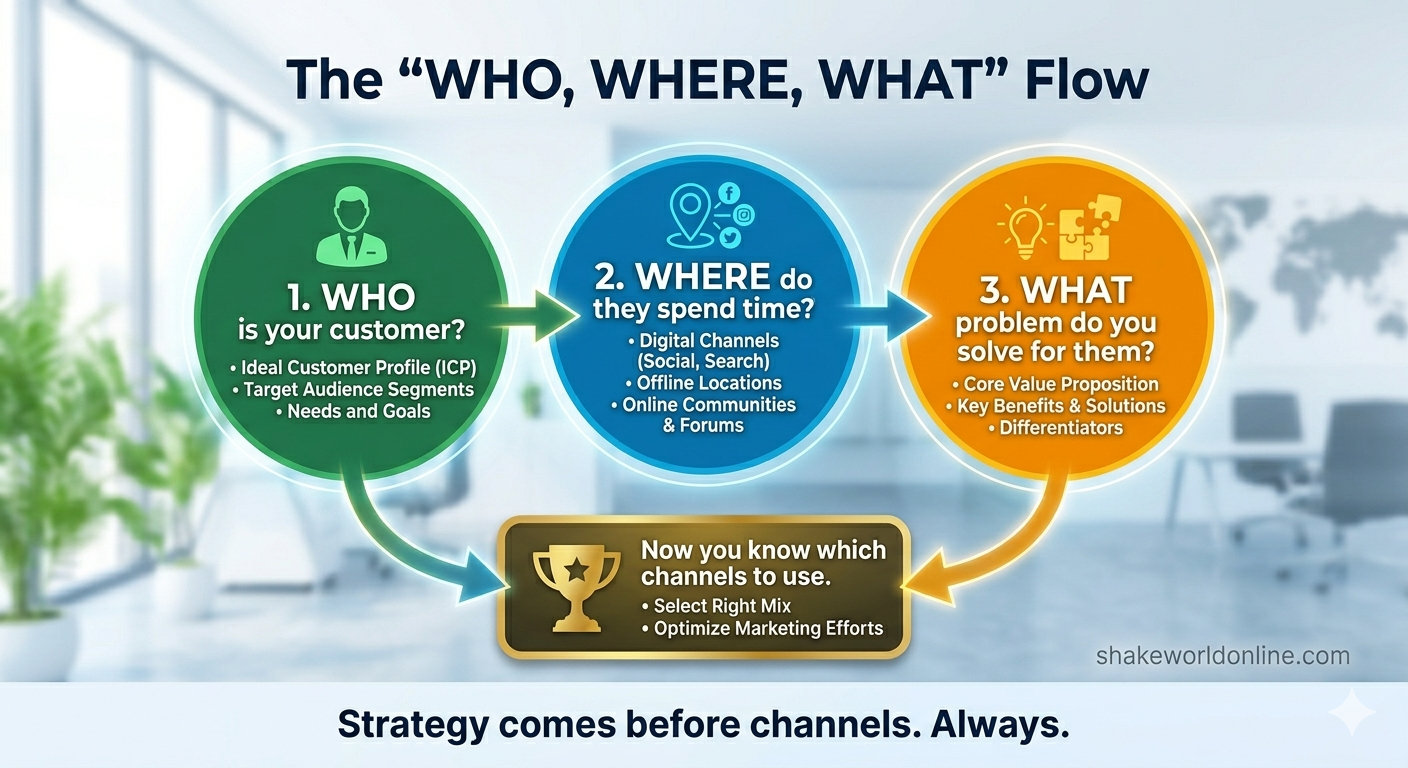
Step One: Know Exactly Who You're Talking To
Before you spend a single naira on any channel, you have to answer one question: who is this for?
This is where most marketing quietly dies. People skip straight to "which platform should I use" when they haven't decided who they're trying to reach. If you don't know your customer, you're not marketing. You're just paying for expensive noise.
Your ideal customer profile is a clear picture of the person you serve best. Not "everyone." Not "anyone with money." The specific person whose problem you solve better than anyone else. What keeps them up at night? What words do they use to describe their problem? Where do they spend time online? What do they need to believe before they'll buy?
You don't need a fancy research department for this. If you already talk to customers, you probably know more than you think. Listen to the exact words they use. Read the reviews and complaints in your industry. Lurk in the subreddits, WhatsApp groups, and forums where your people gather. The language they use is marketing gold, because when you echo their own words back to them, they feel understood.
Closely tied to this is positioning: the clear story of why someone should choose you over the alternatives. Positioning isn't a tagline. It's the answer to "why you and not them?" When ten businesses solve the same problem, positioning is what makes a customer pick you. Often it comes down to trust, clarity, and how well you connect to their actual situation.
Get clear on who you serve and why they choose you, and every later decision gets easier. You'll know which channels to use (the ones where they hang out), what to say (their words, their problems), and what to offer. This is so foundational that I've given it its own guide: ideal customer profile and positioning.
Step Two: Decide Where to Spend (Budget and Channel Mix)
Once you know who you're reaching, you face the question every business wrestles with: where do I put my money and time?
Here's the honest truth that took me years to fully accept. You cannot be everywhere, and you shouldn't try. The biggest mistake I see is a business spreading itself thin across five channels, doing a weak job on all of them, and learning nothing. Far better to pick one channel, go deep, learn what works, then expand.
So how do you pick? Two questions:
First, where does your ideal customer already spend time? If your buyers are professionals, that might be Google search and LinkedIn. If they're younger consumers, maybe Instagram or TikTok. In many markets, including across Africa, the honest answer is WhatsApp. Go where they already are. Don't try to drag them somewhere new.
Second, do you need results now or are you building for the long term? This is the key tradeoff between paid and owned channels.
Paid channels like Google and Meta ads give you fast feedback. You can launch today and have data by tomorrow. But you're renting that traffic, and it stops the moment you stop paying. Owned channels like content, SEO, and email are slow to start, sometimes taking six to nine months to gain real traction, but they build an asset you keep. Content you publish can bring in customers for years.
The smart play for most businesses is a blend. Use a little paid advertising to get fast feedback and early customers while you build your slower, owned channels in the background. Paid buys you data and time. Owned buys you a future.
One more honest point on budget. Don't obsess over having a big one. I've seen businesses with tiny budgets win by being precise, knowing exactly who they serve and showing up consistently where those people are. And I've seen businesses burn fortunes being vague. Precision beats budget. For the full framework on splitting your spend, see marketing budget and channel mix.
There's a related strategic choice worth understanding: the balance between building your brand for the long term and chasing immediate sales. Lean too hard on instant-sales tactics and you stay forever dependent on ads. Invest only in brand and you may starve before it pays off. Brand versus performance marketing unpacks how to hold both.
A Simple Way to Choose Your First Channel
If you're staring at the list of channels feeling paralyzed, here's a decision shortcut I give people.
If your customers actively search for a solution when they need one (a plumber, a lawyer, a credit card comparison), start with search: SEO and Google Ads. They're already raising their hand. Meet them there.
If your customers discover things while browsing and your product is visual or impulse-friendly (fashion, food, gadgets, lifestyle), start with social, paid or organic, on the platform they actually use.
If you sell to other businesses, start where professionals gather and where relationships form: search, LinkedIn, email, and direct outreach.
And whatever you sell, if your audience lives on WhatsApp, treat it as a core channel from day one, not an afterthought.
Pick the one that matches your customer's behavior. Commit to it for at least three months. Only once it's producing results you understand should you add the next. One channel done well beats five done badly, every single time.
Not sure where to start with your marketing?
Find out which channels will move the needle fastest for your specific business. Get a free audit and we will map your biggest marketing opportunities.
Get My Free SEO Audit →The Paid Advertising Family: Renting Attention That Converts
Let's go deeper into each family, starting with paid, because it's where people are most eager to spend and most likely to waste money.
Paid advertising is powerful for one reason: speed. You can be invisible today and in front of thousands of your exact customers tomorrow. No other channel offers that. But that power cuts both ways. You can also burn your whole budget in a day with nothing to show for it. So let's be smart.
The two giants are Google and Meta, and they serve different purposes.
Google Ads (and search advertising) is about catching people who are already looking. When someone types "emergency plumber Lagos" into Google, they have high intent. They want to buy now. Search ads put you in front of that person at the exact moment of need. This is some of the highest-intent, highest-converting advertising that exists, which is why it's also competitive and can be expensive in crowded industries. The full playbook is in Google Ads and PPC.
Meta Ads (Facebook and Instagram) works differently. People on Facebook and Instagram aren't searching for you. They're scrolling, relaxing, watching. So Meta ads are about interrupting that scroll with something so relevant it stops them. The targeting is remarkably mature, which is why many businesses, especially those selling to consumers, find Meta their most reliable paid channel. The creative (the image or video) matters even more than on Google. See Meta Facebook and Instagram ads.
Beyond these two sits the broader craft of media buying: planning, purchasing, and scaling ad placements across many platforms, from display networks to connected TV. As you grow, buying media well, getting more attention for less money, becomes a real competitive edge. Media buying covers how this works at scale.
Now, two pieces of paid advertising deserve special attention because they quietly determine whether the rest works at all.
Retargeting (also called remarketing) is showing ads to people who already visited you but didn't buy. This is some of the most cost-effective advertising there is, because you're talking to people who already know you. Most visitors don't buy on the first visit. Retargeting gently brings them back. Skipping it is leaving money on the table. Learn it in retargeting and remarketing.
Landing pages and conversion rate optimization (CRO) is where paid traffic either turns into customers or bounces away. You can run perfect ads, but if the page they land on is slow, confusing, or untrustworthy, you've wasted every naira. CRO is the art of turning more of your existing traffic into action, which is often the cheapest growth there is. You don't need more clicks if you convert the ones you have better. See landing pages and CRO.
Here's the honest reality of paid advertising that the "set up an ad and watch leads roll in" crowd won't tell you. Real paid advertising is weeks of tracking setup, testing audiences, testing creative, finding the winning combination, scaling it carefully without breaking it, and starting over when the platform shifts. The "boring middle" is where most people quit. The ones who push through it win.
The Owned Family: Building Audiences You Don't Have to Rent
If paid is renting, owned is building. These are the channels you control, where you don't pay for each person reached, and where your effort compounds over time. This is how you escape total dependence on ad platforms.
Email marketing remains, year after year, the highest-return channel in all of digital marketing. That surprises people who think email is old-fashioned. But think about it: your email list is an audience you own outright. No algorithm decides who sees it. You can reach them any time, for almost no cost, with a personal message. The money in marketing is often in the follow-up, and email is the follow-up machine. Build your list from day one. Everything else you do should feed into it. Dive into email marketing and automation.
For many businesses, especially across Africa and much of the world, two channels sit right next to email in power, and often beat it for immediacy.
WhatsApp marketing is, in many markets, where business actually happens. People don't just chat on WhatsApp; they ask questions, negotiate, and buy. A message on WhatsApp gets opened and answered in ways email can only dream of. Used well (with permission and genuine usefulness, not spam), it's one of the most direct, personal, high-trust channels available. If your customers live on WhatsApp, this might be your single most important channel. See WhatsApp marketing.
SMS marketing is the old workhorse that still hits harder than almost anything. A text message gets read within minutes, nearly every time. For time-sensitive offers, reminders, and updates, nothing beats its reach and immediacy. It works on every phone, no app or data required, which matters enormously in many markets. Learn to use it without annoying people in SMS marketing.
Then there's the channel that fuels almost everything else.
Content marketing is the practice of attracting and earning trust by being genuinely useful, through articles, videos, guides, and podcasts, rather than by interrupting people. It's the engine of the whole top of the funnel. Done right, a single great piece of content can bring you traffic, leads, and trust for years. The secret is simple but hard: solve your audience's real problems better than anyone else, and do it consistently. Content is also what feeds your SEO, your email, your social, and increasingly, what AI tools cite when someone asks them a question. The deep guide is content marketing strategy.
Here's a content secret most beginners miss: the best ideas aren't invented, they're discovered. Your customers are already telling you what content to make. The questions they ask in your DMs, the objections in your sales calls, the complaints in reviews, the searches that bring people to your site, these are pure gold. Turn each real question into a piece of content that answers it clearly, and you'll never run out of ideas, and you'll never make content nobody wants. The biggest waste in content marketing is creating things that sound smart but answer questions nobody is asking.
Social media marketing is how you build a brand and a community in public. It's not just broadcasting; it's a two-way conversation. The honest truth about social in 2026 is that organic reach is harder than it used to be on almost every platform. The platforms shifted from showing your posts to your followers, to showing whatever their algorithm thinks will keep people scrolling. That means consistency and genuinely engaging content matter more than ever, and that "post a few times and grow" is a myth. The winners commit to one or two platforms for the long haul. See social media marketing.
The Earned Family: When Others Vouch For You
Earned media is the most trusted marketing there is, because it doesn't come from your mouth. It comes from someone else's.
Influencer and affiliate marketing is borrowing other people's trust and audiences. An influencer who recommends you transfers some of their audience's trust to you. An affiliate promotes you in exchange for a cut of sales, so you only pay for results. The big shift worth knowing: smaller "micro" influencers with engaged, niche audiences now often outperform giant celebrities, because their followers actually trust them. Authenticity beats reach. See influencer and affiliate marketing.
Earned media and PR is getting talked about by people who aren't on your payroll: press coverage, reviews, mentions, word of mouth. In 2026, this matters more than ever, and not only for humans. When you get mentioned across the web with real context, you don't just reach people, you teach AI systems what your business is and when to recommend it. PR has quietly become part of how you get found in an AI-driven world. And at the bottom of the funnel, a personal recommendation still decides more purchases than any ad. Learn how to earn it in earned media and PR.
Here's a practical, free way to start earning attention that I've seen work again and again: go where your customers are already asking questions, on Reddit, in forums, in WhatsApp and Facebook groups, and genuinely help. Don't pitch. Just be useful and present. Over time, you become a trusted name, and mentioning what you do stops feeling like spam and starts feeling like a recommendation. It's slow, it's unglamorous, and it works.
The Conversion and Growth Family: Turning Effort Into Revenue
You can have traffic from every channel above and still fail if you can't turn that attention into customers and prove what's working. This last family is where marketing becomes a real business engine.
Lead generation is the system of capturing interested people so you can follow up. A visitor who leaves your site is usually gone forever. A visitor who gives you their email, phone number, or WhatsApp contact is someone you can build a relationship with. Lead gen is about creating that bridge: an offer valuable enough that people happily trade their contact details for it. Without it, you're starting from zero every single day. See lead generation.
Marketing analytics and attribution is how you learn which of your efforts actually drive revenue, and which just feel busy. This is where most businesses are flying blind. They can't tell you whether their sales came from ads, content, or word of mouth. The customer journey is messy and hard to track perfectly, but you can get close enough to make smart decisions. Often, fixing your measurement does more for growth than any new tactic, because you stop pouring money into what doesn't work. The guide is marketing analytics and attribution.
Marketing automation and CRM is how you deliver personal, timely marketing at scale without hiring an army. A CRM (customer relationship management system) is the memory of your business: who your contacts are, where they are in the funnel, what they've bought. Automation lets you send the right message at the right time, automatically, a welcome sequence, a reminder, a follow-up, so nobody falls through the cracks. This is how small teams compete with big ones. See marketing automation and CRM.
A/B testing and experimentation is how you replace guessing with knowing. Instead of arguing about which headline or which button color is better, you test both and let your customers decide with their clicks. Small, steady improvements compound into enormous gains over time. The best marketers aren't the ones with the best gut instinct; they're the ones who test the most and learn the fastest. Learn the discipline in A/B testing and experimentation.
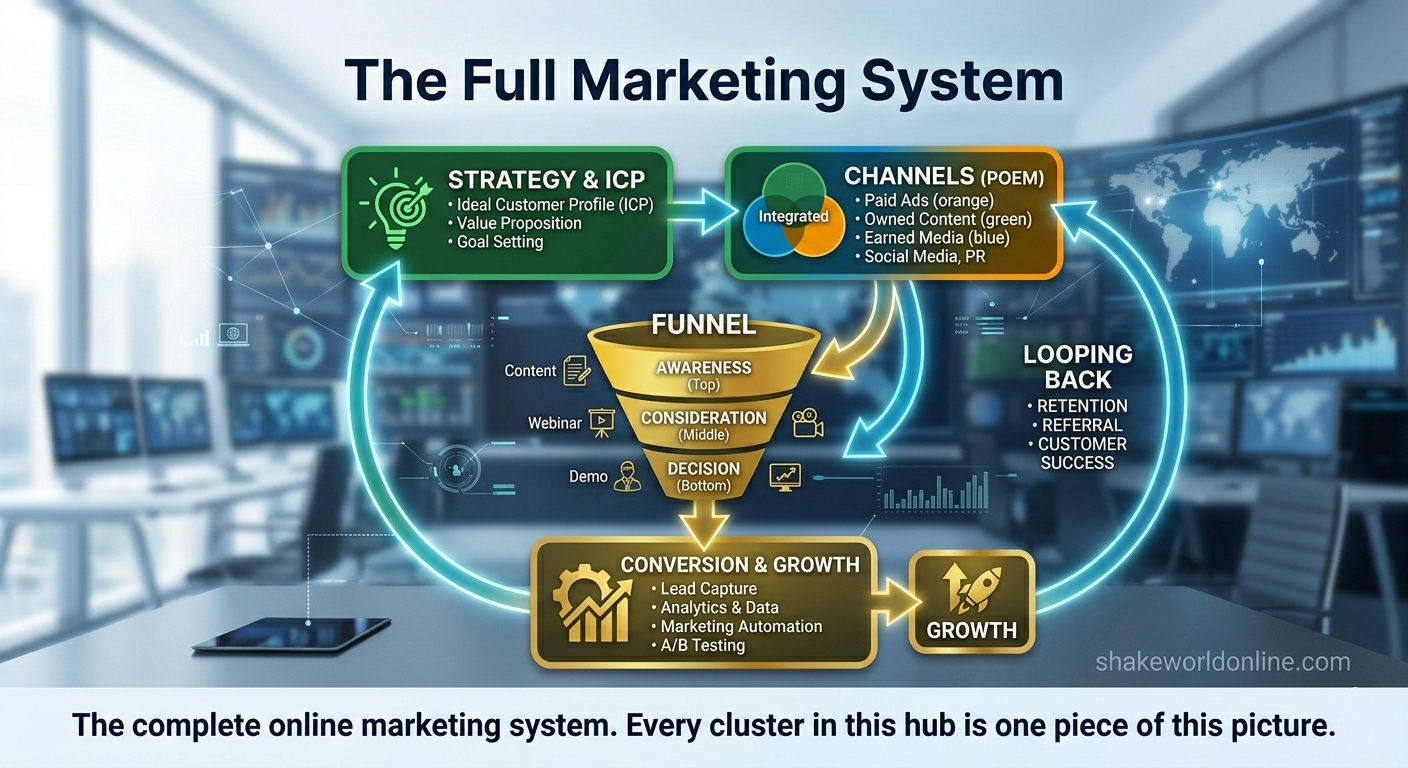
How It All Fits Together: Your Growth Engine
Let's zoom out, because this is the part that turns scattered tactics into a real system.
Think of your online marketing as one machine with a logical flow:
It starts with strategy. You decide who you serve, why they choose you, and where they spend their time. Nothing else works without this.
That strategy points you to your channels. You pick the paid, owned, and earned channels where your people actually are, and you go deep on a focused few rather than thin on many.
Those channels feed your funnel. At the top, you build awareness with content, social, and ads. In the middle, you nurture with email, WhatsApp, and case studies. At the bottom, you convert with strong offers, landing pages, and clear calls to action.
Then conversion and growth systems make sure nothing leaks. You capture leads so attention isn't wasted. You measure so you know what works. You automate so the right message reaches the right person at the right time. You test so the whole machine keeps getting better.
And it doesn't end at the sale. Happy customers stay (retention) and bring others (referral), which feeds the top of the funnel again. That's the loop. That's the engine.
You don't build it all at once. You start with strategy, pick one or two channels, get one part working, prove it with real numbers, then add the next piece. Marketing is built, not bought, one working part at a time.
The Honest Truths Nobody Puts in the Brochure
I'd be doing you a disservice if I made this sound easy. So here are the realities I make sure every business I work with understands.
There are no magic hacks. Every "crazy hack" that actually works, when you look closely, turns out to be a fundamental done well: understanding your customer, being useful, showing up consistently, fixing what's broken, measuring honestly. The boring, methodical fundamentals beat the shiny tactics almost every time. Chase fundamentals, not hacks.
Consistency is the real secret, and it's harder than it sounds. Everyone says "just post regularly" or "just keep emailing." Actually showing up every week, for months, before you see results, is where almost everyone quits. The businesses that win are usually just the ones that didn't stop. Distribution is a long commitment, not a quick campaign.
More isn't the answer. Better usually is. When something isn't working, the instinct is to do more, more posts, more channels, more spend. Often the real fix is to do less, but better: sharper message, clearer offer, better targeting, fewer but stronger pieces. I've watched businesses grow by cutting weak content and doubling down on what worked, not by adding more noise.
It takes longer than you hope. Owned channels especially are a slow build. Anyone promising overnight results is selling something. Real marketing is a snowball: painfully slow to start, then unstoppable once it's rolling. Set your expectations to "months," not "days," and you'll outlast the people who give up.
Measure the cash register. At the end of all of it, the only number that truly matters is whether marketing is bringing in more money than it costs. Not likes, not impressions, not follower counts. Customers and revenue. Keep your eye on that, and you'll never get lost chasing vanity metrics.
Want a marketing engine, not random tactics?
Real growth takes strategy, the right channels, and the systems that tie them together. We build complete marketing engines for businesses every day.
Work With Shakeworld →Your First 90 Days: A Simple Starting Plan
Theory is comforting, but you grow by doing. So here's a simple, realistic plan for your first three months, no matter your business. Adjust it to your situation, but the order matters.
Weeks 1 to 2: Get clear. Don't touch a single ad or post yet. Write down exactly who your ideal customer is, the problem you solve for them, and why they'd choose you over the alternatives. Then write your core message in one clear sentence a child could understand. This is the foundation. If it's fuzzy, everything built on it will be too.
Weeks 2 to 3: Set up the basics. Make sure you have one place to send people (a clean, fast, clear website or landing page) and one way to capture interested people (an email signup, a WhatsApp link, a contact form). You need somewhere for attention to land and a way to keep it. Without these, traffic just leaks away.
Weeks 3 to 4: Pick one channel and start. Choose the single channel where your customers actually are. Start showing up there consistently, helpful content, useful answers, or a small, well-targeted ad test. Resist the urge to be everywhere. Go deep on one.
Weeks 4 to 8: Show up and learn. Stay consistent. Publish, post, or run your test on a steady schedule. Talk to anyone who responds. Pay attention to what gets a reaction and what falls flat. This is the unglamorous middle where most people quit. Don't. You're gathering the real-world feedback that no course can give you.
Weeks 8 to 12: Measure and double down. Now look at what actually happened. Which efforts brought you leads or sales? Which brought nothing? Do more of what worked, cut what didn't, and only now consider adding a second channel. Ask every customer how they found you, that simple question reveals more than most analytics tools.
By the end of 90 days you won't have a finished marketing machine. But you'll have something far more valuable: real evidence about what works for your specific business, and the start of a system you can build on. That beats any amount of guessing.
Where AI Fits Into All of This
You can't talk about online marketing in 2026 without talking about AI, so let me give you the honest, practical view rather than the hype.
AI has changed marketing in two big ways. First, it made creating content almost free and instant. Anyone can generate a hundred blog posts, captions, or images in an afternoon. Second, it changed how people find things. More and more, people ask ChatGPT, Perplexity, or Google's AI for recommendations instead of scrolling through links.
Both of these have a counterintuitive effect. When everyone can produce endless content, content itself becomes cheap and the internet gets noisier. So the things AI can't easily fake become more valuable: real experience, genuine trust, a clear point of view, a recognizable brand, and actual relationships with customers. The flood of average AI content raises the value of being genuinely good.
So how should you use AI? As a powerful assistant, not a replacement for thinking. Use it to research faster, draft quicker, analyze your data, and handle repetitive work. But the strategy, the real understanding of your customer, the clear positioning, the human judgment about what's actually good, that still has to come from you. The businesses winning with AI use it to do more of what works, faster. The ones losing use it to flood the world with forgettable noise and wonder why nothing converts.
There's also the discovery side. Just as you once optimized to be found on Google, you now also want to be the business that AI tools recommend when someone asks. That comes from the same fundamentals this whole guide is about: being genuinely useful, being mentioned and trusted across the web, and being clear about what you do and who you serve. Do the fundamentals well and you get found by humans and machines alike.
The takeaway: AI is a tool that amplifies whatever you already are. It makes a clear, customer-focused marketer far more productive, and it makes a confused one produce confusion at scale. Get your fundamentals right first. Then let AI pour fuel on the fire.
Frequently Asked Questions
Online marketing is using the internet to get the right people to notice your business, trust it, and buy from it repeatedly. It covers everything from ads and email to social media and content. The core idea behind all of it is simple: people do not buy products, they buy solutions to problems they have. So good online marketing means clearly showing the right people that you solve a real problem they care about, then guiding them from first hearing about you to becoming a loyal customer.
Every channel falls into one of three families. Owned media is what you control, like your website, email list, and WhatsApp contacts. Earned media is attention others give you for free, like word of mouth, reviews, and press. Paid media is attention you rent, like Google and Meta ads. Paid is fast but stops when you stop paying; owned is slow to build but becomes an asset you keep; earned is the most trusted because it does not come from you. The best strategies combine all three rather than relying on one.
There is no single right number, and a big budget matters far less than people think. What matters more is precision: knowing exactly who you serve, picking the one or two channels where those people actually are, and showing up consistently. Many small businesses win with tiny budgets by being focused, while others waste large budgets being vague. A practical approach is to use a small amount of paid advertising for fast feedback and early customers while you build slower, free owned channels like content and email in the background.
It depends on the channel. Paid advertising can produce results within days, because you are renting immediate attention. Owned channels like content, SEO, and email are a slow build, often taking six to nine months to gain real traction, but they create lasting assets. The honest truth is that marketing is a snowball: slow to start, then powerful once it rolls. Anyone promising overnight results is overselling. Set your expectations in months, stay consistent, and you will outlast competitors who quit early.
Clarity about the problem you solve and who you solve it for. Before any channel or tactic, you must be able to say plainly: my customer struggles with this, I help them with that, and here is why I am the better choice. People buy the solution they understand and trust the fastest, not necessarily the best one. Get that core message clear, point it at the right people in the right place, and stay consistent. Everything else in marketing works better once that foundation is solid.
The Bottom Line: Start Here, Then Go Deep
Online marketing isn't a hundred disconnected tactics. It's one system: understand your customer, reach them where they are, guide them from stranger to customer through the funnel, and build the systems that turn attention into revenue and customers into fans.
If you remember nothing else, remember this. Solve a real problem and make it crystal clear. Pick the channels where your people actually are, and go deep instead of wide. Build owned audiences you don't have to rent. Be consistent long after it stops being exciting. And always, always measure whether it's making money.
This guide is your map. Each branch of this hub goes deep on one piece of the picture, and they all connect back here.
Start with the foundations: the marketing funnel, your ideal customer profile and positioning, budget and channel mix, and brand versus performance marketing.
Then explore the channels that fit your business: paid advertising and media buying, the owned powerhouses of email, WhatsApp, SMS, and content, the reach of social media, and the trust of influencer, affiliate, and earned media and PR.
And tie it all together with the growth systems: lead generation, analytics and attribution, automation and CRM, and A/B testing.
You don't have to master it all today. Start with one piece, get it working, and build from there. That's how every strong marketing engine gets built.
And if you'd rather have a team build and run that engine for you, from strategy and ads to email, content, and the analytics that prove the return, that's exactly what we do at Shakeworld Digital. Get a free marketing audit and we'll map out where your biggest, fastest wins are.
Written by Popmati Samson, Founder of Shakeworld Digital, systems builder, and AI entrepreneur. I help businesses turn online marketing from guesswork into a predictable engine for growth.
Ready to turn marketing into real growth?
You have the map. If you would rather have a team build and run the whole engine for you, that is what we do at Shakeworld Digital.
Get Your Free SEO Audit →