

Social Media Marketing
 By Popmati Samson
11 min readUpdated 2026
By Popmati Samson
11 min readUpdated 2026Social media marketing is the practice of using platforms like Instagram, Facebook, TikTok, and others to build an audience, earn their trust, and guide them toward becoming customers. Done well, it's not about chasing likes. It's about becoming a business that people know, like, and remember, so that when they're ready to buy, they think of you.
Here's a quick example of how it actually works, probably on you.
You're scrolling, half paying attention, and a short video stops you. It teaches you something useful, or makes you laugh, or shows you something you didn't know. You follow the account. Over the next few weeks you see a few more of their posts, and each time you trust them a little more. Then one day you actually need what they sell. Who do you buy from? Not a stranger. You buy from the account that has been quietly helping you for weeks.
That's social media marketing. The sale happened at the end, but the trust that made it possible was built long before. And once you understand that this is what social media is really for, almost everything about how to do it well starts to make sense.

What Social Media Marketing Really Is
Let me give you the honest, plain version of what social media marketing is, because a lot of the confusion around it comes from a wrong idea of what it's supposed to do.
Social media is a place to start relationships, not close sales. It's where you show up consistently, share things your ideal customer finds useful or entertaining, talk to people in the comments, and slowly build a reputation. Over time, that reputation becomes trust, and trust is what eventually leads to sales, follows, sign-ups, and word of mouth.
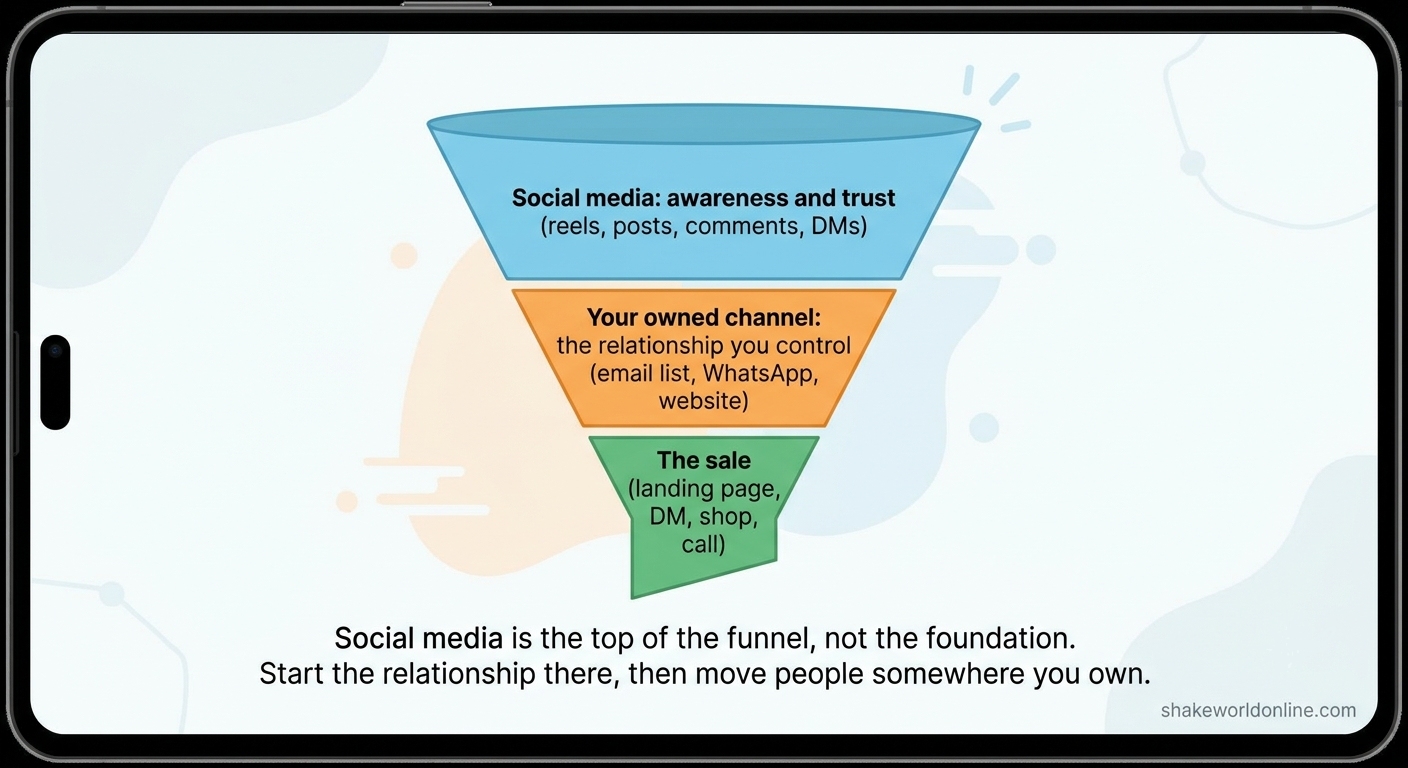
The single most useful way to think about it is this: social media is the top of your funnel, not the foundation of your business. It's brilliant at getting attention and building familiarity with lots of people. But the actual buying usually happens a step later, on your website, in a WhatsApp chat, on your email list, or on a focused landing page. Social media's job is to fill those places with people who already trust you.
I run Shakeworld Digital, and I've watched this play out hundreds of times. The businesses that treat social media as a slot machine, where you pull the lever and expect sales to fall out, almost always feel like they're wasting their money. The ones that treat it as a trust-building engine that feeds the rest of their marketing tend to win. So let me show you how to be the second kind.
Why Social Media Marketing Matters
Two reasons make social media worth the effort.
First, it's where attention lives. Your customers, wherever they are in the world, spend hours every day on these platforms. In Nigeria and across Africa, that often means Instagram, Facebook, TikTok, and WhatsApp are woven into daily life. If you want to be in front of people while they form opinions about who to trust, this is where it happens. Ignoring social media is like opening a shop on a street nobody walks down.
Second, it builds something ads alone can't: familiarity and trust at scale. People don't buy from businesses they've never heard of and have no reason to trust. A steady presence on social media fixes that quietly, with thousands of people at once. By the time someone is ready to spend money, you're not a stranger asking for a sale, you're the brand they already follow and like. This is the same reason a strong brand makes all your other marketing cheaper and easier, an idea we go deeper on in brand versus performance marketing.
But here's the part to hold onto, because it sets up everything else: social media rarely makes the sale by itself. It works as part of a system. Your content builds trust, your ads put you in front of the right people, and your website or chat is where the sale actually closes. When all three work together, social media becomes one of the best investments you can make. When the other pieces are missing, it feels like burning money. That's the difference between businesses that swear by it and businesses that swear at it.
Why Most Social Media Marketing Feels Like a Money Drain
Now let me be honest about why so many businesses pour time and money into social media and see almost nothing back. Nearly every case comes down to the same handful of mistakes.
The biggest one is judging it by the wrong scoreboard. Likes are not sales. Engagement is not intent. It's completely normal to get plenty of likes and very few customers, and it sends people into a panic. But that's often a sign you're measuring the wrong thing, not that social media is broken. A post that gets fewer likes but starts real conversations, gets saved, or sends people to your website is worth far more than a viral post that leads nowhere.
The second mistake is believing that consistency alone is enough. You've probably heard "just post every day." So people post every day, faithfully, for months, into total silence. Here's the hard truth: the algorithm does not care about your schedule if the content doesn't make anyone stop scrolling. Posting daily without a strong hook, real value, and a clear sense of who you're talking to is just screaming into an empty room, politely, on time. Consistency matters, but only once the content is actually worth seeing.
The third mistake is trying to be everywhere at once. Spreading yourself thin across five platforms almost always produces mediocre results on all of them. Each platform has its own audience and its own feel, and content copy-pasted from one to another usually lands flat.
And the fourth: having no funnel behind the content. If your posts get attention but there's no clear next step, no link, no offer, nowhere for an interested person to go, then the attention just evaporates. You did the hard part, getting noticed, and then let those people wander off. Fix these four things and social media stops feeling like a money pit.
Posting and posting, but nothing converts?
Find out why your social media is winning likes but not customers, and what to fix first. Get a free audit and we will review your whole setup, from the content itself to where the clicks actually go.
Get My Free Audit →How to Do Social Media Marketing That Actually Works
Here is the approach that works today, explained step by step. Follow them in order.
1. Pick One or Two Platforms, and Go Deep
Resist the urge to be everywhere. It's far better to be genuinely good on one or two platforms than forgettable on five. So start by asking the only question that matters: where does my ideal customer actually spend their time?
Different platforms suit different businesses. A visual product like fashion, food, or crafts often thrives on Instagram and TikTok. A business targeting older or more local customers might do better on Facebook. A professional or B2B service often belongs on LinkedIn. Pick where your people already gather, then commit to learning that one platform deeply. And make your content native to it, meaning shaped for that specific platform's style, rather than the same post blasted everywhere. A video made specifically for TikTok's casual, fast feel will always outperform one you copy-pasted from somewhere more polished. Choosing the right place starts with truly knowing your customer, which is the heart of your ideal customer profile and positioning.
2. Get Specific: One Niche, One Clear Point of View
Generic content gets ignored. The accounts that grow are specific, both in who they're for and in having a real personality behind them.
Two things make this work. First, niche down. The platforms increasingly show your content to people based on their interests, so the clearer it is what you're about, the better the algorithm can find your people. A page that's clearly about "home cooking for busy Nigerian families" will outgrow a vague "lifestyle" page every time. Second, let your point of view and your story show. People buy from people, not faceless logos. The content winning right now is often a little raw, a little opinionated, and clearly made by a real human with a real perspective. There's a great piece of advice that captures this: stop showing your work, and start showing you working. Don't just post the finished product. Show the process, the reason you do it your way, the story behind it. That's what makes someone choose you specifically instead of any other business selling the same thing.
3. Lead With Short-Form Video and a Hook That Stops the Scroll
If you take one practical tip from this guide, make it this: prioritize short-form video, and obsess over the first two seconds.
Short videos, Reels, TikToks, Shorts, are the format the platforms push hardest to people who don't already follow you. On Instagram, for example, Reels are the main way to reach new people, while photos and standard posts mostly get shown to your existing followers. So if growth is the goal, video is where to focus. But video only works if people don't scroll past it, and that decision is made in the first second or two. That opening moment, the hook, is the most important part of the whole video. It needs to grab attention instantly, with a bold statement, a surprising claim, or a question that hits a real frustration. After the hook, the best-performing videos do one simple thing: they teach one useful thing, or tell one quick story, in under a minute. Not a "day in the life" with no point. One specific, useful idea. And keep it real rather than over-polished. People have grown tired of slick, obviously artificial content, and a genuine person talking to the camera now beats a glossy production.
4. Make Content Worth Saving and Sharing
Here's something most people don't realize: the platforms quietly care far more about saves and shares than they do about likes. A like is cheap. A save means "this is so useful I want to come back to it." A share means "this is so good I'm putting my name behind it and sending it to someone." Those are the strongest signals you can send the algorithm, and they're how your content reaches new people.
So create things people want to keep and pass on. Useful checklists, step-by-step how-tos, a genuinely clever tip, a before-and-after, a clear answer to a question your customers always ask. Before you post, ask yourself: would anyone save this, or send it to a friend? If the honest answer is no, rework it until the answer is yes. This single shift, from making content people glance at to making content people keep, changes everything about how far your posts travel.
5. Engage Like a Human, Not a Billboard
Social media is social. The businesses growing fastest aren't just posting and disappearing. They're in the comments, replying to DMs, and showing up genuinely in their community. This is half the work, and most people skip it entirely.
A simple, powerful habit is to comment before you post. Spend fifteen minutes leaving thoughtful, genuinely useful comments on other accounts in your niche before you publish your own content. Not "great post," but something that adds a real thought. People notice, click your profile, and discover you, so you've warmed up the room before you even speak. Beyond that, reply to every comment and message you can, especially quickly. Each real reply tells the platform your account is alive and worth showing to others, and more importantly, it turns passive followers into people who actually feel a connection to you. Treating your comment section like a conversation, not a notice board, is one of the most underrated growth moves there is.
6. Give Every Post a Job and a Next Step
Stop posting just to fill a calendar. Every single piece of content should have a purpose, and ideally, a next step for the person consuming it.
A simple way to plan this is with content pillars, a few recurring themes that each do a job. For most businesses those are: content that builds awareness and gets engagement (relatable, entertaining, problem-spotting posts), content that teaches and builds authority (tips, how-tos, explanations), content that shows your product or service solving the problem, and proof (testimonials, results, happy customers). Rotate through these so you're not just selling and not just entertaining. And crucially, guide people toward a next step that matches where they are. Sometimes that's "follow for more," sometimes "grab the free guide in my bio," sometimes "send us a message to order." Just make sure the path forward is always obvious and easy, because attention with nowhere to go is wasted. Make that next step as frictionless as possible, since every extra hurdle loses people.
7. Use It as the Top of Your Funnel, and Build Something You Own
This is the strategy that protects everything else: never let social media be your entire foundation. Platforms change their rules constantly, algorithms shift overnight, and accounts can be restricted without warning. If your whole business lives on a platform you don't control, you're building on rented land.
So use social media for what it's best at, the top of the funnel, getting attention and building trust, and then move those people somewhere you actually own. Funnel followers onto your email list, into your WhatsApp audience, or onto your website. That way, even if a platform disappears tomorrow, you keep the relationship. This is also the right order for spending money: let your organic posts run first and show you what genuinely connects, then put paid budget behind the content that already proved it works, and use Meta ads to reach more of the right people. Organic content is like building a house, slow but yours to keep. Paid ads are like renting, the moment you stop paying, the reach disappears. The smart play is to build the house, then rent extra space only when it pays off. To know what's actually working across all of this, lean on proper analytics and attribution.
Want a social presence that feeds real sales?
A social media engine takes the right platforms, content people actually save and share, and a funnel that moves followers somewhere you own. We build and run that for businesses every day.
Work With Shakeworld →A Few Honest Truths About Social Media Marketing
Before you dive in, here are the realities that the hype skips.
Likes are not sales, so measure the right things. Social media's main job is trust and awareness, and those don't always show up as a direct click-to-purchase. Often a post plants a seed that turns into a sale weeks later through a different channel, which means last-click numbers undervalue it. Judge social media by whether your overall awareness, audience, and inbound interest are growing, not just by likes.
It's a long game, and most people quit too early. Real results usually take months, often four to six or more, especially without an existing audience. The early phase feels painfully quiet. Most businesses give up at month two or three, right before it would have started working. Commit to the long game or don't start.
Consistency alone is a myth. Posting every day does nothing if the content isn't good, isn't aimed at a clear person, and doesn't hook attention. Consistency only compounds when what you're being consistent about is genuinely worth seeing. Quality first, then consistency.
It's not equally good for every business. Visual, impulse-friendly products like fashion, beauty, food, and ecommerce tend to thrive on social. But big-ticket, considered purchases, or urgent needs like emergency services, are often better served by search, where people actively look for a solution at the moment they need it. Match the channel to what you sell instead of forcing it.
The shortcuts will hurt you. Buying followers, joining engagement pods, or using bots is like inviting a crowd of mannequins into your shop. They fill the room, but they never buy, and they scare off the real customers because your engagement looks fake. A small, genuine audience beats a large, hollow one every single time.
Frequently Asked Questions
Social media marketing is using platforms like Instagram, Facebook, TikTok, and others to build an audience, earn its trust, and guide those people toward becoming customers. Done well, it is not about chasing likes; it is about becoming a business people know, like, and remember, so that when they are ready to buy, you are the name they think of first. The most useful way to picture it is as the top of your funnel: it is brilliant at winning attention and building familiarity with many people at once, while the actual buying usually happens a step later on your website, in a chat, or on your email list. Its real job is to fill those places with people who already trust you.
Yes, but rarely on its own and rarely on the same day. Social media mostly builds trust and awareness, and that often turns into a sale weeks later through a different channel, which is why judging it purely by likes or last-click numbers badly undervalues it. It works as part of a system: your content earns trust, your website or chat closes the sale, and your email or WhatsApp list keeps the relationship. When those pieces work together, social media becomes one of the best investments you can make. When they are missing, the attention you win simply evaporates because there is nowhere for interested people to go.
One or two, chosen well, almost always beats five done thinly. Each platform has its own audience and feel, and content copy-pasted across all of them tends to land flat everywhere. The question that matters is where your ideal customer already spends time: visual products often thrive on Instagram and TikTok, more local or older audiences on Facebook, and professional or B2B services on LinkedIn. Pick where your people gather, learn that platform deeply, and make content shaped for it rather than the same post blasted everywhere. You can always add a second platform once the first is genuinely working.
Longer than most people expect, usually four to six months or more before it meaningfully pays off, especially if you are starting without an existing audience. The early phase feels painfully quiet: you post consistently and almost nothing moves. But underneath, familiarity, trust, and recognition are building. Most businesses quit at month two or three, right before it would have started working. The realistic move is to commit to the long game and watch the right early signals, growing audience, saves, shares, real conversations, and inbound interest, rather than expecting direct sales in the first few weeks.
Start with organic, then put paid budget behind what already works. Organic content is like building a house: slow, but it is yours to keep and it shows you what genuinely connects with people. Paid ads are like renting: the reach disappears the moment you stop paying. The smart order is to let your organic posts run first and reveal which ideas land, then spend on ads to put more reach behind the content that has already proven itself. That way you are amplifying something that works instead of gambling budget on something untested.
The Bottom Line
Social media marketing isn't a slot machine that pays out sales. It's a trust-building engine that sits at the top of your funnel.
Pick one or two platforms where your people actually are. Get specific, with a clear niche and a real point of view. Lead with short-form video and a hook that stops the scroll. Make content worth saving and sharing. Engage like a human, not a billboard. Give every post a job and a next step. And use it all to move people somewhere you own.
Above all, be patient and measure the right things. Trust takes months to build, but once it's there, social media quietly does what no ad can: it makes you the business people already know, already like, and choose without thinking twice.
Ready to turn scrolls into customers?
You have the playbook. If you would rather have a team build a social media presence that earns trust and quietly brings in customers, that is what we do at Shakeworld Digital.
Get Your Free Audit →This is one piece of the bigger picture. To see how it all fits together, start with the complete guide to online marketing, then pair this with content marketing (the useful content your posts are built from), Meta ads (how you put budget behind what works), email marketing and WhatsApp marketing (the owned channels you funnel followers into), influencer and affiliate marketing (how other people's audiences amplify you), landing pages and CRO (where the trust turns into a sale), ideal customer profile and positioning (who all of this should speak to), and marketing analytics and attribution (so you can see social media's true impact).
And if you'd like a team to build a social media presence that earns trust and feeds real sales, that's exactly what we do at Shakeworld Digital. Get a free marketing audit and we'll show you where your social media is leaking attention and how to turn it into customers.
Written by Popmati Samson, Founder of Shakeworld Digital, systems builder, and AI entrepreneur. I help businesses turn scrolls and likes into trust that quietly becomes customers.