

Ideal Customer Profile and Positioning: Who You Serve and Why They Choose You
 By Popmati Samson
11 min readUpdated 2026
By Popmati Samson
11 min readUpdated 2026Your ideal customer profile is a clear picture of the specific person or business you serve best. Your positioning is the clear reason they should choose you over every other option.
Get these two right and the rest of your marketing gets dramatically easier. You'll know who to talk to, where to find them, what to say, and why they should care. Get them wrong, or skip them entirely, and you'll spend money shouting into a void.
This is the most skipped step in all of marketing, and the most expensive one to skip. So let me show you how to nail it, in plain terms, with no fluff.
What Is an Ideal Customer Profile (and What It Isn't)
Let's clear up the confusion first, because three terms get tangled together.
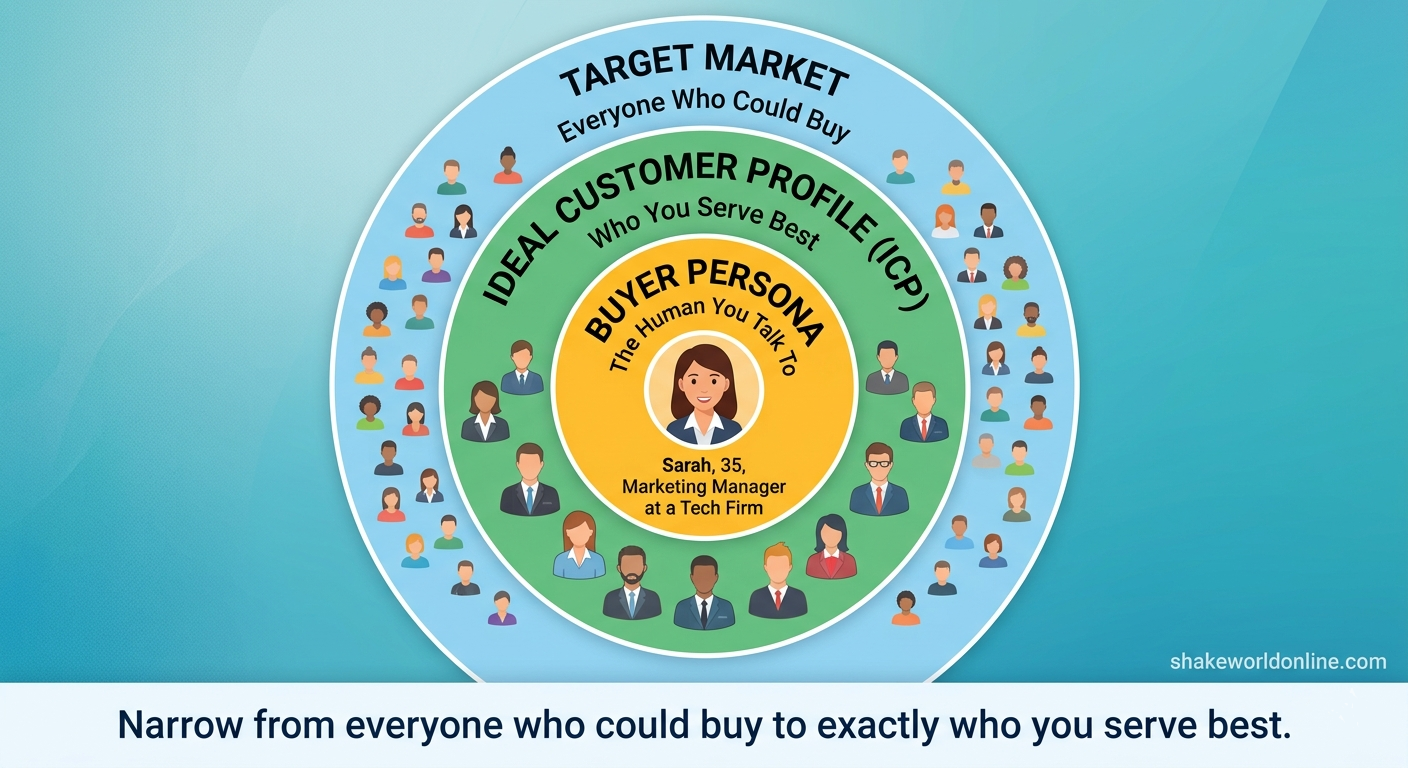
Your target market is everyone who could possibly buy from you. Broad. "Small businesses." "People who like coffee."
Your ideal customer profile (ICP) is narrower and far more useful. It's the specific type of customer you serve best, the one who gets the most value from you, sticks around longest, and tells their friends. It's not everyone who could buy. It's everyone who should buy, because you're uniquely good at helping them.
Your buyer persona is the actual human you talk to within that profile, their role, their day, their worries. The ICP tells you which businesses or households are worth reaching; the persona tells you who inside them you're speaking to.
Here's the trap. Most people define their ICP as something vague like "busy professionals" or "anyone who needs marketing." That's not an ICP. That's a wish. A real ICP is specific enough to act on: not "small businesses," but "Lagos-based service businesses with 5 to 20 staff who rely on word of mouth and have no real online presence yet."
I'm Popmati Samson, founder of Shakeworld Digital. I've watched businesses with great products quietly fade because they never got clear on this. And I've watched ordinary businesses thrive because they did. Let me show you why it matters so much.
Why Your ICP Is a Survival Mechanism, Not a Marketing Doc
This is the part most guides get wrong. They treat your ideal customer profile like a box to tick. It's far more important than that.
Here's the truth: every customer you accept shapes your business. Take on the wrong ones and they slowly pull you off course, one reasonable-sounding exception at a time.
It happens like this. You're serving your sweet spot nicely. Then someone slightly outside it shows up with money. "We could also sell to them," someone says. Technically true. So you bend a little. A custom request here. A feature for that one client there. Each change makes sense on its own. But stack them up over a year and you've built a product nobody actually designed, serving a customer you can't describe, competing with everyone and beating no one.
This is how good businesses die slowly while calling it growth. Some famous companies collapsed exactly this way, by adding "also" until they no longer knew who they were for, while sharper competitors just picked one thing and got aggressively good at it.
So your ICP isn't a marketing artifact. It's a survival mechanism. It's not about who could buy. It's about who is allowed to shape your business. Bad-fit revenue feels like momentum in the moment, but it quietly rewires your whole company underneath you. Learning to say "no thanks" to the wrong customers is one of the most valuable disciplines you can build.
There's hard data behind this too. It costs five to twenty-five times more to win a new customer than to keep one, and the customers who don't fit your profile are the ones who churn fastest and complain loudest. One study found that when a company deliberately turned away poor-fit segments, its average deal size jumped dramatically. Focus doesn't shrink your business. It concentrates it.
Not sure exactly who you should be targeting?
Get clear on the customers worth chasing and the ones to politely turn away. Get a free audit and we will help you sharpen your ideal customer profile.
Get My Free SEO Audit →How to Find Your Ideal Customer Profile
Now the practical part. Here's how to actually define your ICP, step by step.
1. Start With Your Best Existing Customers
If you already have customers, your ICP is hiding in your data. Don't invent it from your imagination. Look at who you already serve well.
Which customers are happiest? Which stick around longest and spend the most? Which ones refer others and rarely complain? List your best handful and look for what they have in common. Same industry? Same size? Same problem? Same moment that pushed them to buy? Those shared traits are the seed of your ICP. Your happiest customers are quietly telling you who to go find more of.
2. If You're New, Talk to 20 to 30 Real People
No customers yet? Then do not write a "fairytale" ICP from guesswork. That's the classic mistake: a tidy persona built without ever speaking to a single real human.
Instead, go talk to 20 to 30 people who look like they might be your customer. Not to pitch. To understand. Ask about their actual day, their real problems, the moment the pain shows up. Your true ICP emerges from those conversations, and it's often not who you assumed. A founder convinced their smartwatch was for "busy professionals" might discover, after twenty conversations, that the real buyers are tradespeople who can't pull out a phone with dirty hands. You only learn that by asking.
3. Get Specific Enough to Act On
Vague ICPs are useless. The fix is to layer details until it's concrete.
Don't stop at "small businesses." Add their size, their location, their industry, the tools they use, and above all the specific pain they feel right now. The test is simple: could you walk into a room and point to the exact people who fit? If yes, it's specific enough. If you're still describing "anyone," keep narrowing.
4. Define Who You're NOT For
This sounds backwards, but it's powerful. Write down who is a bad fit for you, the customers who'll drain your time, never be happy, or pull your product off course.
Naming your "anti-customer" makes saying no much easier when that tempting-but-wrong deal appears. And it sharpens everything you say to the right people, because messaging that clearly isn't for everyone lands much harder with the ones it is for.
5. Notice Their Language and Their Watering Holes
As you research and talk to people, write down two things: the exact words they use to describe their problem, and the places they gather.
Their words become your marketing copy. When you echo a customer's own phrasing back to them ("I'm tired of waiting weeks for my developer to change one line"), they feel understood instantly. And knowing where they gather, the specific groups, forums, WhatsApp communities, or platforms, tells you exactly which channels to focus on. You can also reach them through businesses that already serve them: partner with non-competing providers who sell to the same people.
Sound just like every competitor?
Strong positioning takes a real difference, a clear outcome, and the right words working together. We help businesses stand out and stop competing on price every day.
Work With Shakeworld →Positioning: Why They Should Choose You
A clear ICP tells you who to talk to. Positioning tells you what to say so they pick you and not a competitor. The two are inseparable.
Here's the brutal truth most businesses never face: it's not enough that people need what you offer. They need to want it from you specifically. If a prospect can't quickly tell why you're different from the ten other options, you become a commodity, and commodities compete on price, which is a race to the bottom.
So positioning is really about answering one question with confidence: "Why you and not them?" Here's how to answer it well.
1. Answer the Differentiation Question Head-On
Most positioning fails because it describes what you do, which sounds identical to every competitor. "I'm a marketing agency." "I build websites." So what? Everyone says that.
You have to finish a different sentence: "Unlike the alternatives, I ___." Maybe you're faster. Maybe you specialize in one industry nobody else serves well. Maybe your process is different, or you offer a guarantee no one else dares to. Often the difference isn't in what you do but in how you do it: better, faster, more focused, more reliable. Find that, and lead with it.
2. Position Around the Outcome, Not the Features
This is the single biggest upgrade most businesses can make. Stop selling what your thing is. Start selling what it gives them.
A web developer who says "I build sites you can edit yourself via a CMS" is listing a feature. Boring. The same developer who says "launch your campaign in hours instead of waiting weeks on your developer" is selling an outcome people desperately want. Same service, completely different power. Always translate your features into the result the customer actually cares about. They don't want the tool. They want what the tool does for them.
3. Narrow Your Category to Change Who You Compete With
Here's a clever move. When you position yourself broadly, you compete with everyone. When you narrow, you compete with almost no one.
Think of it this way: a business that washes both dogs and ferrets isn't competing with every dog-washing service if it positions itself as "the ferret-washing specialists." By claiming a narrower category, you stop being one of many and become the obvious choice for a specific need. Specialists can charge more and close easier than generalists, precisely because they're not lost in the crowd. This connects directly to your ICP: the narrower your customer, the sharper your positioning can be.
4. Let Your Customers Tell You Your Strengths
Don't guess at your positioning from inside your own head. Ask the people who chose you.
Talk to your best customers and ask why they picked you and why they stay. Their answers are often clearer than your own. You'll hear the same phrases repeated, and those phrases are your positioning, validated by the people who actually pay you. It's surprising how often a business is famous for something it never thought to put on its homepage.
A Few Honest Truths About ICP and Positioning
Let me give you the balanced view.
Your ICP can evolve, but evolve it on purpose. Markets shift and you'll learn as you go, so your profile shouldn't be frozen forever. But there's a world of difference between deliberately refining your ICP based on real data and letting it erode by accident, one stray deal at a time. Sharpen it intentionally. Don't let it drift.
Don't niche so hard that you starve. Focus is powerful, but make sure enough people actually have the problem and will pay to solve it. The goal is the sweet spot where the audience is specific enough to win and large enough to sustain you. Validate that real demand exists before you commit everything to a tiny corner.
Positioning isn't a tagline. It's not a clever slogan you write once. It's the consistent answer to "why you" that shows up in everything: your homepage, your ads, your sales conversations. A great tagline can express your positioning, but it can't replace the strategic clarity underneath it.
This work is never truly "done," and that's fine. You'll refine your ICP and positioning as you grow. That's not a failure; it's how good businesses stay sharp. The point isn't perfection. It's clarity, clear enough to guide every decision you make.
Frequently Asked Questions
An ideal customer profile is a clear, specific description of the type of customer you serve best, the ones who get the most value from you, stay longest, and refer others. It is different from your target market, which is everyone who could possibly buy, and from a buyer persona, which is the individual human you talk to. A good ICP is not vague like 'busy professionals'; it is specific enough to point at, for example 'Lagos-based service businesses with 5 to 20 staff who rely on word of mouth and have no real online presence yet.'
Because every customer you accept shapes your business, and the wrong ones slowly pull you off course one reasonable-sounding exception at a time, until your product serves no one clearly. Beyond strategy, the numbers are stark: it costs five to twenty-five times more to win a new customer than to keep one, and poor-fit customers churn fastest and complain loudest. Companies that deliberately turn away bad-fit segments often see larger average deal sizes and healthier growth. A clear ICP is less a marketing document and more a survival mechanism.
If you already have customers, look at your happiest, longest-staying, highest-value ones and find what they share: industry, size, the specific problem, the moment they bought. Those common traits are your ICP. If you are new, do not invent a persona from imagination; talk to 20 to 30 real potential customers about their actual problems and daily workflow, and let the profile emerge from what you hear. Then make it specific enough to act on, and also define who you are clearly not for.
Your ICP is who you serve; your positioning is why they should choose you over the alternatives. Positioning answers the question 'why you and not them?' Most businesses fail at it because they describe what they do ('I build websites'), which sounds identical to every competitor. Strong positioning leads with a real difference, often in how you do it (faster, more focused, a guarantee), and sells the outcome rather than the features. Narrowing your category also helps, because a specialist competes with far fewer rivals than a generalist.
Translate what your product is into what it gives the customer. A feature describes the thing ('you can edit the site yourself via a CMS'); an outcome describes the result the customer actually wants ('launch your campaign in hours instead of waiting weeks on your developer'). Same offering, far more compelling. A practical way to find your real outcome is to ask your best customers why they chose you and why they stay; their repeated phrases reveal the benefit worth leading with, which is often something you never thought to highlight.
The Bottom Line
Your ideal customer profile and your positioning are the foundation everything else in marketing sits on. Skip them and you build on sand.
Your ICP is the specific customer you serve best, not everyone who could buy, but the ones who get the most value, stay longest, and refer others. Find it in your happiest existing customers, or in honest conversations with 20 to 30 real people. Make it specific enough to point at. Name who you're not for. And protect it, because every customer you accept shapes what your business becomes.
Your positioning is why they choose you over the alternatives. Answer the "why you, not them" question head-on. Sell the outcome, not the features. Narrow your category so you stop competing with everyone. And let your best customers tell you what you're truly great at.
Do this work and everything downstream gets easier and cheaper: your message lands, your channels become obvious, and the right people feel like you're speaking directly to them. Because you are. That's the whole point.
This is one piece of the bigger picture. To see how it all fits together, start with the complete guide to online marketing, then pair this with the marketing funnel (the journey you'll guide your ideal customer through), content marketing (built around their real questions), your budget and channel mix (the channels where they actually gather), and brand versus performance marketing.
And if you'd like help getting crystal clear on exactly who you serve and why they should choose you, that's exactly what we do at Shakeworld Digital. Get a free marketing audit and we'll help you sharpen your ideal customer and your positioning.
Written by Popmati Samson, Founder of Shakeworld Digital, systems builder, and AI entrepreneur. I help businesses get clear on exactly who they serve and why those customers should choose them.
Ready to get clear on who and why?
You have the framework. If you would rather have a team define your ideal customer and nail your positioning with you, that is what we do at Shakeworld Digital.
Get Your Free SEO Audit →