
The Marketing Funnel Explained: How Strangers Become Customers
 By Popmati Samson
12 min readUpdated 2026
By Popmati Samson
12 min readUpdated 2026A marketing funnel is the journey a person takes from first hearing about your business to becoming a paying customer, and ideally, a loyal fan who brings you more.
It's called a funnel because of its shape. A lot of people enter at the top, where they first notice you. Fewer move down as they get interested. And only some reach the bottom and buy. Wide at the top, narrow at the bottom. Just like a funnel.
You'll hear marketers throw around three letters constantly: TOFU, MOFU, and BOFU. Those are just the three stages of the funnel: Top of Funnel, Middle of Funnel, and Bottom of Funnel. Don't let the jargon scare you. By the end of this guide you'll understand exactly what each one means and what to do at every stage.
Let me show you how it works, and more importantly, how to use it to actually grow.
What Is a Marketing Funnel?
Here's the simplest way I can explain it. Think of meeting someone.
A stranger notices you across a room. That's awareness. They find you interesting enough to come say hi. That's consideration. You talk a few times and they actually like you. That's the decision. Eventually, they commit. That's the sale.
Nobody walks up to a stranger and opens with a marriage proposal. And nobody walks up to a customer and opens with a pricing plan. Yet that's exactly what most businesses do. They skip straight to "buy my thing" before the person even knows who they are or why they should care.
A marketing funnel just maps out that whole journey on purpose, so you stop leaving it to chance. It reminds you to meet people where they are: to be helpful when they're curious, to build trust when they're comparing, and to make buying easy when they're ready.
I'm Popmati Samson, founder of Shakeworld Digital. I've built funnels for businesses in very different markets, and the same truth holds everywhere: people buy when you guide them, not when you rush them. Let me walk you through it.
Why the Marketing Funnel Matters
You might be thinking, "Can't I just run ads and make sales?" You can try. But here's why the funnel matters so much.
Almost nobody buys on the first visit. Studies suggest only about 4% of visitors are ready to buy the first time they land on your site. The other 96% need time, trust, and nurturing before they'll spend money. If your only move is "buy now," you're ignoring 96 out of every 100 people who show up.
It tells you where you're losing people. This is the part most people miss, and it's powerful. The funnel is a diagnostic tool. Say you get 10,000 visitors but zero sales. That tells you your top of funnel works (people are showing up), but something in the middle or bottom is broken. Without the funnel as a map, you're just guessing at why people aren't buying. With it, you can pinpoint the leak.
It lets you send the right message at the right time. A person just discovering they have a problem needs something completely different from a person with their card out ready to buy. The funnel matches your message to the person's mindset. Research suggests brands that map their content to the buyer's stage see far higher conversion rates than those blasting the same generic "buy" message at everyone.
In short: the funnel turns marketing from random guessing into a system you can understand, measure, and improve.
The Three Stages of Marketing Funnel
Let's break down each stage in plain terms: what the person is thinking, what your job is, and what content fits.
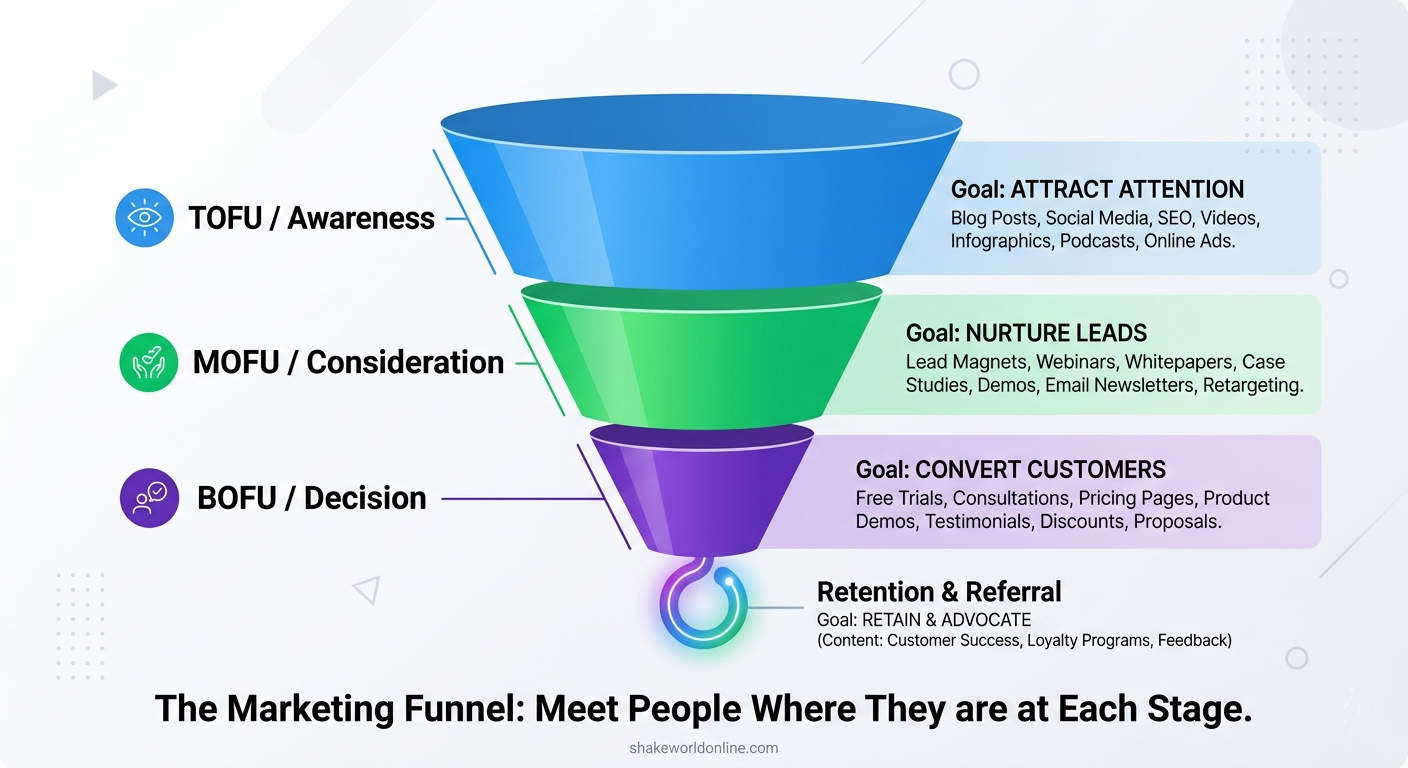
Top of the Funnel (TOFU): Awareness
At the top, the person barely knows you exist. They might not even fully realize they have a problem yet. They're not shopping. They're searching for answers, ideas, or entertainment.
Your job here is not to sell. It's to be found and be useful. Push a hard sales pitch now and you'll scare people off. This is the single most common reason cold traffic bounces. Instead, you earn attention by helping.
Think of someone who feels their laptop is slow. They search "why is my laptop so slow" long before they search "buy new laptop." TOFU content meets them at that first moment.
Content that fits TOFU: blog posts, social media posts, short videos and reels, YouTube videos, podcasts, and helpful guides. The goal is reach and trust, not conversions. You're planting a seed so that when they're ready, you're the name they remember. This is where content marketing and social media do their best work.
Middle of the Funnel (MOFU): Consideration
Now the person knows they have a problem and knows there are solutions, including yours. They're comparing options and deciding who to trust.
Your job here is to build trust and show why you're the right fit. Not a hard sell yet. You're proving you understand their problem better than anyone, and that your solution actually works.
Content that fits MOFU: email newsletters, case studies, comparison guides ("us vs. the alternatives"), webinars, product demos, and in-depth guides. This is also where interactive content shines, more on that below. The middle of the funnel is where your email marketing earns its keep, because email lets you nurture people over days and weeks until they're ready.
Bottom of the Funnel (BOFU): Decision
Finally, the person is ready to buy. They just need a final nudge and a reason to choose you, now.
Your job here is to make buying easy and the decision feel safe. Remove every last bit of friction and doubt.
Content that fits BOFU: sales pages, customer testimonials and reviews, free trials, demos, limited-time offers, and clear, confident calls to action. This is where a strong landing page and good conversion optimization turn interest into actual money.
Here's the crucial thing to remember about all three stages: people don't move through them in a neat, straight line. Someone might watch your video today, forget you for a month, see a friend mention you, then Google your brand and buy. They jump around. They enter at different points. That's exactly why you need a presence at every stage, not just a "buy now" button.
Not sure where your funnel is leaking?
Find out exactly which stage is losing you customers, and what to fix first. Get a free audit and we will map your funnel end to end.
Get My Free SEO Audit →How to Build a Funnel That Actually Works
Understanding the stages is the easy part. Here's how to actually put a funnel to work, step by step.
1. Build It Backwards, Starting From the Sale
This is the trick most people get wrong. They start at the top ("let me make some awareness content") and hope it eventually leads to sales.
Flip it. Start at the bottom. Ask: what makes someone actually buy from me? Then work backwards. What did they need to believe right before that? And before that? And what first made them aware they had this problem?
When you build backwards from the moment of purchase, every piece of content has a clear job: to move someone one step closer to buying. You stop making random content and start building a path. Some of the sharpest marketers plan their bottom-of-funnel content first, then their middle, then their top, precisely for this reason.
2. Map Your Content to Each Stage
Once you know your stages, take inventory. List every piece of content and marketing you have, and tag each one: is this TOFU, MOFU, or BOFU?
You'll almost always find gaps. Maybe you have tons of awareness blog posts but nothing that helps people compare you to competitors (a MOFU gap). Or great testimonials but no top-of-funnel content bringing in new people (a TOFU gap). Fill the gaps. A funnel with a missing stage leaks badly.
A simple spreadsheet is all you need. One column for the content, one for its stage, one for the problem it solves. This single exercise reveals more than most expensive tools.
3. Use the Funnel to Find Your Leaks
Treat your funnel like a doctor treats a body: look for where things break down.
Lots of traffic but few leads? Your top works, but your middle isn't converting visitors into contacts. Lots of leads but few sales? Your middle works, but your bottom isn't closing. Each symptom points to a different fix. This is the real superpower of the funnel: it stops you from throwing money at the wrong problem. Pour effort into the stage that's actually leaking, not the one that already works.
4. Capture People Before They Leave
Most people who visit you will never come back unless you give them a reason and a way. So at every stage, offer a way to stay in touch: an email signup, a WhatsApp opt-in, a free guide in exchange for contact details.
A visitor who leaves is usually gone forever. A visitor who joins your list is someone you can guide through the rest of the funnel over time. This bridge is what lead generation is all about, and without it, you're refilling the top of your funnel from scratch every single day.
5. Add Interactive Content in the Middle and Bottom
Here's an advanced move that works beautifully. Tools like calculators, quizzes, and assessments often convert far better than plain articles, especially in the middle and bottom of the funnel.
Why? Because reading a blog post is passive. Using an ROI calculator or a "which option is right for me" quiz is active problem-solving. The person is plugging in their own numbers and situation, which creates real intent. One simple calculator can outperform a dozen blog posts on conversions, even with less traffic.
A bonus most people miss: the result becomes a sales asset. When someone gets a personalized score or estimate, your follow-up can reference it directly ("you scored X, here's how we fix that") instead of starting cold. Save interactive tools for MOFU and BOFU, where people already have context and want help deciding.
6. Don't Religiously Force the Funnel Into Your Ad Structure
This is an honest one that saves you money. For years, the standard advice was to build separate ad campaigns for each funnel stage: an awareness campaign, then retarget those people with a consideration campaign, then a conversion campaign.
On modern ad platforms, that rigid three-step structure is often no longer the best approach. Platforms like Meta have gotten smart enough to find your buyers across all stages on their own. Many advertisers now get better results with simpler setups and strong creative, letting the platform do the funneling, rather than over-engineering a complex multi-stage maze.
So use the funnel as a thinking model for your overall strategy and content. But don't assume it must become a literal, rigid blueprint for every ad campaign. Test simpler structures. Often they win. The funnel lives in your strategy, not necessarily in your campaign settings. For more, see Meta ads and retargeting.
7. Don't Stop at the Sale
The biggest mistake of all: treating the funnel as if it ends the moment someone buys.
It doesn't. The smartest businesses obsess over what comes after: keeping customers happy so they buy again (retention) and turning them into people who refer others (advocacy). It costs far less to keep a customer than to win a new one. And a referred customer arrives already trusting you, dropping them straight into the bottom of your funnel.
So think of your funnel as a loop, not a dead end. Happy customers feed the top of the funnel by bringing you new ones. That loop is where the real, compounding growth lives.
Want a funnel that runs itself?
A funnel that converts takes the right content, capture systems, and follow-up working together. We build complete marketing funnels for businesses every day.
Work With Shakeworld →A Few Honest Truths About the Funnel
Let me give you the balanced view, because the funnel isn't sacred scripture.
The funnel is a model, not reality. Real customer journeys are messy, looping, and unpredictable. The neat three-stage triangle is a simplification. It's a useful map, but don't mistake the map for the territory. People will surprise you.
It's an old idea, and that's mostly fine. The funnel traces back to a sales model from 1898. Some marketers argue it's outdated, that journeys today are too tangled for a tidy funnel. They have a point. But as a simple way to make sure you're not skipping straight to the sell, and to spot where you're losing people, it still works beautifully. Use it as a guide, not a religion.
Don't over-build it. You don't need a 12-stage funnel with twenty automated sequences on day one. Start with the three basic stages. Make sure you have something for each. Get that working, then refine. Complexity is not the same as effectiveness.
The goal is always the same: the right message, to the right person, at the right time. If a fancy framework helps you do that, use it. If it's getting in the way, simplify. Never lose sight of the actual goal.
Frequently Asked Questions
A marketing funnel is the journey a person takes from first hearing about your business to becoming a paying customer. It is called a funnel because of its shape: many people enter at the top when they first notice you, fewer move down as they get interested, and only some reach the bottom and buy. It maps that journey on purpose so you can guide people step by step, being helpful when they are curious, building trust when they are comparing, and making buying easy when they are ready, instead of rushing straight to the sale.
They are the three stages of the funnel. TOFU (Top of Funnel) is the awareness stage, where people barely know you exist and your job is to be useful and get found, not to sell. MOFU (Middle of Funnel) is the consideration stage, where people compare options and your job is to build trust and show why you fit. BOFU (Bottom of Funnel) is the decision stage, where people are ready to buy and your job is to make the purchase easy and the choice feel safe. Each stage needs different content and a different message.
Three reasons. First, almost nobody buys on the first visit; studies suggest only about 4% of visitors are ready to buy immediately, so the other 96% need nurturing. Second, the funnel is a diagnostic tool: if you get lots of traffic but no sales, it shows your top works but your middle or bottom is broken, so you fix the right problem instead of guessing. Third, it lets you send the right message at the right time, matching your content to where the person actually is in their journey.
At the top (awareness), use blog posts, social media, short videos, podcasts, and helpful guides to get found and build trust, with no hard selling. In the middle (consideration), use email newsletters, case studies, comparison guides, webinars, demos, and interactive tools like calculators and quizzes to build trust and help people evaluate. At the bottom (decision), use sales pages, testimonials, free trials, demos, and limited-time offers to make buying easy and remove doubt. Match the content to the person's mindset at that stage.
Yes, as a thinking model, though with caveats. Real customer journeys are messy and people jump between stages rather than moving in a straight line, so treat the funnel as a useful map, not a rigid rulebook. It traces back to a sales model from 1898, and some argue it is dated, but it remains excellent for making sure you do not skip straight to selling and for spotting where you lose people. One modern note: on ad platforms like Meta, rigid multi-stage campaign structures are often no longer best practice, so keep the funnel in your strategy without forcing it into every ad setup.
The Bottom Line
The marketing funnel is the single most useful mental model in all of marketing. It's just the journey from "never heard of you" to "loyal customer," mapped out so you can guide people instead of guessing.
Remember the three stages. At the top (TOFU), be useful and get found; don't sell. In the middle (MOFU), build trust and help people compare; show why you fit. At the bottom (BOFU), make buying easy and safe; give them a reason to choose you now. Then keep them happy so they come back and bring others.
Build it backwards from the sale. Map your content to each stage and fill the gaps. Use it to find and fix your leaks. Capture people before they leave. And don't over-engineer it, the funnel is a guide for your thinking, not a rigid cage.
Get this right and marketing stops feeling like throwing things at a wall. It becomes a system you understand and can steadily improve. That's the whole point.
This is one piece of the bigger picture. To see how it all fits together, start with the complete guide to online marketing, then pair this with your ideal customer profile and positioning (so you know who you're guiding through the funnel), content marketing and email marketing (the engines that move people between stages), and marketing analytics and attribution (to measure where your funnel leaks).
And if you'd like a clear picture of where your own funnel is losing people, and a plan to fix it, that's exactly what we do at Shakeworld Digital. Get a free marketing audit and we'll map your funnel and show you the biggest, fastest wins.
Written by Popmati Samson, Founder of Shakeworld Digital, systems builder, and AI entrepreneur. I help businesses turn scattered marketing into a funnel that reliably turns strangers into customers.
Ready to stop guessing and start guiding?
You have the blueprint. If you would rather have a team build and run your funnel for you, that is what we do at Shakeworld Digital.
Get Your Free SEO Audit →