

Lead Generation: How to Build a Pipeline of People Who Actually Buy
 By Popmati Samson
9 min readUpdated 2026
By Popmati Samson
9 min readUpdated 2026Lead generation is the work of turning strangers into interested prospects you can actually follow up with. It is the bridge between marketing, which gets you noticed, and sales, which closes the deal. And the most important thing to understand about it is that it is a system, not a single clever tactic. The businesses that win at lead generation are not the ones with the cleverest cold email. They are the ones who treat the whole journey, from first attention to closed sale, as one connected pipeline.
Here's the trap almost everyone falls into.
Most businesses pour all their energy into the front of that pipeline, getting more leads, more enquiries, more names. Then they quietly lose most of those hard-won leads at the back of it, because the follow-up is slow, the tracking is a mess, and good prospects fall through the cracks. As one business owner put it, almost everyone is decent at finding leads; the real money gets left behind in what happens after. That single insight will reshape how you think about all of this.
So in this guide I'll walk you through the whole system: what a lead really is, how to bring leads in through inbound and outbound, what actually works in 2026 now that AI has flooded every channel, and, most importantly, how to stop leaking the leads you already have. Let me show you how to build a pipeline of people who actually buy.

What Lead Generation Really Is
Let me start by clearing up the most common confusion, because it quietly wastes a lot of money.
A lead is not the same as traffic or attention. Someone who saw your advert, watched your video, or visited your site is not yet a lead. A lead is someone who has raised their hand in some way and whose contact details you now hold: a name with a phone number, an email, or a WhatsApp chat, together with some sign that they are interested. The whole job of lead generation is to convert anonymous attention into identified, interested people you can have a conversation with.
That is why I keep calling it a system. It runs in stages: you attract the right people, you capture their interest and contact details, you qualify whether they are a good fit, you follow up and nurture them, and finally you convert them into customers. Marketing fills the top of that pipeline; sales closes the bottom; lead generation is the connective tissue that moves people from one to the other without losing them along the way.
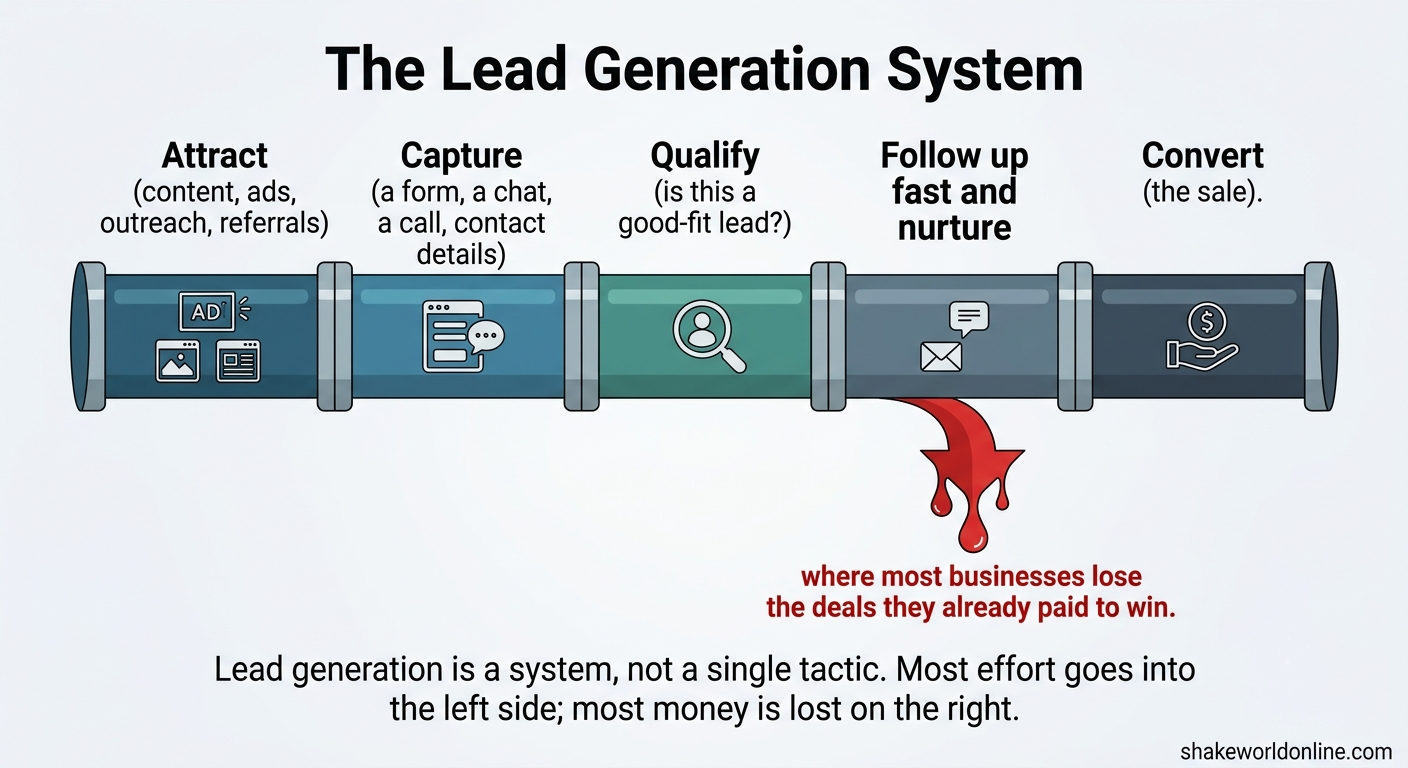
Keep that picture in mind, because almost every mistake in lead generation is really a broken or missing stage in this pipeline.
The Two Engines: Inbound and Outbound
There are two fundamental ways to bring leads in, and you decide between them based on where your buyers are and how they like to be reached.
Inbound is when prospects come to you. They find your content in search, ask an AI tool for a recommendation, stumble onto your social posts, or get referred by someone they trust, and then they reach out. Inbound is slower to build, but it compounds, and the leads are usually warmer because they chose you. Outbound is when you go to them: cold email, cold calls, direct messages, and paid search or social ads aimed at people who fit your profile. Outbound is faster to switch on and gives you control over exactly who you target, but it costs more effort per lead, and the people you reach were not asking to hear from you.
Here is the honest comparison, so you can decide where to start.
| Inbound | Outbound | |
|---|---|---|
| Who moves first | The prospect finds and contacts you | You reach out to the prospect |
| Speed to start | Slow to build, compounds over time | Fast to switch on |
| Lead temperature | Warmer, they chose you | Colder, they were not asking |
| Cost over time | Cheaper per lead once it works | Steady effort and cost per lead |
| Built on | Content, SEO, AI search, social, referrals | Cold email, calls, DMs, targeted ads |
| The 2026 edge | Showing up in AI answers and search | Signal-based timing, not volume |
You do not have to choose one forever. The common pattern is to use outbound for speed and control while you slowly build inbound for cheaper, warmer leads over time. The right mix depends entirely on who you serve, which is why everything starts with a clear ideal customer profile.
What Actually Works in 2026
The biggest shift in lead generation is simple to state: the spray-and-pray era is dead. For years you could blast thousands of identical messages and win on sheer volume. Now AI has made that easy for everyone, so inboxes are drowning in generic outreach, and the lazy approach not only gets ignored, it actively burns your reputation. The edge has flipped from volume to quality and timing.
In practice that means a few things are clearly winning right now. Signal-based outreach is the big one: instead of contacting a cold list, you reach out only to people who have shown a recent reason to buy, a new role, a new location, recent growth, a fresh need. Good timing turns a mediocre message into a welcome one, while bad timing kills even a great message. Alongside that, small and genuinely personalised batches beat mass blasts every time. As one operator put it, anyone can send ten thousand emails, but few can send five hundred truly relevant ones, and those five hundred win.
On the inbound side, the fastest-growing channel is AI search. More and more buyers now ask tools like ChatGPT or Perplexity to recommend options before they ever open Google, and businesses that show up in those answers are quietly capturing demand everyone else cannot even see. Getting recommended there is its own discipline, which we cover in answer engine optimization. And through all of this, the oldest channel of all still closes fastest: referrals and word of mouth. The lesson across every channel is the same. Relevance and timing now beat raw volume.
Getting leads but watching them slip away?
Find out where your pipeline is leaking, from the channels that bring leads in to the follow-up that loses them, before you spend more on getting more. Get a free audit and we will map your whole lead system end to end.
Get My Free Audit →How to Build a Lead Generation System That Works
Here is the approach that works today, as a system, in order.
1. Define What a Good Lead Actually Is
Before you chase a single lead, decide who is worth chasing. More leads is not the goal; more of the right leads is. Get specific about who you serve best and what makes a lead qualified, the signs that someone is a genuine fit rather than a tyre-kicker. This is the heart of your ideal customer profile and positioning, and it saves you from the most common waste in lead generation: pouring effort into people who were never going to buy.
2. Pick One or Two Channels Where Your Buyers Already Are
Resist the urge to be everywhere. It is far better to do one inbound and one outbound channel well than to half-run five. Match the channel to your buyer: if they actively search for a solution, lean on content, search, and AI search; if they hang out on a platform, meet them there; if you sell to other businesses, targeted outreach may fit best. Commit to learning one or two channels deeply before you add more.
3. Make Your Outbound Signal-Based, Not Spray-and-Pray
If you do outbound, do it the 2026 way. Build a small, clean, well-targeted list rather than a giant one, and reach out around real buying signals and good timing rather than blasting everyone at once. Personalise enough that the message could only have been written for that person. Fewer, sharper, better-timed touches will beat a mountain of generic ones, protect your reputation, and actually get replies.
4. Give People a Reason to Raise Their Hand
Attention is not a lead until someone acts, so give them an easy, valuable reason to. That usually means an offer in exchange for their details, a useful free guide, a checklist, a quote, a consultation, a discount, paired with a simple way to claim it. Send that interest to a focused page built to convert, not your busy homepage, and keep the form short. This capture step is where a lot of traffic quietly dies, and getting it right is the whole craft of landing pages and conversion optimisation.
5. Respond Fast, Because Speed Wins Deals
This is the single highest-leverage habit in lead generation, and almost everyone is slow at it. Studies of response times have repeatedly found that contacting a fresh lead within a few minutes makes them dramatically more likely to convert, by some measures many times more, than waiting even half an hour, yet the typical business takes far longer. When someone raises their hand, they are interested right now, and that interest cools fast. Whatever else you do, build a way to respond to new leads almost immediately. It will quietly outperform almost any clever tactic.
6. Follow Up Persistently and Nurture the Rest
Most leads are not ready to buy the moment they appear, and that is normal. The businesses that win are the ones that follow up more than once and keep the relationship warm until the timing is right, instead of giving up after a single try. Set up a simple sequence of follow-ups, and for the people who are not ready yet, keep gently in touch through channels they actually use, like email and, especially locally, WhatsApp. A lead you nurture for two months is still far cheaper than a brand-new one.
7. Track Every Lead in One Place, and Score Them
Finally, give every lead a single home. The fastest way to lose good leads is to scatter them across spreadsheets, inboxes, and WhatsApp chats where nobody can see the full picture and follow-ups fall through the cracks. Keep them in one place, a simple CRM, with a clear status and next step for each, and score them hot, warm, or cold so you know who to call first. This is where lead generation hands off to marketing automation and CRM, and where you finally see, through proper analytics and attribution, which channels bring leads that actually become customers.
Want a pipeline that fills itself?
Choosing the right channels, capturing leads cleanly, responding fast, and following up without dropping anyone is a real system to build and run. We design and operate lead-generation engines for businesses every day.
Work With Shakeworld →A Few Honest Truths About Lead Generation
Before you dive in, here are the realities the hype skips.
More leads is not the goal. A pile of poor-fit leads costs you time and morale and closes nothing. Chase qualified leads and a higher conversion rate, not a bigger vanity number at the top of the funnel.
Speed beats almost everything. The business that replies in five minutes usually wins over the one with better marketing that replies in five hours. If you fix only one thing, fix your response time.
You are probably leaking deals in the follow-up. Most owners have closed-able deals sitting dead in old leads they never followed up with. The gap between getting a lead and working it properly is where the real money hides.
One or two channels done well beats ten done badly. Spreading thin produces mediocre results everywhere. Go deep on the channels that fit your buyer before you add more.
Own your lead sources where you can. Leads you rent from a portal or a platform stop the moment you stop paying. Channels you own, your content, your search presence, your list, keep producing, and the leads usually convert better because they found you specifically.
Frequently Asked Questions
Lead generation is the work of turning strangers into identified, interested prospects you can follow up with. A lead is not just anyone who saw your advert or visited your site; it is someone who has raised their hand in some way and whose contact details you now have, a name with a phone number, an email, or a WhatsApp chat, plus some sign of interest. That distinction matters, because traffic and attention are not leads. The point of lead generation is to capture genuine interest and start a relationship you can move toward a sale. It sits between marketing, which builds awareness, and sales, which closes, and its real job is to feed your pipeline with people worth talking to, not just to inflate a number.
They are the two engines, and they differ by who makes the first move. Inbound is when prospects come to you: they find your content in search, ask an AI tool for a recommendation, see your social posts, or get referred, and then reach out. It is slower to build but compounds over time, and the leads tend to be warmer because they chose you. Outbound is when you go to them: cold email, calls, direct messages, and targeted ads. It is faster to switch on and gives you control over who you target, but it takes more effort per lead and the people you reach were not asking. Most businesses do not pick one forever. They use outbound for speed and control while building inbound for cheaper, warmer leads over time.
The honest answer is that most channels still work, but only if you change how you use them. The spray-and-pray era is over: blasting thousands of identical messages now burns your reputation and gets ignored, because everyone is doing it with AI. What works is the opposite, fewer, sharper touches. Signal-based outbound, reaching out only to people who showed a recent reason to buy, like a new role, a new location, or recent growth, converts far better than cold lists. Small, genuinely personalised batches beat mass blasts. Inbound through content and especially AI search is rising fast, as more buyers ask tools like ChatGPT for recommendations before they ever Google. And referrals and word of mouth still close fastest of all. The pattern is the same everywhere: quality and timing now beat raw volume.
Almost always because of what happens after the lead arrives, not before. This is the most expensive and most overlooked problem in lead generation. The two usual culprits are speed and follow-up. Speed matters more than almost anyone believes: studies of response times have repeatedly found that contacting a fresh lead within a few minutes makes them dramatically more likely to convert, by some measures many times more, than waiting even half an hour, yet most businesses take far longer. The second culprit is follow-up. Most leads are not ready to buy the moment they appear, and the businesses that win are the ones that follow up persistently and keep the relationship warm, instead of giving up after one try. If leads come in and then sit in a spreadsheet or a messy WhatsApp thread, you are leaking deals you already paid to win.
Once you have more than a trickle of leads, yes, in spirit if not in name. The single most common way businesses waste good leads is by scattering them across spreadsheets, sticky notes, inboxes, and WhatsApp chats, so nobody can see the full picture and follow-ups quietly fall through the cracks. A CRM, which simply means one place where every lead lives with its status and history, fixes that. It lets you see who is new, who replied, who is ready, and what the next step is, so nothing gets dropped. You do not need anything fancy to start; even a simple, disciplined system beats chaos. The goal is one source of truth for every lead, because the money is lost in the gaps between tools, not in finding leads in the first place.
The Bottom Line
Lead generation is not a single tactic you switch on. It is a system that turns strangers into interested prospects and then into customers, and it only works when every stage works together.
Define who a good lead really is. Pick one or two channels where your buyers already are. Make your outbound signal-based instead of spray-and-pray, and give people an easy reason to raise their hand. Then, above all, respond fast, follow up persistently, and keep every lead in one place you actually track.
Do that, and you stop obsessing over the top of the funnel while quietly leaking money out of the bottom. You build something far more valuable than a burst of enquiries: a steady, reliable pipeline of people who actually buy.
Ready to stop leaking leads?
You have the playbook. If you would rather have a team build the channels, the capture, and the fast follow-up that turns leads into customers, that is what we do at Shakeworld Digital.
Get Your Free Audit →This is one piece of the bigger picture. To see how it all fits together, start with the complete guide to online marketing, then pair this with ideal customer profile and positioning (who a good lead really is), content marketing and answer engine optimization (how inbound leads find you), Google Ads and Meta ads (how you buy attention at speed), landing pages and CRO (where interest becomes a captured lead), email and WhatsApp marketing (how you follow up and nurture), marketing automation and CRM (how you track and never drop a lead), and marketing analytics and attribution (so you know which leads are worth the most).
And if you would like a team to build a lead-generation engine that brings in the right people and actually converts them, that is exactly what we do at Shakeworld Digital. Get a free marketing audit and we will show you where your pipeline is leaking and how to fix it.
Written by Popmati Samson, Founder of Shakeworld Digital, systems builder, and AI entrepreneur. I help businesses build lead systems that fill the pipeline and stop leaking deals.