

Marketing Analytics and Attribution: How to Know What's Actually Working
 By Popmati Samson
10 min readUpdated 2026
By Popmati Samson
10 min readUpdated 2026Marketing analytics and attribution are how you answer the most important question in all of marketing: is this actually working? Analytics is the measuring, counting your traffic, leads, costs, and sales. Attribution is the harder part, working out which of your marketing efforts deserves the credit when a customer finally buys. Together they are supposed to tell you where your money is working and where it is wasted.
Here's the problem almost everyone runs into.
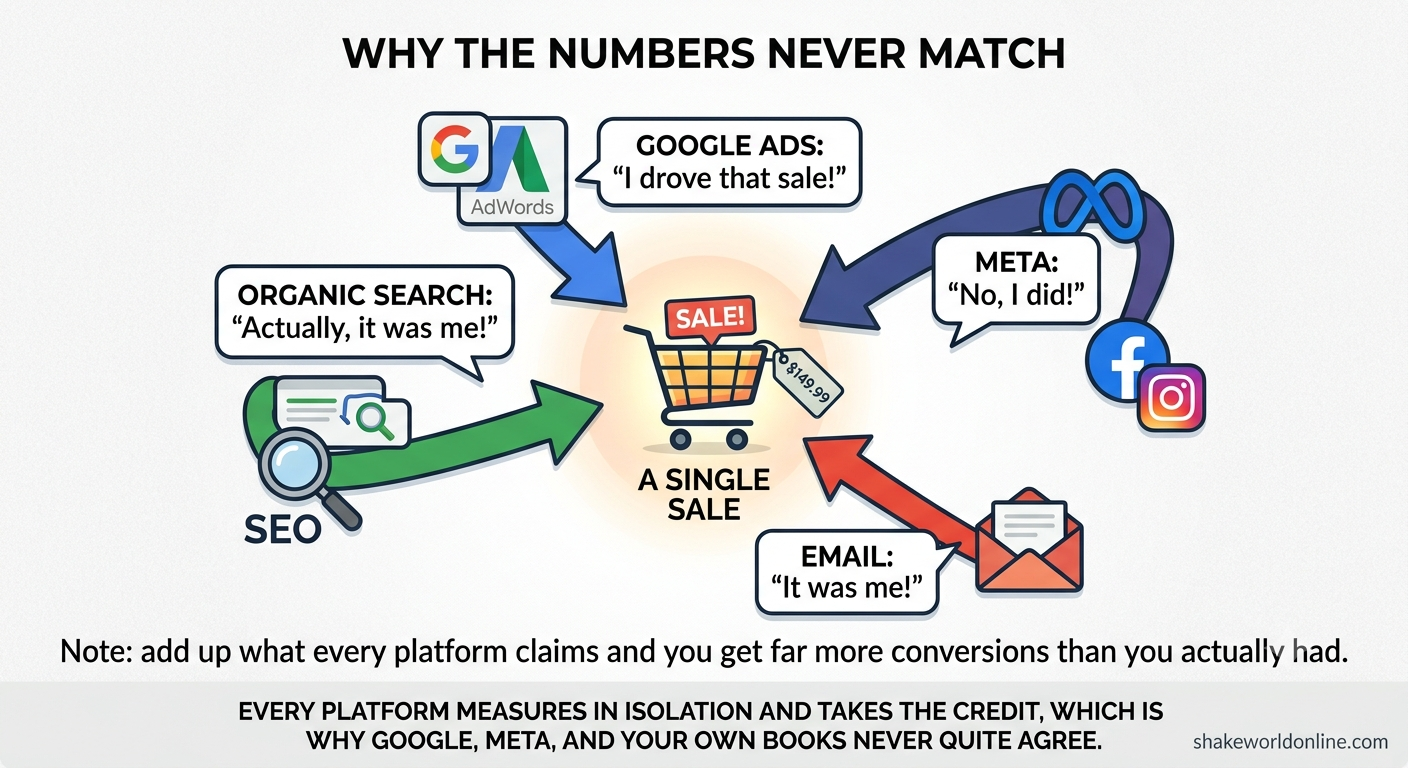
You are running a few things at once, some ads, some posts, an email or two. A sale comes in. So which one earned it? Google's dashboard swears it was the Google ad. Facebook insists it was the Facebook ad. Your own records show something different again. Every tool is claiming the same single sale, your numbers refuse to add up, and you are left genuinely unsure what to spend more on and what to cut.
I want to tell you the truth that most guides dance around: perfect attribution is impossible. You will never trace every sale back to its exact cause, and that is fine, because you do not need to. What you need is to be directionally right, clear enough about what is working to make confident bets, without drowning in dashboards. So let me show you how analytics and attribution really work, why the numbers never match, and how to measure what matters without losing your mind.
What Marketing Analytics and Attribution Really Are
Let me separate the two ideas clearly, because people use them interchangeably and then get confused.
Analytics is measurement. It is the scoreboard: how many people visited your site, how many became leads, what each channel cost you, how much revenue came in. It answers the question, what happened? This part is relatively straightforward, and most businesses already have some of it through their website analytics and their ad accounts.
Attribution is the credit question. It tries to answer what caused a result, which touchpoint or channel should get the credit when someone buys. And this is where it all gets hard, because real buying journeys are nothing like a straight line. A customer might discover you on Instagram, read a blog post a week later, click a Google ad after that, and finally buy only once a friend reassures them. Analytics can count every one of those steps. Attribution has to decide how much credit each step deserves, and there is simply no perfect way to divide it.
The Models, and Why They Disagree
To divide that credit, marketers use attribution models, which are just rules for who gets the points. There are three you will meet most often, and they openly disagree with each other, by design.
First-touch gives all the credit to whatever first brought someone to you. It is great for understanding what creates demand, but it ignores everything that actually closed the sale. Last-click does the opposite, handing all the credit to the final step before the purchase. It is great for understanding what closes, but it is blind to all the earlier work that warmed the person up, so it tends to over-reward things like brand searches and retargeting that were going to convert anyway. Multi-touch tries to be fairer by spreading credit across several steps. It paints a fuller picture, but it is genuinely hard to set up, often unreliable, and easy for anyone to tweak until it tells the story they want.
Here is the honest comparison, so you can see why no single one is the answer.
| Model | Gives credit to | Good for answering | Watch out for |
|---|---|---|---|
| First-touch | The first thing that brought them in | What creates demand and awareness | Ignores everything that closed the sale |
| Last-click | The final step before they bought | What closes and captures demand | Misses all the earlier influence |
| Multi-touch | A share to several steps in the journey | The fuller, end-to-end picture | Complex, unreliable, easy to argue with |
| Models and experiments | Whole-channel impact, statistically | Big, strategic budget bets | Costly and really meant for large spenders |
The key insight is this: none of these models is the truth. Each answers a different question, so the smart move is not to crown one winner but to match the model to the decision you are making. There is also a heavier tier, statistical models and controlled experiments, that big spenders use for major budget calls, but for most businesses that is using a sledgehammer to crack a nut.
Why Attribution Is Never Perfect (and Why That's Fine)
It helps to accept, early and fully, that perfect attribution is not coming. It is not a tooling problem you can buy your way out of; it is closer to a law of nature.
Part of the reason is the messy journey we already saw. The rest is signal loss. The little trackers that follow people around the web, cookies, are dying off. Privacy changes on phones hide a growing share of activity. People hop between a phone, a laptop, and a work computer, breaking the trail. And a huge amount of real influence happens in places no tracker can ever reach: a podcast someone listened to, a recommendation from a friend, a comment in a group chat. These are genuine attribution black holes, and they are only getting bigger.
So here is the mindset shift that changes everything: attribution is a compass, not a courtroom. Its job is to point you roughly in the right direction, not to deliver a verdict on exactly who is guilty. You never act on it alone. You trust it when it lines up with the things that are actually real, your total revenue, your cost per customer, the patterns you see over time. And when two models disagree, that is not a sign someone is lying; it is a sign the journey is genuinely complex. Used this way, imperfect attribution is still enormously useful. Treated as gospel, it will lead you straight off a cliff.
Why Most Businesses Get This Wrong
Knowing all this, here is where businesses still trip up, again and again.
The biggest mistake is chasing perfect precision, and so building nothing. People get so determined to map every touchpoint flawlessly that they freeze, and end up with no measurement at all rather than imperfect measurement they could actually use. A workable answer today beats a perfect one that never arrives.
The second is trusting a single platform's numbers as the truth. Remember, Google and Meta are grading their own homework, and both will claim the same sale. If you make decisions off one platform's dashboard, you will systematically overspend wherever that platform flatters itself. The third is letting every team or channel pick the model that makes it look best, so the conversation becomes a fight over whose story wins instead of what is actually true.
And the quietest, most expensive mistake of all: measuring activity instead of money. It is easy to celebrate clicks, impressions, and lead counts, but the only number that pays your bills is revenue. As one experienced marketer bluntly put it, most people overthink attribution and under-execute on what they already know. You can usually feel what is working and what is not long before a dashboard confirms it.
Spending on marketing but flying blind?
Find out which of your channels are actually driving sales and which are just taking the credit, before you cut the wrong one. Get a free audit and we will untangle your numbers and show you what is really working.
Get My Free Audit →How to Measure What's Actually Working
Here is a practical system that gives you real clarity without the overwhelm. Follow it in order.
1. Start With the Decision, Not the Dashboard
Before you measure anything, decide what choice you are trying to make: where to put next month's budget, whether to scale a channel, what to cut. The decision tells you which numbers actually matter, and it stops you from drowning in metrics that look interesting but change nothing. A dashboard built for its own sake gets ignored; a dashboard built to answer a real question gets used. This starts with knowing who you serve and what a valuable customer looks like, the heart of your ideal customer profile.
2. Track the Basics Cleanly
You do not need a fancy stack, but you do need clean fundamentals. Put consistent tracking links, UTMs, on the links you share, so your analytics can tell your channels apart instead of lumping everything into a vague pile. Make sure your website analytics and your ad accounts are actually set up and connected. Get these basics right and you have removed most of the chaos before it ever starts. Get them wrong, and no clever model can save you, because the underlying data is already garbage.
3. Anchor Everything to One Source of Truth: Your Money
When the platforms disagree, let your own revenue settle the argument. Tie your marketing back to actual enquiries and sales recorded in one place, rather than trusting the conversion counts each ad platform reports about itself. For most businesses that single place is a simple CRM, where every lead and sale lives with its source attached. The rule is simple: if attribution disagrees with your bank account, the bank account wins.
4. Just Ask People How They Found You
The most underrated attribution tool in the world is a single question: how did you hear about us? Ask every new lead or customer, and let them answer in their own words rather than picking from a dropdown. It is wonderfully low-tech, but it captures exactly the things no software can see, the word of mouth, the earned media, the offline recommendation. The patterns show up fast, and they will often surprise you by crediting channels your analytics quietly ignored.
5. Pick One Model Per Decision, and Write It Down
Stop model-shopping. Agree, in advance and in writing, which model you use for which decision: for instance, first-touch when you are judging what creates demand and where to invest in awareness, and last-click when you are optimising what converts. Treat the others as a sense-check, not ammunition. The data does not change when you do this, but the arguing stops, and everyone finally trusts the same story.
6. Watch Trends and Signals, Not Single Reports
Make decisions on patterns over time, not on one noisy week. A few honest signals will serve you better than any precise-looking model: is your overall revenue growing, is your cost per real customer sane, and is your branded search, people Googling your name, climbing? That last one is a brilliant, hard-to-fake sign that your brand and demand are genuinely growing. And for a truly big bet, run a simple experiment, turn a channel off for a while, or test it in one area and not another, and watch what happens to sales. That is the closest thing to real proof you will ever get.
7. Start Simple, and Refine
Do not wait for the perfect setup. Build something workable now, even a single sheet that tracks spend against sales by channel, and improve it every couple of weeks. The most common reason businesses have no useful measurement is that they tried to build the perfect system first and gave up. A rough dashboard you actually look at beats a beautiful one that only ever exists in your imagination.
Want numbers you can actually trust?
Clean tracking, one source of truth, and reporting that ties marketing back to real revenue is fiddly, ongoing work. We build measurement and attribution that tells businesses the truth, so you can spend with confidence instead of guessing.
Work With Shakeworld →A Few Honest Truths About Analytics and Attribution
Before you dive in, here are the realities the hype skips.
Perfect attribution is impossible, so stop chasing it. Aim to be directionally right rather than precisely wrong. Clarity good enough to make confident decisions is the real goal, not a flawless map of every sale.
Every platform overcounts in its own favour. Google, Meta, and the rest each take credit for sales they merely brushed against. Never let one platform's dashboard be your single source of truth.
The number that matters most is revenue. Clicks and leads are means, not ends. If your attribution says one thing and your bank balance says another, believe your bank balance.
You probably already know what is working. The gap is rarely more data; it is acting on the data you have. Politics, habit, and indecision waste more growth than missing dashboards ever do.
Simple beats sophisticated for almost everyone. Asking how customers found you, watching revenue, and tracking your links will take you most of the way. The heavy statistical models are for the rare few spending at a scale that justifies them.
Frequently Asked Questions
Analytics is the measurement of what is happening in your marketing: how many people visited, how many became leads, what each channel cost, and how much revenue came in. It answers the question, what happened? Attribution is the harder layer on top, and it tries to answer what caused it, which marketing effort deserves the credit when a customer finally buys. The reason attribution is so much harder is that real buying journeys are messy. Someone might see your Instagram post, read a blog, click a Google ad two weeks later, then buy after a friend recommends you. Analytics can count all of that; attribution has to decide how much credit each step deserves, and there is no perfect way to do it. In short, analytics is the scoreboard, and attribution is the argument about who actually scored.
An attribution model is simply a rule for how you hand out credit across the touchpoints in a customer journey. The common ones are first-touch, which gives all the credit to how someone first found you and is good for measuring what creates demand; last-click, which gives all the credit to the final step before buying and is good for measuring what closes; and multi-touch, which shares credit across several steps for a fuller picture but is far harder to set up and far easier to argue with. There is no single right model, because each one answers a different question. The practical move is not to hunt for the perfect model but to pick one model per decision and write it down: for example, first-touch when you are deciding where to invest in awareness, and last-click when you are optimising what converts. The worst thing you can do is let everyone choose whichever model happens to flatter their own channel.
Because every advertising platform measures in isolation and is quietly incentivised to take the credit. Google only sees what happened on Google, Meta only sees what happened on Meta, and each will claim a sale if it so much as touched that customer in the last few weeks. So if one person saw a Facebook ad and later clicked a Google ad before buying, both platforms count that same single sale, and your totals end up showing far more conversions than you actually had. Add in cookies expiring, people switching between phone and laptop, and privacy changes that hide a lot of activity, and the numbers will simply never line up perfectly. The fix is not to force them to match, which is impossible, but to stop treating any one platform's dashboard as the truth and to anchor your real reporting to your own revenue instead.
No, and chasing it will cost you time you should be spending on actual marketing. Perfect attribution is genuinely impossible, not merely difficult. A real customer journey crosses devices, platforms, and weeks, and a huge amount of influence happens where no tracking can ever see it: a podcast mention, a word-of-mouth recommendation, a conversation no pixel records. Every model is an estimate that is wrong in its own particular way, and the real skill is choosing the one that is least wrong for the decision in front of you. The healthier goal is to be directionally right rather than precisely wrong. If your overall revenue is growing, your cost per customer is sensible, and your best guesses about which channels help all point the same way, that is about as much certainty as attribution can honestly give you, and it is more than enough to make good decisions.
Three habits will take you most of the way, and none of them need expensive tools. First, ask every new lead or customer how they heard about you, in their own words rather than from a dropdown. It is imperfect, but it captures the word of mouth and offline influence that no software can see, and the patterns emerge surprisingly fast. Second, tie your marketing back to actual money: which efforts are followed by real enquiries and sales, kept in one place rather than scattered across apps and chats. Third, put consistent tracking links, called UTMs, on the links you share, so your analytics can tell your channels apart. Do those three things, watch the trends over time rather than reacting to every weekly wobble, and you will understand what works better than most businesses with far fancier dashboards.
The Bottom Line
Marketing analytics tells you what is happening. Attribution tries to tell you what caused it. And the most freeing thing you can learn is that attribution will never be perfect, because it was never possible to make it so.
So stop chasing precision and start chasing clarity. Start with the decision you need to make. Track the basics cleanly, anchor everything to your real revenue, and simply ask people how they found you. Pick one model per decision and write it down, watch the trends instead of the noise, and build something workable now rather than something perfect never.
Do that, and you stop being paralysed by numbers that refuse to agree. You get something far more useful than false precision: a clear enough picture to keep spending on what works, cut what does not, and grow with confidence.
Ready to know what is actually working?
You have the playbook. If you would rather have a team set up the tracking, the dashboards, and the honest reporting that ties every naira to a result, that is what we do at Shakeworld Digital.
Get Your Free Audit →This is one piece of the bigger picture. To see how it all fits together, start with the complete guide to online marketing, then pair this with lead generation (the pipeline these numbers measure), marketing automation and CRM (your single source of truth for every lead and sale), ideal customer profile and positioning (who a valuable customer really is), Google Ads and Meta ads (the paid channels whose numbers never agree), landing pages and CRO (where you turn measured traffic into conversions), brand versus performance marketing (why branded search is such a telling signal), and earned media and PR (the influence no pixel can ever see).
And if you would like a team to set up clean tracking, one source of truth, and reporting you can actually trust, that is exactly what we do at Shakeworld Digital. Get a free marketing audit and we will show you what your numbers are really telling you.
Written by Popmati Samson, Founder of Shakeworld Digital, systems builder, and AI entrepreneur. I help businesses cut through messy numbers and see what is actually working.