

Earned Media and PR: How to Win the Coverage and Trust You Can't Buy
 By Popmati Samson
10 min readUpdated 2026
By Popmati Samson
10 min readUpdated 2026Earned media is the coverage, mentions, and recommendations you earn instead of buy: a press article, a podcast feature, a journalist quoting you as an expert, a customer review, a friend telling a friend. Public relations, or PR, is simply the work of earning that coverage on purpose. And the reason it matters so much is hidden in the word itself. You earned it. You did not pay for it, which is exactly why people believe it.
Here's how it actually works.
You're weighing up two businesses you've never used. One you only know from its ads. The other you read about last month in a publication you trust, or a friend mentioned it, or you saw a wall of genuine reviews. Which one do you lean toward? Almost always the second, because someone other than the business itself vouched for it. That third-party trust is the whole magic of earned media, and it is the one thing your own advertising can never quite buy.
The catch is that earned media is also the hardest of the three kinds of marketing to get, because by definition you do not control it. You cannot simply pay to make a journalist write about you or a customer recommend you. You can only earn it. So let me show you what earned media really is, why it is worth the effort, and a practical way to win it even on a small budget.
What Earned Media and PR Really Are
The clearest way to understand earned media is to put it next to the other two kinds, because every business shows up in exactly three ways.
Paid media is what you pay to appear in: Meta ads, Google ads, sponsorships. You control it completely, but everyone knows it is an advert, so it carries the least trust. Owned media is what you control directly: your website, your email list, your social accounts. It is yours and free to use, but only the audience you have already built will see it. Earned media is what other people give you: press coverage, podcast features, reviews, referrals, and word of mouth. You do not control it, it is the hardest to get, and that is precisely why it carries the most trust of all three.
PR is just the discipline of earning that third kind on purpose. It means finding a story worth telling, building relationships with the people who can tell it, and giving them a reason to. And here is something most small businesses miss: earned media is far bigger than getting into the news. For a typical local business, the most powerful earned media is not a national headline at all. It is a stack of honest reviews, a steady stream of referrals, and being the name people pass around when a friend asks for a recommendation.
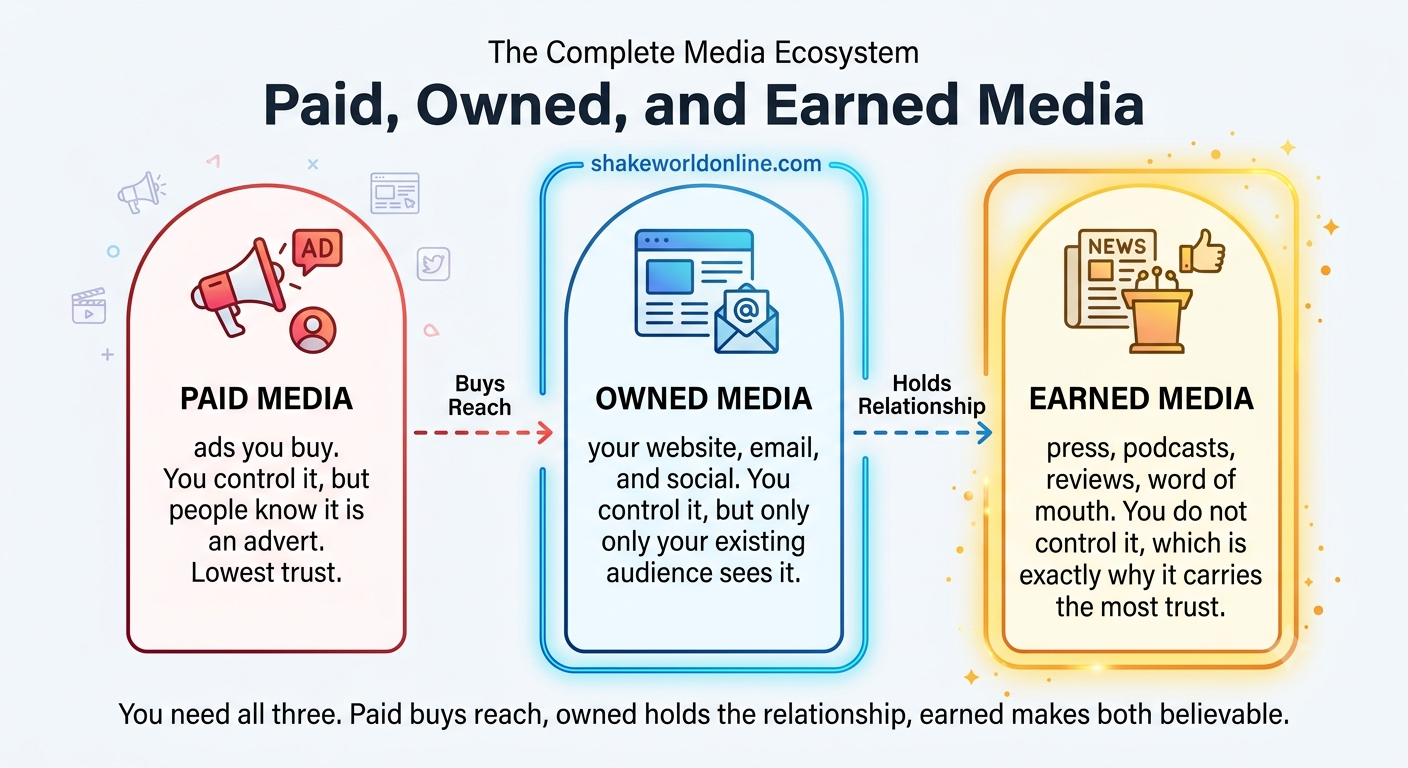
Here's the same idea laid out simply, so you can see where each one helps.
| Paid media | Owned media | Earned media | |
|---|---|---|---|
| What it is | Ads you buy | Channels you control | Coverage others give you |
| Do you control it | Fully | Fully | Not at all |
| What it costs | Money per placement | Time and effort | Time, effort, and a real story |
| Trust it carries | Low, people know it is an advert | Medium | High, a third party vouches for you |
| Examples | Meta and Google ads | Your site, email list, social | Press, podcasts, reviews, word of mouth |
The point is not to choose one. You build a solid owned foundation, use paid to reach new people quickly, and earn the coverage and word of mouth that makes both of the others far more believable.
Why Earned Media Is So Powerful (and Its Catch)
People do not buy from businesses they have no reason to trust, and trust is the one thing advertising struggles to manufacture. When a third party vouches for you, a journalist, a respected podcast, a customer leaving an honest review, they hand you their credibility. That borrowed trust is worth more than almost anything you could say about yourself, because you saying you are great is marketing, and someone else saying it is proof.
Earned media also pays off in ways that compound. A genuine article gives you a backlink and a presence in search that keeps working for years. It increasingly shapes what AI tools say about you too, because answer engines lean on what credible sources have written, an idea worth understanding through answer engine optimization. And it quietly strengthens your whole brand, which is the same force that makes every other channel cheaper and easier, something we go deeper on in brand versus performance marketing.
But there is a real catch, and it is the price you pay for all that trust: you do not control earned media. You cannot guarantee a journalist will cover you, you cannot dictate what a reviewer writes, and you cannot rush it. It is slow, it is uncertain, and it demands a genuine story and genuine relationships. That uncertainty is not a flaw to fix. It is the very reason earned media is believable in the first place.
Why Most PR Efforts Go Nowhere
Now the uncomfortable part. Plenty of businesses pour time and money into PR and hear nothing back, and it nearly always comes down to the same handful of mistakes.
The biggest one is pitching your product instead of a story. Journalists do not care about your features. They care about people, problems, and what is interesting to their readers. A press release that reads like a product page gets ignored, while a real story about why you started, what you fixed, or a surprising thing you learned gets read.
The second is blasting the same generic release to fifty reporters at once. It feels productive, but journalists can smell a mass email instantly, and many will not touch a story they know is sitting in fifty other inboxes. Fifty well-targeted, personalised pitches beat five hundred random ones every time.
The third is aiming only at the famous outlets. Everyone wants the big national feature, but for most businesses that is the least likely and least useful win. A piece in a trade publication or local outlet your actual customers read builds more real trust than a throwaway mention somewhere huge that none of your buyers will ever see. The fourth mistake is expecting instant results and quitting at the first silence, when PR is a slow game measured in months. And the fifth is reaching for cheap pay-for-play services that publish weak, obvious advertorials, which annoy the very journalists whose respect you are trying to earn.
Doing PR but hearing only silence?
Find out why your pitches are not landing and where your story is falling flat, before you spend another hour on it. Get a free audit and we will review your angle, your media list, and your owned foundation end to end.
Get My Free Audit →How to Earn Media and Do PR That Actually Works
Here is the approach that works today, even with little or no budget. Follow it in order.
1. Build Your Story and Your Owned Foundation First
Before you pitch anyone, get two things right. First, your story: not what your product does, but why it exists, what frustrated you into building it, and who it helps. That human angle is what makes a journalist care. Second, your owned foundation, a credible website and active social presence, because the moment a reporter is interested, they will check you out, and a thin or empty presence kills the story. Strong content that shows a clear point of view does double duty here: it gives reporters evidence you know your space and gives them something to quote.
2. Make a Small, Targeted Media List, Not a Blast List
Resist the urge to email everyone. Instead, build a short list of the specific people who might genuinely care: journalists, bloggers, newsletter writers, and podcast hosts who have covered your space or your competitors in the last few months. For most businesses the richest targets are trade publications, local outlets, and niche podcasts, not the giant national names. Fifty well-chosen contacts who actually cover your world are worth far more than a thousand random addresses.
3. Lead With the Story, and Pitch From the Founder
When you reach out, lead with the story, not the announcement, and keep it short, three or four sentences that say who you are, what is happening, and why their readers would care. Send it from the founder's own email, not a faceless press address, because journalists respond far better to a real person than to a company. People connect with people, so let the human behind the business do the talking.
4. Offer Exclusives, Use Embargoes, and Follow Up Lightly
Instead of blasting your story everywhere, offer it to one outlet at a time as an exclusive: give your top target first refusal a week or so ahead, and if they pass, move to the next. This is exactly how expensive agencies operate, and it works because reporters value being first. If you need several outlets to publish together, use an embargo, simply asking them to hold the story until an agreed date. Then follow up at most twice before moving on. Reporters get dozens of pitches a day, and the fastest way to be remembered for the wrong reasons is to chase them with six emails.
5. Use Wins to Earn More Wins
Earned media compounds, so put every win to work. When you get coverage, amplify it everywhere: share it on your social channels, add it to your site, and send it to your email list. Referencing past coverage is also a powerful trust signal when you approach a new outlet, especially podcasts and broadcast, which want proof you are worth featuring. One important caveat: do not pitch the exact same story to competing outlets, because few want to cover what a rival just did. Instead, bring a fresh angle or a new development. You can even put a little ad budget behind your best coverage and target it at journalists and their followers, because nobody pays closer attention to the media than the media.
6. Mine the Earned Media You Already Have
Do not overlook the earned media sitting right in front of you. For most businesses, reviews, referrals, and word of mouth are the highest-converting earned media there is, and far easier to influence than national press. So ask happy customers for reviews and referrals as a normal part of doing business, and make it effortless for them to say yes. Locally, much of this runs beautifully through WhatsApp, where a trusted personal recommendation does the heavy lifting. This is quietly the most reliable PR a small business has, and it costs nothing but the discipline to ask.
7. Measure by Correlation, and Feed Coverage Back Into Search
Earned media rarely gives you a clean click to track, so judge it the honest way: by correlation. When a feature runs or a wave of reviews lands, watch whether your branded searches, website visits, and sign-ups rise that week, and over time whether you are being taken more seriously by customers and partners. For the fuller picture, lean on proper analytics and attribution. Then close the loop by feeding coverage back into your search presence, because credible mentions strengthen both your SEO and how AI answer engines describe you, turning a single article into an asset that keeps paying off.
Want the coverage without the grind?
Finding the right journalists, shaping a story they actually want, and following up without burning the relationship is real, time-consuming work. We build and run earned-media programs for businesses, so the press does the vouching while you run the company.
Work With Shakeworld →A Few Honest Truths About Earned Media and PR
Before you dive in, here are the realities the hype skips.
PR is a marathon, not a sprint. Relationships and reputation take months to build, coverage is never guaranteed, and one article rarely changes everything. Commit to the long game or do not start, because the people who quit at the first silence get nothing for the effort they already spent.
Most small businesses do not need big press yet. If you just want more customers today, a sharp offer, a solid website, and steady word of mouth will usually do more than chasing headlines, and for far less money. Earn trust from your customers first; pursue the press once you have a real story.
Trade and local beat the famous outlet. A feature in a publication your actual customers read builds more trust than a fleeting mention somewhere huge that none of your buyers will see. Chase relevance, not vanity.
You cannot control it, and that is the point. You will not dictate what gets written or when, and trying to will only frustrate you. The lack of control is exactly what makes earned media believable, so make peace with it and focus on giving people a story worth telling.
Cheap pay-for-play does more harm than good. Bargain services that pump out obvious advertorials annoy the very journalists whose respect you want, and the damage lingers. A few genuine relationships, built through being useful and having a real point of view, are worth more than any volume of paid placements.
Frequently Asked Questions
Earned media is any coverage, mention, or recommendation you earn rather than pay for. It includes press articles, podcast and radio features, a journalist quoting you as an expert, a blogger writing about you, and, just as importantly for a small business, customer reviews, referrals, and plain word of mouth. The defining feature is that someone other than you is vouching for you, which is exactly why it carries trust that an advert never can. Public relations, or PR, is simply the practice of earning that coverage on purpose: telling a story worth covering, building relationships with the people who can tell it, and giving them a reason to. You cannot buy earned media directly, and that is the whole point. The fact that you did not pay for it is what makes people believe it.
They are the three ways your business shows up, and you need all three. Paid media is what you pay to appear in, like Meta or Google ads: you control it completely, but people know it is an advert, so it carries the least trust. Owned media is what you control directly, like your website, email list, and social accounts: free to use but limited to the audience you have already built. Earned media is what others give you, like press coverage, reviews, and word of mouth: you do not control it and it is the hardest to get, which is precisely why it carries the most trust. The smartest approach is not to pick one. You build a strong owned foundation, use paid to reach new people quickly, and earn coverage that makes both of the others more believable.
Often less than you think, and rarely as early as you think. If your goal right now is simply more customers, a tight offer, a good website, and steady word of mouth will usually do more than a press push, and they are cheaper to build. Chasing big national press before you have a real story or a proven product is one of the most common ways small businesses waste money. That said, earned media in its broader sense, reviews, referrals, being the quoted local expert, a guest spot on a relevant podcast, is genuinely valuable for almost everyone, because it builds the third-party trust that makes every other channel work harder. So the honest answer is: you probably do not need an expensive PR campaign yet, but you should absolutely be earning trust from day one, mostly through happy customers and a clear point of view.
PR is a marathon, not a sprint. Relationships with journalists take months to build, coverage is never guaranteed, and a single article rarely changes your business overnight. Measuring it is genuinely hard, because most earned media has no clean click to track: someone reads about you, remembers the name, and buys weeks later through a different channel. So instead of demanding a direct return on each hit, watch for correlation. When a feature runs, do your branded searches, website visits, and sign-ups tick up that week? Over time, is it getting easier to be taken seriously, by customers and by partners? A useful real-world signal is walking into a meeting where the other person already knows your name because they read about you. That trust, hard to put a number on, is what you are really buying.
Early on, do it yourself. The PR playbook is not a secret: build a small, targeted list of journalists who cover your space, lead with a real story rather than your product, pitch from the founder's own email in a few sentences, offer one outlet an exclusive, and follow up a couple of times before moving on. Most of what expensive agencies charge for is execution time, not magic. The catch is that this execution genuinely eats hours, which is why founders skip it. Bargain agencies are usually worse than doing nothing, because they annoy the exact reporters you want a relationship with and lean on low-quality pay-for-play. Bring in a good agency or consultant later, once you have real news, a budget, and more demand on your time than you can handle yourself.
The Bottom Line
Earned media is the coverage, mentions, and word of mouth you earn rather than buy, and it carries a trust that no advert can match, precisely because you did not pay for it.
Build your story and your owned foundation first. Make a small, targeted media list instead of a blast list. Lead with the story and pitch from the founder. Offer exclusives, use embargoes, and follow up lightly. Use every win to earn more, mine the reviews and referrals you already have, and measure by correlation while feeding coverage back into search.
Do that with patience, and you stop shouting your own praises into the void and start getting other people, journalists, podcasters, and happy customers, to vouch for you instead. That borrowed trust is the most valuable thing in marketing, and it is the one thing you can never simply buy.
Ready to get others vouching for you?
You have the playbook. If you would rather have a team find the right outlets, craft the story, and earn the coverage that builds real trust, that is what we do at Shakeworld Digital.
Get Your Free Audit →This is one piece of the bigger picture. To see how it all fits together, start with the complete guide to online marketing, then pair this with content marketing (the stories and expertise your PR is built on), social media marketing (where you amplify every win), influencer and affiliate marketing (other ways to borrow trusted audiences), brand versus performance marketing (why earned trust makes everything cheaper), Meta ads (how you put budget behind your best coverage), WhatsApp marketing (where referrals and word of mouth actually travel), answer engine optimization (how coverage shapes what AI says about you), and marketing analytics and attribution (so you can see what earned media is really doing).
And if you would like a team to find the right outlets, shape a story worth covering, and earn the coverage that builds real trust, that is exactly what we do at Shakeworld Digital. Get a free marketing audit and we will show you where your reputation is being built, and where it is being left on the table.
Written by Popmati Samson, Founder of Shakeworld Digital, systems builder, and AI entrepreneur. I help businesses earn the kind of trust that no advert can buy.