
Brand vs Performance Marketing: Why You Need Both
 By Popmati Samson
10 min readUpdated 2026
By Popmati Samson
10 min readUpdated 2026Brand marketing and performance marketing feel like rivals. They're not. They're partners that make each other work.
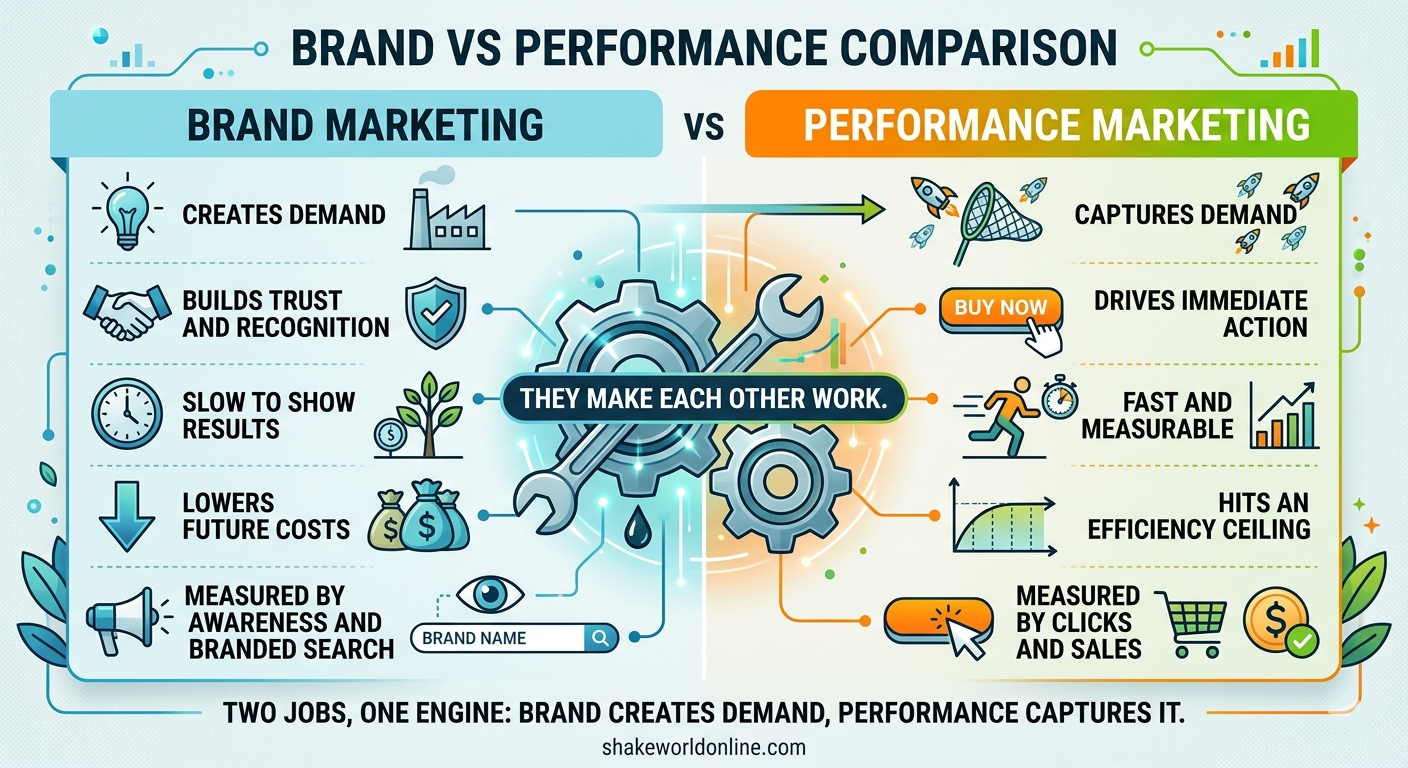
Performance marketing is the measurable side: ads and campaigns built to drive a clear action right now, a click, a lead, a sale. You can track almost every naira of it. Brand marketing is the slower side: building recognition, trust, and a reputation so that when people are finally ready to buy, they think of you first.
Most businesses pour everything into performance because it's easy to measure, and starve the brand side because it's harder to prove. That's a mistake, and it's an expensive one. Let me show you why you need both, and how to balance them, in plain terms.
What's the Difference, Really?
Let me make this simple with the best analogy I know.
Performance marketing is the gears. Brand marketing is the grease.
Gears are what actually turn and move you forward, your ads, your conversions, your sales. But gears with no grease grind. They take enormous effort to move and wear out fast. Grease with no gears? That's just a useless puddle. You need both. And here's the key: good brand marketing makes your performance marketing work better. It greases the gears so every sales effort takes less force.
Put another way, performance marketing captures demand that already exists. Brand marketing creates the demand in the first place. If nobody knows or trusts you, your ads are working with cold, empty hands. If people already know and like you, those same ads convert far more cheaply.
I'm Popmati Samson, founder of Shakeworld Digital. I've run both sides for businesses of very different sizes, and the pattern never changes: the brands that invest in both grow steadier and cheaper than the ones chasing only the next sale. Let me explain why.
Why You Can't Win on Performance Alone
Here's the trap. Performance marketing gives you a dashboard with clear numbers, so leaders love it. Brand marketing is fuzzier to measure, so it gets cut first. This feels smart. It isn't. Here's what pure performance misses.
Most of your market isn't ready to buy yet. At any given moment, only a small slice of people, often estimated at around 5%, are actively in the market for what you sell. Performance marketing fights over that 5%. The other 95% aren't ready today, but they will be eventually. Brand marketing is how you get into their heads now, so that when they finally need you, you're the first name they think of. As one way of putting it goes, you can only buy the sale when it's on the shelf; brand is what stocks your shelf with future customers.
Performance hits an efficiency ceiling. When you only chase the people ready to buy now, you quickly run out of cheap ones. Costs climb. Each extra naira buys less. The only way to lift that ceiling is to warm up the wider market so more people arrive already knowing you. Studies of hundreds of campaigns found that brands investing in both brand and performance saw sharply lower customer acquisition costs and far higher conversion rates than unknown competitors.
Without a brand, you compete on price, and that's a race to the bottom. Brand is your margin. If people don't know or trust you, the only lever you have left is being cheaper than the next option. A strong brand lets you charge what you're worth. This connects straight to your positioning: a clear, trusted brand is what lets you stop competing on price alone.
The empty-funnel problem. I've seen businesses where the sales team spends the first twenty minutes of every call just explaining who they are and what they do. That's a brand failure. With no brand, there's nothing at the top of your funnel, and pretty soon the whole funnel runs dry. Performance can pull people through a funnel, but it can't fill one from nothing.
Spending only on what you can measure?
Find out where leaning too hard on performance is quietly raising your costs. Get a free audit and we will map the right brand-and-performance mix for you.
Get My Free SEO Audit →How to Balance Brand and Performance
So you need both. The real question is how to split your effort between them. Here's how to think it through, step by step.
1. Start From the 60/40 Idea, Then Adjust for Your Stage
There's a well-known guidepost from decades of research across hundreds of campaigns: for steady long-term growth, a rough split of about 60% brand and 40% performance tends to work best. Brands that pushed almost everything into short-term performance saw quick wins followed by long-term decline.
But treat 60/40 as a starting point, not a law. Adjust it to your stage. If you're brand new and proving the product works, lean toward performance (closer to 70%), because you need sales now and brand spend reaches people you can't serve yet. As you grow, move toward an even split. Once you're established and defending your position, tilt back toward brand to keep your acquisition costs low. Your stage decides your mix.
2. If You're Small, Lead With Performance, But Don't Skip Brand
For most small businesses and startups, survival comes first. So put the larger share into performance that brings in sales you can measure and reinvest. That's the right call early on.
The mistake is going 100% performance and ignoring brand entirely. You don't need a big-budget TV campaign to build a brand. Showing up consistently, the same look, the same clear message, the same point of view, across your content, social, and every customer touch builds brand cheaply over time. A small brand that shows up consistently for two years will beat a bigger one running scattered, disconnected campaigns. Consistency is the budget-friendly version of brand building.
3. Build Brand Through Your Performance, Not Just Beside It
This is a mindset shift that saves money. Brand and performance aren't always separate activities. Your performance ads can build your brand at the same time, if you let them.
Every ad is a brand impression whether you like it or not. So make even your direct-response ads look and sound unmistakably like you: your colours, your voice, your point of view. People who don't click today still absorb your brand. Then, months later, they convert more easily because they already feel they know you. You don't always need a separate "brand campaign." You need performance that also carries your brand.
4. In a Small or Local Market, Lean Into Brand
Here's a case where the usual advice flips. In a big city, broad brand spend often disappears into the noise unless you have a huge budget, so performance is usually the smart play. But in a small town or tight niche, the maths changes.
When you can actually reach most of your market without spending a fortune, becoming the name everyone knows creates a moat competitors can't easily cross. Word of mouth travels fast in small communities, and being "the one" for your service locks in years of referrals. The one caution: don't overexpose yourself or saturate awareness faster than you can serve the demand, in a small market, being everywhere can tip into fatigue. But generally, in a small market, brand is king.
5. Decide Whether to Add Brand by Watching Your Numbers
You don't have to guess when it's time to invest more in brand. Your performance data will tell you. The clearest signal: when your traffic is rising but your conversions are flattening or falling, that often means you've squeezed the ready-to-buy crowd dry and now need to warm up the wider market. That's a brand problem, not a performance one.
The other signal is rising costs. When your cost per lead or sale keeps climbing no matter how you optimise the ads, you've likely hit the performance ceiling. Adding brand is how you bring those costs back down over time.
How to Measure Brand
The number one reason brand gets cut is that nobody can tie it to a sale. So let me give you the honest fix: you can't measure brand as precisely as a click, but you absolutely can measure it. Here's how.
Track branded search and direct traffic. When more people search for your name specifically, or type your website in directly, that's brand working. It's one of the cleanest proxies you have. Watch it climb as your brand efforts grow.
Ask "how did you hear about us?" Self-reported attribution is imperfect but powerful, especially for the channels dashboards can't track. The answers reveal the brand-building that's quietly feeding your sales.
Run a simple before-and-after or holdout test. Run two versions of a campaign: one straight to conversion, and one with a brand-awareness layer on top that you then retarget. Compare the cost per sale. Done right, this proves that brand exposure lowers your costs further down the funnel, exactly the evidence data-driven leaders need.
Compare your customers by source. Look at customers who came through brand and word of mouth versus pure ads. Often the brand-sourced ones convert higher, stay longer, and spend more. That's the long-term value brand builds that a single campaign report will never show. This all rests on solid analytics and attribution.
Want growth today and tomorrow?
Steady growth takes brand and performance working together, the right split, and honest measurement. We help businesses balance the two every day.
Work With Shakeworld →A Few Honest Truths About Brand and Performance
Let me give you the balanced view, including the case against over-investing in brand.
Brand is not a free pass for unmeasurable spending. This is the fair criticism of brand marketers, and it's often deserved. I've seen businesses sink money into a flashy sponsorship or a "brand campaign" that generated plenty of impressions and zero measurable business for years. If you spend on brand, you still owe yourself proxy metrics and a clear theory of how it leads to revenue. Brand is not an excuse to stop measuring.
Brand building has changed, not died. The old model of one big emotional TV ad reaching half the country is mostly gone, media is too fragmented now. Modern brand building looks different: becoming a trusted authority through content, earning attention through PR and earned media, partnering with creators, and building community on social. Some of it even looks like performance. The goal is the same; the tactics evolved.
Your stage genuinely matters. If you're a tiny business fighting to make payroll, it's reasonable to lean heavily on performance for now. The error isn't prioritising performance early; it's pretending brand never matters. Build it in small, consistent doses even when performance leads.
In a crowded, AI-flooded market, brand matters more, not less. As AI makes "good enough" marketing cheap and everywhere, a distinct, trusted brand is increasingly how you stand out. Even AI tools tend to surface brands that are well-known and consistent. Sameness is the risk; brand is the cure.
Frequently Asked Questions
Performance marketing is the measurable side: ads and campaigns built to drive a clear action right now, a click, a lead, or a sale, where you can track almost every naira spent. Brand marketing is the slower side: building recognition, trust, and reputation so that when people are ready to buy, they think of you first. The simplest way to picture it: performance captures demand that already exists, while brand creates the demand in the first place. A useful analogy is that performance is the gears that move you forward, and brand is the grease that makes those gears turn with far less effort.
Yes, because they make each other work. Pure performance hits an efficiency ceiling: you quickly exhaust the small slice of people ready to buy now (often estimated around 5% of your market), and costs climb. Brand warms up the other 95% so more of them arrive already knowing you, which lowers your acquisition costs and lifts conversion rates. Without a brand you also end up competing on price alone, a race to the bottom, and your sales team wastes time explaining who you even are. Performance pulls people through a funnel; brand fills the funnel in the first place.
It is a well-known guidepost from decades of research across hundreds of campaigns, suggesting that for steady long-term growth, roughly 60% of marketing effort should go to brand building and 40% to short-term performance. Brands that pushed almost everything into performance tended to see quick wins followed by long-term decline. Treat 60/40 as a starting point, not a law: lean toward performance (around 70%) when you are new and proving the product, move toward an even split as you grow, and tilt back toward brand once you are established and want to keep acquisition costs low.
You cannot measure brand as precisely as a click, but you can measure it with proxies. Track branded search and direct traffic: when more people search your name or type in your site, that is brand working. Ask customers 'how did you hear about us?' for self-reported attribution. Run a before-and-after or holdout test, comparing a straight-to-conversion campaign against one with a brand-awareness layer, to prove brand exposure lowers downstream costs. And compare customers by source, since brand and word-of-mouth customers often convert higher, stay longer, and spend more than pure-ad customers.
Most small businesses should lead with performance because survival and measurable sales come first, then reinvest. The mistake is going 100% performance and ignoring brand entirely. You do not need a big-budget campaign to build a brand; showing up consistently with the same look, message, and point of view across your content, social, and every customer touch builds brand cheaply over time. A small business that shows up consistently for two years will beat a bigger one running scattered campaigns. One exception: in a small town or tight niche, brand and word of mouth often matter more than performance, because you can own mindshare affordably.
The Bottom Line
Brand versus performance is the wrong way to frame it. It's brand AND performance, because they make each other work.
Performance captures the demand that exists; brand creates the demand for tomorrow. Performance is the gears; brand is the grease. Lean on performance when you're small and need sales now, but never go to zero on brand, because the day your traffic rises while your conversions stall is the day you'll wish you'd been filling the top of your funnel all along.
Start from the rough 60/40 idea and adjust for your stage. Build brand consistently and cheaply through everything you do, including your performance ads. And measure brand honestly with proxies, branded search, direct traffic, "how did you hear about us," and source comparisons, so it never gets cut just because it's harder to track.
Get the balance right and you stop choosing between growth today and growth tomorrow. You get both. That's the whole point.
This is one piece of the bigger picture. To see how it all fits together, start with the complete guide to online marketing, then pair this with your budget and channel mix (where this balance lives), ideal customer profile and positioning (what your brand stands for), the marketing funnel (what each side feeds), and marketing analytics and attribution (how you prove brand is working).
And if you'd like help striking the right balance between building your brand and driving sales, that's exactly what we do at Shakeworld Digital. Get a free marketing audit and we'll show you where your mix is costing you growth.
Written by Popmati Samson, Founder of Shakeworld Digital, systems builder, and AI entrepreneur. I help businesses balance building a brand people trust with driving the sales they need today.
Ready to stop choosing one over the other?
You have the framework. If you would rather have a team build and balance your brand and performance marketing for you, that is what we do at Shakeworld Digital.
Get Your Free SEO Audit →