
Influencer and Affiliate Marketing: How to Borrow Other People's Trust and Turn It Into Customers
 By Popmati Samson
10 min readUpdated 2026
By Popmati Samson
10 min readUpdated 2026Influencer and affiliate marketing are two ways of doing the same powerful thing: borrowing other people's trusted audiences to grow your business. Instead of building an audience from scratch, you partner with someone who already has one, and you borrow the trust they have spent years earning.
Here's how it actually works.
Someone you follow, a creator whose taste you trust, mentions a product they genuinely use. You don't see it as an advert. You see it as a tip from someone you like. So you check it out, and because the recommendation came from them and not from the brand shouting at you, you actually consider buying. That transfer of trust, from a person you follow to a business you'd never heard of this morning, is the whole game.
The catch is that influencer marketing and affiliate marketing are not the same thing, even though people use the terms loosely. They borrow trust in two different ways, they cost you in two different ways, and they suit two very different moments in your growth. Get the difference right and you can combine them into one system that builds awareness and drives sales at the same time. Get it wrong and you will burn money paying for likes that never turn into customers. So let me walk you through both, and how to make them work together.
What Influencer and Affiliate Marketing Really Are (and How They Differ)
The cleanest way to understand these two is by what you actually pay for.
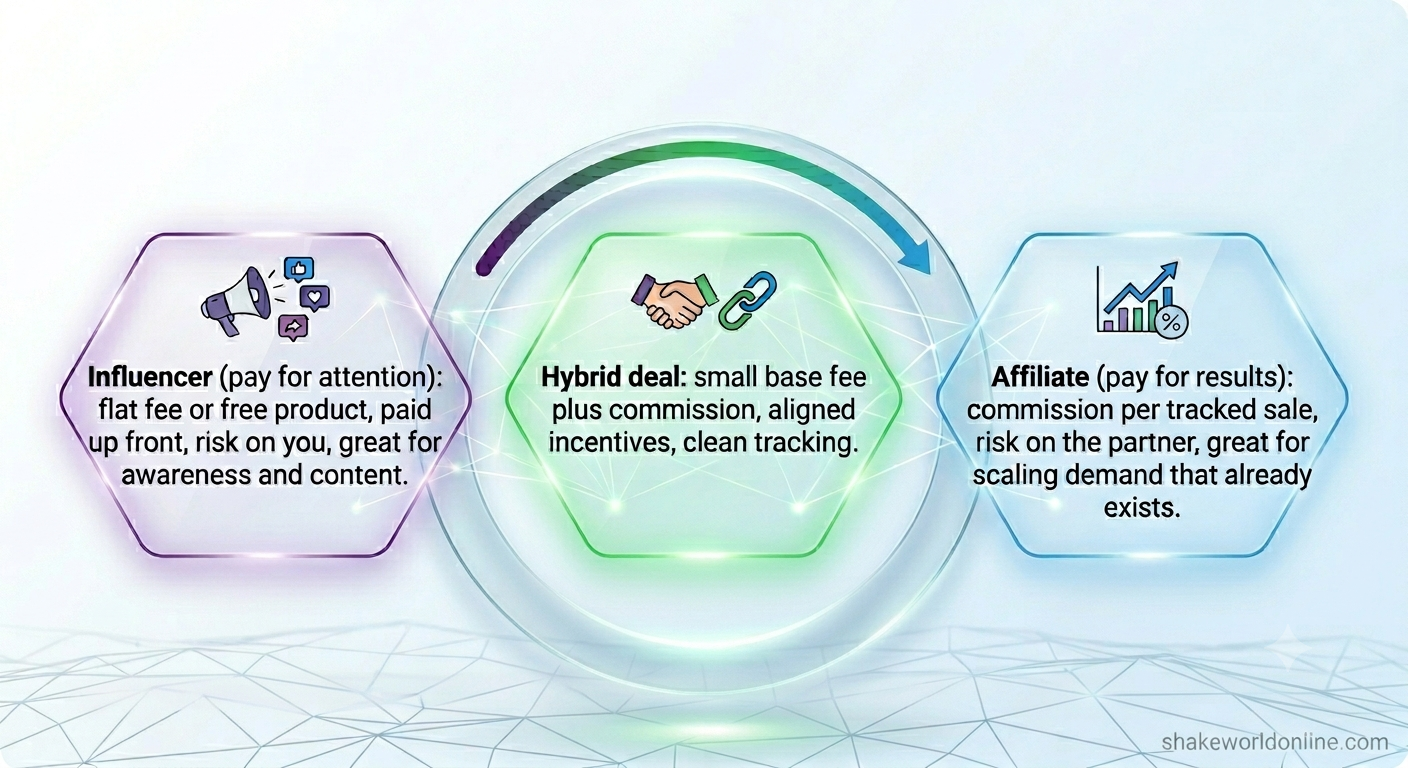
Influencer marketing is paying for attention. You give a creator a flat fee, or send them free product, and in return they feature you to their audience. You pay whether or not a single person buys, which means the risk sits entirely with you. What you get in return is reach, credibility, and something most businesses underrate: a pile of authentic content you can reuse. It is fundamentally an awareness and trust play, and it sits right at the top of your funnel.
Affiliate marketing is paying for results. A partner promotes you using a unique discount code or a tracked link, and they earn a commission only when a sale actually happens. The risk shifts onto them, because if they don't sell, they don't get paid. That makes affiliate marketing a performance play: it is built to drive and scale sales, and it costs you nothing until money comes in.
So influencer marketing pays for attention, and affiliate marketing pays for results. Hold onto that one line, because it explains almost every decision that follows.
Here's the part that ties them together. The moment you hand an influencer a unique discount code, that influencer post quietly becomes a trackable affiliate sale. The line between the two has all but dissolved, and the smartest businesses now run a hybrid: a small base fee so good creators say yes, plus a commission so everyone is rewarded for actual sales. That hybrid, sitting between pure attention and pure results, is where most of your effort should eventually live.
Why Borrowed Trust Works So Well
People do not buy from businesses they have no reason to trust. That is the wall every new brand runs into. You can have a great product and a fair price, and still watch people hesitate, simply because they have never heard of you.
Borrowing trust is how you get over that wall quickly. When a creator your customer already follows vouches for you, they lend you their credibility. The trust they built over years transfers to you in a single recommendation, and the buyer skips the long, slow process of learning to trust a stranger. This is the same force that makes a strong brand make all your other marketing cheaper and easier, which we go deeper on in brand versus performance marketing.
It also fits neatly beside the audience you build yourself. On social media you grow your own following slowly, and you own that relationship. With influencer and affiliate marketing you rent access to an audience someone else already owns. Renting is faster, but you do not keep it, which is exactly why the goal is always to convert that borrowed attention into something you control. More on that shortly.
Influencer vs Affiliate: Which One, and When?
Because they pay for different things, they suit different stages. Choosing wrong is the most common and most expensive mistake here.
Reach for influencer marketing when you are still introducing yourself: a launch, a new market, or any moment when most people simply do not know you exist. It is the right tool when your goal is awareness and trust, when you need fresh content to fuel your other marketing, and when you cannot yet attribute sales cleanly. You are paying to be seen and vouched for, and that is worth real money early on.
Reach for affiliate marketing once you already have demand. If your product is recognisable, people already want it, and the buying decision is quick, affiliate partners can pour fuel on that fire at almost no risk to you. This is the hard truth a lot of founders learn the expensive way: affiliate marketing amplifies demand that already exists, it does not create demand from nothing. For an unknown brand, even a strong creator video often fails to convert, because the audience still hesitates to buy a name they have never heard of.
Here is the side-by-side, so you can place your own business on it.
| Influencer marketing | Affiliate marketing | |
|---|---|---|
| You pay for | Attention and content, up front (a flat fee or free product) | Results only, a commission on each tracked sale |
| Who carries the risk | You. You pay whether or not anyone buys | The partner. They only earn if they actually sell |
| Best for | Awareness, launches, trust, and generating creative | Driving and scaling sales once demand already exists |
| Attribution | Hard. Much of the impact is verbal or delayed | Clear. Codes and links tie each sale to a partner |
| Use it when | You are introducing yourself and need reach and credibility | You have a proven offer and want low-risk growth |
| Main thing to watch | Paying for vanity metrics from creators who cannot sell | Weak traction while the brand is still unknown |
For most businesses the honest sequence is: use influencers first to build awareness and trust, attach affiliate mechanics as soon as you can track sales, and lean harder on affiliate once you clearly have demand. You rarely pick one forever. You move along the spectrum as you grow.
Why Most Influencer Spend Gets Wasted
Now the uncomfortable part. A lot of businesses pour money into creators and see almost nothing back, and it nearly always comes down to the same handful of mistakes.
The biggest one is chasing follower count instead of fit. A creator with a million followers who has nothing to do with your customer will sell less than a creator with ten thousand of exactly the right people. Reach is not the same as relevance, and you are paying for the wrong number.
The second is assuming influencers can sell. Most cannot. They are brilliant at living their lives in an engaging way, but hand them a product and many freeze, either because the fit feels wrong and it shows, or because they simply do not know how to make an offer. Selling is a separate skill from influencing, and outsourcing your selling to someone who has never done it is a gamble.
The third is having no code and no link, which leaves you with no attribution. If you cannot tell which partner drove which sale, you are flying blind and you will keep paying for posts that do nothing. The fourth is paying a flat fee for an unproven offer: if you do not yet know that your offer converts, a creator just sends traffic to a leaky bucket. And the fifth is treating it as a one-off transaction rather than a relationship, when the partners who actually move the needle are the ones you work with repeatedly over months.
Spending on creators but not sure it is working?
Find out whether your influencer and affiliate spend is actually driving sales, and where it is leaking. Get a free audit and we will map your creator strategy, your tracking, and your offer end to end.
Get My Free Audit →How to Run Influencer and Affiliate Marketing That Actually Works
Here is the approach that works today, in order.
1. Prove Your Offer Before You Scale Spend
Before you hand money to creators, make sure the thing you are sending them traffic to actually converts. Test your offer with your own organic content or a small run of Meta ads, and tighten the page it lands on with basic landing page and conversion work. Just as important, know your numbers going in, your cost to acquire a customer and the lifetime value of one, so you can later tell a profitable partnership from a flattering one. If you are unsure how to measure that, start with analytics and attribution.
2. Pick Creators for Fit, Not Follower Count
Choose partners whose audience is your ideal customer, which means you first need to be clear on who that is, the heart of your ideal customer profile and positioning. As a rule, smaller often wins. Nano and micro creators, roughly five to fifty thousand followers, carry the highest trust, because their audiences treat them like a knowledgeable friend. Mid-tier creators, around fifty to two hundred thousand, are frequently the sweet spot: large enough to move volume, small enough to genuinely use your product and keep an engaged audience. Before you pay anyone, look past the follower number at whether their comments are real conversations and whether their audience actually matches yours.
3. Always Attach a Code and a Tracked Link
This is the habit that changes everything, and it is the bridge between influencer and affiliate marketing. Give every single partner a unique discount code and a tracked link. The code gives their audience a reason to act now, and both together let you see exactly which partner drove which sale. The moment you do this, a fuzzy influencer post becomes a measurable affiliate result, and you can stop guessing about what is working.
4. Structure the Deal as a Hybrid
Once you can track sales, move toward the hybrid model: a smaller base fee plus a commission on every sale through their code. The base fee is what gets good creators to say yes, especially while you are still building recognition. The commission keeps them motivated to actually sell rather than just post and forget. Early on, when nobody knows you, expect to pay more up front, because unproven brands rarely attract strong partners on commission alone. As your recognition grows, you can tilt the deal further toward performance.
5. Turn Creator Content Into Ad Fuel
This is the move most businesses miss, and it quietly doubles your return. The authentic videos a creator makes for you are often far better ad creative than anything polished you would produce in-house. So take that content, with permission, and run it as paid social ads. You get a native-feeling advert that you can target precisely and scale on demand, which means a single creator partnership feeds both organic reach and paid performance.
6. Build a Real Affiliate Program, Not a Pile of One-Offs
If affiliate marketing is going to be more than the occasional code, treat it like a program. That means clear terms, reliable tracking, and prompt, accurate payouts, because the fastest way to lose good partners is to pay them late or wrongly. A simple affiliate tool that handles codes, sales tracking, and payments will save you from drowning in spreadsheets as your partner count grows. And do not overlook the partners already in front of you: happy customers, who can earn a commission for referrals, and locally that often runs beautifully through WhatsApp, where a trusted personal recommendation does the heavy lifting.
7. Funnel Borrowed Attention Into Something You Own
Never forget that the audience you are reaching belongs to the creator, not to you. The whole point is to convert that borrowed attention into a relationship you control. So make the next step a move onto your turf: joining your email list, saving your WhatsApp number, following you, or buying directly. That way, even after the campaign ends and the creator moves on, you keep the customer. And nurture the partners themselves, because a creator you work with repeatedly, who genuinely likes your product, becomes worth far more over time than a string of strangers you hire once.
Want a creator program that pays for itself?
Picking the right creators, structuring hybrid deals, and wiring up tracking so every code and link is measured is a lot of moving parts. We build and run influencer and affiliate programs for businesses every day.
Work With Shakeworld →A Few Honest Truths About Influencer and Affiliate Marketing
Before you dive in, here are the realities the hype skips.
Most influencers cannot sell, so do not hand them your selling. They can build awareness and lend you trust, but the actual conversion usually depends on your offer, your page, and your follow-up. Treat creators as the top of your funnel, not the whole machine.
Affiliate marketing amplifies demand, it does not create it. If your brand is still unknown, do not expect commission-only deals to produce sales. Build recognition first, then let affiliates pour fuel on a fire that is already lit.
Attribution is genuinely hard, so do not judge on last-click alone. A great deal of real impact is invisible: someone hears your name in a video, searches for you a week later, and buys directly, and no code ever captures it. Watch whether your overall sales, branded searches, and audience are growing, not just which codes fired.
It is relationship work, not a vending machine. You do not put in money and get sales out automatically. The partnerships that pay off are nurtured over months, with the right people who actually like what you sell.
Vanity metrics and fake followers will burn you. Bought followers and engagement pods make an account look impressive and sell nothing. Audit real engagement and audience fit before you pay, and a small genuine audience will beat a large hollow one every time.
Frequently Asked Questions
Both borrow someone else's trusted audience, but they pay for different things. Influencer marketing pays for attention: you give a creator a flat fee or free product to feature you, and you pay whether or not anyone buys, so the risk sits with you. Affiliate marketing pays for results: a partner earns a commission only when a sale actually happens through their unique link or discount code, so the risk sits with them. In plain terms, influencer marketing is brilliant for awareness, trust, and generating content, while affiliate marketing is built to drive and scale sales once demand already exists. The smartest modern setups combine the two into a hybrid deal, a small base fee plus a commission, so good creators say yes and everyone is rewarded for actual sales.
Early on, when nobody knows you yet, expect to pay a flat fee or send free product, because unproven brands rarely get strong creators to work on commission alone. Once you have a proven offer and some recognition, shift toward a hybrid: a smaller base fee that gets the creator on board, plus a commission on every sale tracked through their code or link. The hybrid is the sweet spot because it lowers your upfront risk, keeps the creator motivated to actually sell rather than just post, and gives you clean attribution. Pure commission only works reliably once your product has real demand, since the creator is betting their effort on your brand converting.
For most businesses, smaller creators win. Nano and micro creators, roughly five thousand to fifty thousand followers, tend to have far higher trust and engagement, and their audiences treat a recommendation as advice from a friend rather than an advert. Mid-tier creators, around fifty thousand to two hundred thousand, are often the real sweet spot: big enough to move volume, small enough to genuinely use your product and have an engaged audience. Mega creators and celebrities deliver reach but rarely direct sales, and they cost a fortune. The thing that matters more than size is fit: a creator whose audience is exactly your ideal customer will outsell a much larger account every time. Choose for audience fit, not follower count.
Usually not on its own, and this trips up a lot of founders. Affiliate marketing amplifies demand that already exists, it does not create it from nothing. When a creator promotes a brand people already trust, sales follow quickly because the buying decision is easy. When the brand is unknown, even a good creator video often fails to convert, because the audience still hesitates to buy from a name they have never heard of. So if you are new, use creators first for awareness and trust building, and lean on a flat fee or hybrid deal rather than expecting pure commission to produce sales. Once you have product-market fit and some recognition, affiliate marketing becomes a genuinely powerful, low-risk way to scale.
Give every partner a unique discount code and a tracked link, and you turn a vague influencer post into a measurable affiliate sale. That is the single most important habit, because without it you are guessing. But hold two things in mind. First, a lot of real impact is invisible to last-click tracking: someone hears your brand mentioned in a video, searches for you a week later, and buys directly, which your code never captures. Second, judge the channel by whether your overall sales, branded searches, and audience are growing, not only by the codes that fired. Know your numbers going in, your cost per acquisition and customer lifetime value, so you can tell a profitable partnership from a flattering one. For the full picture, lean on proper analytics and attribution.
The Bottom Line
Influencer and affiliate marketing are two ways of borrowing other people's trusted audiences. One pays for attention, the other pays for results, and the modern play combines them into a single hybrid system.
Prove your offer before you scale spend. Pick creators for fit, not follower count. Put a unique code and tracked link on everything, so attention becomes measurable. Structure deals as a base fee plus commission. Turn creator content into ad fuel, build a proper affiliate program, and funnel every bit of borrowed attention into channels you own.
Do that, and you stop paying strangers for likes and start renting exactly the right trust, from exactly the right people, and turning it into customers who stay.
Ready to put other people's trust to work?
You have the playbook. If you would rather have a team find the right creators, structure the deals, and build the tracking that proves it works, that is what we do at Shakeworld Digital.
Get Your Free Audit →This is one piece of the bigger picture. To see how it all fits together, start with the complete guide to online marketing, then pair this with social media marketing (the audience you build yourself), content marketing (the useful content creators and audiences are drawn to), Meta ads (where creator content becomes scalable paid reach), landing pages and CRO (where the borrowed trust turns into a sale), email marketing and WhatsApp marketing (the owned channels you funnel attention into), ideal customer profile and positioning (who all of this should speak to), and marketing analytics and attribution (so you can see what is really working).
And if you would like a team to find the right creators, structure deals that pay for themselves, and build the tracking that proves it, that is exactly what we do at Shakeworld Digital. Get a free marketing audit and we will show you where your creator spend is leaking and how to turn it into customers.
Written by Popmati Samson, Founder of Shakeworld Digital, systems builder, and AI entrepreneur. I help businesses borrow the right people's trust and turn it into customers who stay.