

A/B Testing and Experimentation: Stop Guessing, Let Your Customers Decide
 By Popmati Samson
9 min readUpdated 2026
By Popmati Samson
9 min readUpdated 2026In 2007, the Obama campaign's experts were certain a video of the candidate speaking would win the most sign-ups on their website. So they tested it against a few photos, just to be sure. Every single video lost. A simple photo of Obama with his family, paired with a button that said Learn More, beat them all.
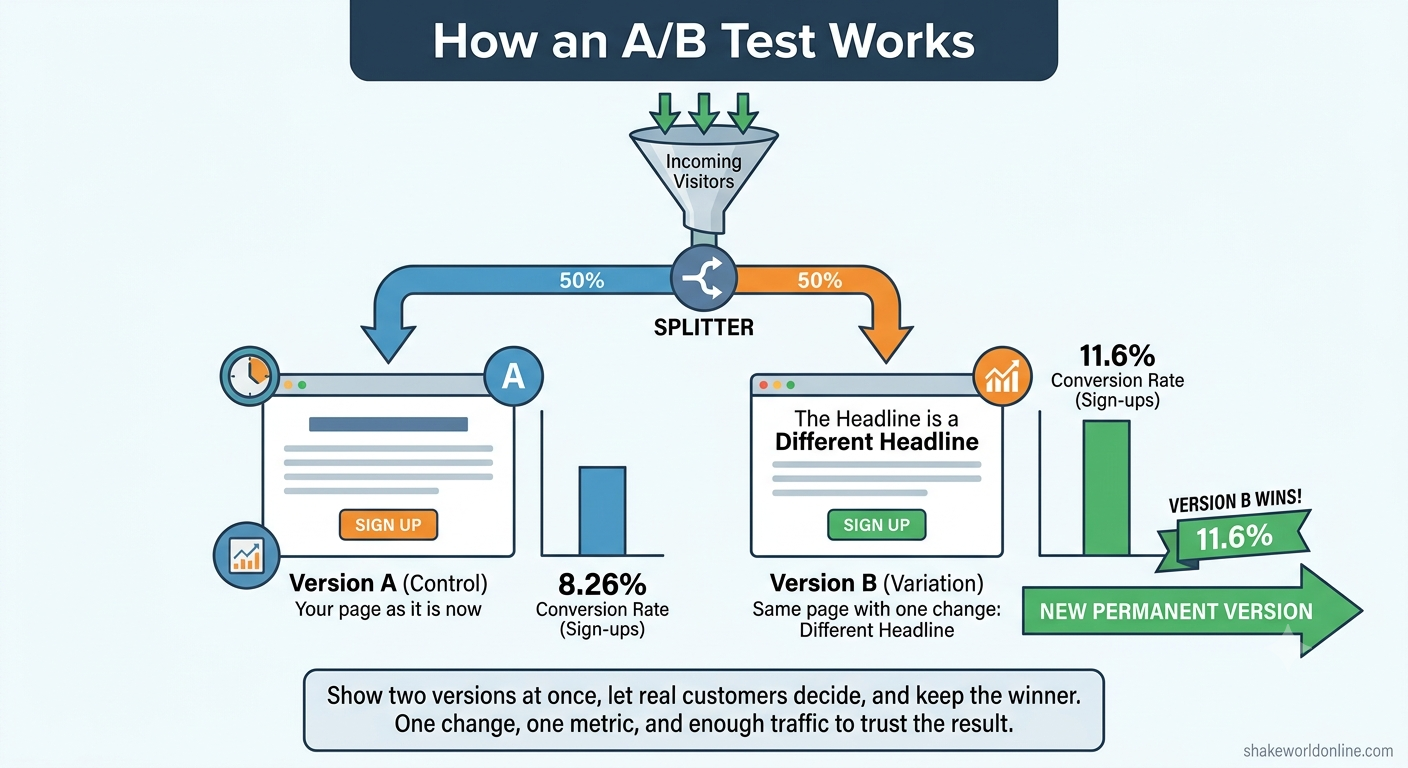
That one change lifted the sign-up rate from 8.26 percent to 11.6 percent. By the campaign's own estimate, it brought in around 2.88 million more email sign-ups and roughly $60 million more in donations. The experts had been confidently wrong, and only a test revealed it.
Show people two versions of something, let their behaviour pick the winner, and keep it. It replaces I think and the expert says with the customers showed us.

What A/B Testing Really Is
You take what you have now and call it Version A, the control. You make one change and call it Version B. Then you show A to half your visitors and B to the other half, at the same time, and measure which one gets more of the result you want, more sign-ups, more sales, more clicks on the button that matters. The winner becomes your new normal. Then you do it again.
Experimentation is just the wider habit: treating every change as a question to be answered with evidence rather than a decision to be argued about. Instead of the loudest person in the room deciding what your homepage says, your actual customers decide, by what they do.
And that matters because, as the Obama story shows, opinions are often wrong, including expert ones. Testing is how you find out before you bet real money on a hunch.
Why It Works
Most tests do not produce a clear winner, and that is normal. In one large analysis of thousands of experiments across more than 90 brands, all judged at the standard 95 percent confidence level, about 36 percent of tests produced a statistically significant winner, around 22 percent produced a clear loser, and the remaining 42 percent were inconclusive. So roughly two-thirds of the time, a test either tells you your idea was wrong or tells you nothing definitive at all.
That sounds discouraging until you see it the right way. Every clear loser is a mistake you did not ship. Every inconclusive test is a reminder that the change you were sure about did not actually matter. And the winners, even modest ones, compound. The Obama test was a single experiment worth tens of millions; most are worth a few percent, but a steady stream of a few percent is exactly how strong businesses pull away from lazy ones.
One honest warning from the data: if a test ever shows a wildly good result, like a doubling, be suspicious. Analysts have a name for it, Twyman's Law, and roughly one in thirteen tests lands in that too-good-to-be-true zone, where the cause is usually a tracking bug, not a miracle. Real wins are usually quiet.
What Makes a Test You Can Trust
The difference between a test that guides you and a test that misleads you comes down to a few simple disciplines.
| A test you can trust | A test that will fool you | |
|---|---|---|
| The change | One clear change at a time | Five things changed at once |
| The metric | One main metric, chosen before you start | Whichever number looks best afterwards |
| The traffic | Enough visitors to reach 95% confidence | A trickle, called a winner anyway |
| The timing | Runs to a set end date | Stopped the moment B pulls ahead |
| The result | A decision you can act on | A coin flip dressed up as data |
The two that trip people up most are traffic and timing. Under-powered tests, ones without enough visitors, are the most common mistake in the entire field, which is why guidance often points to needing somewhere in the range of 10,000 to 50,000 visitors to detect a normal change reliably. And stopping a test the moment Version B is ahead is a form of self-deception: early leads swing wildly and often reverse. Set your end point in advance, run to it, and only trust a result at around 95 percent confidence. Anything less and you are reading tea leaves.
Why Most Small Businesses Get This Wrong
Here is where I have to be straight with you, because most A/B testing advice quietly ignores it.
The classic mistakes are familiar: changing five things at once so you cannot tell what worked, picking the flattering metric after the fact, calling a winner after 50 visitors and two days, or running several overlapping tests that pollute each other's results. All of those turn a test into theatre.
But the biggest one for a small business is simpler and more uncomfortable: you may not have the traffic to run a real A/B test at all. The maths does not care how much you want a clean answer. If a hundred people see each version, the numbers will bounce around so much that whatever looks like a winner is mostly chance. Pretending otherwise is worse than not testing, because you will then make confident decisions based on noise. Knowing this is not a failure; it is the single most useful thing in this article, because it stops you wasting weeks chasing certainty your traffic cannot give you.
Not sure what is worth testing?
Find out which pages and which changes would actually move your numbers, and which ones your traffic can realistically prove. Get a free audit and we will point you at the experiments most likely to pay off.
Get My Free Audit →How to Run an A/B Test That Actually Works
Here is the process, in order, built to keep you honest and to fit a real, traffic-limited business.
1. Start With a Real Hypothesis, Not a Whim
Before you touch anything, write down a clear sentence: if we change X, then metric Y will improve, because Z. Base the Z on something real, a drop-off you can see in your analytics, a complaint you keep hearing, a step where people abandon. A test built on a genuine hunch about your customers beats a test built on a random idea every time, and writing it down first stops you from quietly moving the goalposts later.
2. Change One Thing at a Time
This is the rule that makes the whole thing work. If you change the headline, the image, and the button all at once and sign-ups rise, you have learned nothing, because you cannot tell which change did it. Change one element, learn one clear lesson, then move to the next. The only exception is a deliberate, all-or-nothing redesign, where you are testing the whole new page as a single bet, not trying to learn what specifically worked.
3. Pick One Metric Before You Start
Decide, in advance, the single number that defines winning, and make it one that matters to the business, a lead or a sale, not a vanity number like clicks. Then watch one or two guardrail metrics too, so a change that lifts sign-ups but quietly tanks your sales gets caught. Choosing the metric beforehand is what stops you from hunting through the results afterwards for any number that happened to go up.
4. Test Things That Actually Matter
Spend your limited traffic on changes big enough to move the needle, on pages busy enough to measure. Test a genuinely different headline or offer on your top landing page, not the colour of a button on a page three people visit. The bolder the change and the busier the page, the better your odds of getting a result you can actually read. Timid tests on quiet pages are how testing programmes die of boredom.
5. Split Fairly and Run Long Enough
Send visitors to A and B at random and at the same time, so weekends, paydays, and ad campaigns hit both versions equally. Then run it to the end date you set, ideally a few weeks, and resist the urge to peek and call it early. Remember the benchmark: enough visitors to reach 95 percent confidence, with real tests often running around six weeks. Patience here is not a virtue, it is the difference between a fact and a guess.
6. Read the Result Honestly
When it ends, accept what it says: winner, loser, or inconclusive. Most will not be clear winners, and that is fine. Then look one level deeper, because the gold is often in the segments: a change that did nothing overall might have lifted mobile users sharply while hurting desktop. Those splits are where your next, smarter test comes from. And if a result looks too good to be true, check your tracking before you celebrate.
7. Ship the Winner, Then Test Again
Roll out what won, and immediately look for the next thing to test. That is the whole point: experimentation is a habit, not a one-off project. Apply it everywhere, your email subject lines, your ad headlines, your forms, your offers. Small, steady improvements, compounded across every channel, are how an ordinary business slowly becomes a hard one to beat.
Want testing done properly?
Designing tests that are statistically sound, running them long enough, and reading the results honestly is easy to get wrong. We run experimentation for businesses, so the changes you ship are backed by evidence, not opinion.
Work With Shakeworld →A Few Honest Truths About A/B Testing
Before you start, here are the realities the case studies skip.
Your opinion is often wrong, and so is the expert's. That is the entire point of testing. Obama's team was certain about the video, and the data quietly proved them wrong. Hold your ideas loosely and let the customers settle it.
Most tests will not win, and that is healthy. Only about a third produce a clear winner. Chase learning, not a perfect scoreboard; every loser is a mistake you avoided shipping.
No traffic, no clean stats. A real test needs real volume. If you do not have it, test only big swings on your busiest page, or fall back on honest before-and-after judgement, and never dress up a coin flip as proof.
Stopping early is lying to yourself. Early leads swing and reverse. Set the end date before you begin, run to it, and trust the result only at around 95 percent confidence.
Small lifts compound. A steady habit of three and five percent wins across your pages, emails, and ads will beat one heroic redesign you only do once.
Frequently Asked Questions
A/B testing means showing two versions of something, your current version (A) and one changed version (B), to different people at the same time, then seeing which performs better on a goal you care about. Whoever wins, you keep. That is the whole idea. It matters because it replaces opinion with evidence. Instead of arguing about which headline or button is better, you let real customers vote with their behaviour. The famous example is the 2008 Obama campaign: their experts were convinced a video would win, but when they actually tested it, a simple family photo with a Learn More button beat every video, lifting sign-ups from 8.26 percent to 11.6 percent, and by the team's own estimate that single experiment raised roughly $60 million more in donations. Nobody guessed that. The test revealed it.
Long enough to trust the result, which is almost always longer than people expect. Two things make a test trustworthy: enough visitors and enough time. On traffic, under-powered tests are the single most common mistake in the whole field, and industry guidance suggests you really want somewhere around 10,000 to 50,000 visitors per test to detect a normal-sized change reliably. On time, decide the end date before you start and run to it, rather than stopping the moment version B pulls ahead. In practice, real tests often run for weeks; one large dataset put the median at around six weeks. The standard for calling a winner is 95 percent statistical confidence. If you stop early because the numbers look good, you are not measuring, you are fooling yourself.
Test something that actually matters, on a page that actually gets traffic. The biggest waste is testing tiny things, like a button colour, on a page almost nobody visits, because a small change on low traffic will never produce a clear result. So start with your highest-traffic, highest-stakes page, usually a key landing page or your checkout, and test a bold change rather than a timid one: a completely different headline, a different offer, a different main image, a shorter form. The bigger the change, the bigger the effect you can actually detect with the traffic you have. Begin with one clear idea about that one page, prove it, then move to the next.
Honestly, often not in the strict statistical sense, and it is far better to know that than to fool yourself. A clean A/B test needs a fair amount of traffic to reach reliable numbers, and most small businesses simply do not have it. Calling a test of 80 visitors a winner is worse than not testing at all, because you will then make confident decisions based on noise. So here is the honest path for low traffic: test only big, bold changes that could produce a large effect; run them on your single busiest page; let them run for weeks, not days; and where the numbers are too thin to trust, fall back on a careful before-and-after comparison plus good judgement, while being clear with yourself that it is directional, not proof. Test what you can, and never dress up a coin flip as data.
Not to start. Many of the channels you already use, your email platform, your ads manager, and a lot of website and landing-page builders, have simple A/B testing built in, and that is plenty for your first experiments. The advice from people who do this for a living is consistent: do not build your own testing system from scratch, and do not overspend on a powerful platform before you have proven the habit. Begin with the free or built-in option, run a few real tests, and move to a dedicated paid tool only once your traffic and your appetite for testing genuinely outgrow what you have. As with most of this, the discipline matters far more than the software.
The Bottom Line
A/B testing is how you stop guessing and let your customers decide. You show two versions, let real behaviour pick the winner, keep it, and do it again. It is the discipline that turns marketing from a series of confident hunches into a system that gets measurably better over time.
Start with a real hypothesis. Change one thing. Pick one metric before you begin. Test bold changes on busy pages, split fairly, and run long enough to trust the number. Read the result honestly, ship the winner, and start again. And if your traffic is too thin for clean statistics, be honest about it and test what you can, rather than fooling yourself with noise.
Ready to let evidence decide?
You have the playbook. If you would rather have a team design the tests, run them properly, and turn the results into changes that grow your revenue, that is what we do at Shakeworld Digital.
Get Your Free Audit →This is the final piece of the Online Marketing hub, and it ties the whole thing together. Start with the complete guide to online marketing to see the full picture, then apply testing across everything you have built: your landing pages and CRO (where most testing pays off fastest), your email marketing and Google Ads and Meta ads (test headlines, offers, and creative), your lead generation forms, and your content. Hold it all together with marketing automation and a CRM, measure it honestly through analytics and attribution, and keep it pointed at the right people with clear positioning.
And if you would like a team to design the experiments, run them properly, and turn the winners into real growth, that is exactly what we do at Shakeworld Digital. Get a free marketing audit and we will show you what is worth testing first.
Written by Popmati Samson, Founder of Shakeworld Digital, systems builder, and AI entrepreneur. I help businesses replace guesswork with evidence and improve a little every week.