

Retargeting and Remarketing: Win Back the People Who Almost Bought
 By Popmati Samson
10 min readUpdated 2026
By Popmati Samson
10 min readUpdated 2026Retargeting is showing ads to people who already interacted with you, visited your site, watched your video, added something to their cart, but didn't buy. Instead of chasing strangers, you go back to the people who already raised their hand.
It's one of the highest-return moves in all of marketing, for a simple reason: these people already know you. They're not cold. They're warm, and warm people convert far more cheaply than strangers. Done right, retargeting brings back customers you'd otherwise have lost forever.
But it's also one of the easiest things to get wrong, and a privacy-changed, automation-heavy world has rewritten the rules. Let me show you how it actually works now, in plain terms.
What Retargeting Actually Is (and How It Works)
You've felt retargeting yourself. You look at a pair of shoes online, don't buy, and for the next week those shoes follow you around Instagram and across websites. That's retargeting.
Here's how it works under the hood, simply. A small piece of code (a "pixel") on your website quietly notes when someone visits, and what they did, viewed a product, added to cart, and so on. The ad platform builds an audience from those tagged people. Then you can show ads specifically to that audience later, across the platform's network. The same idea works from engagement that lives on the platform itself, like people who watched your video or interacted with your posts, and from your own customer lists.
A quick note on words: "retargeting" and "remarketing" mean almost the same thing and are used interchangeably. Some people use "remarketing" for email-based re-engagement and "retargeting" for ads that follow people around. Don't worry about the label; the principle is identical, re-engage people who already showed interest.
I'm Popmati Samson, founder of Shakeworld Digital. I've run retargeting for product and service businesses, and I'll be honest up front: most people set it up lazily and either waste money or annoy their best prospects. The good news is that doing it well isn't complicated once you understand a few principles. Let me walk you through them.
Why Retargeting Is So Powerful
First, why it works. At any moment, only a tiny slice of people, often estimated at just a few percent, are ready to buy right now. Most people who show interest aren't ready yet. Retargeting is how you stay in front of that majority until they are, so when the moment comes, you're the obvious choice rather than a forgotten tab.
The numbers back this up. Studies suggest retargeted visitors convert at far higher rates than people seeing a cold ad, and retargeting campaigns typically return more per naira than cold prospecting, because you're talking to people who already know you.
But here's why it's so easy to waste:
The audience is small and burns out fast. Unlike cold prospecting, your retargeting pool is finite, only as big as the number of people who've recently interacted with you. Pour too much budget into it and you'll show the same people your ad over and over, frequency spikes, they get annoyed, and performance collapses within days.
Lazy retargeting retargets junk. If you simply retarget "everyone who visited the site," you're also retargeting bots, accidental clicks, and people with zero real interest. The quality of your retargeting is decided entirely by the quality of the pool you build.
Generic "you forgot something" ads ignore why people actually hesitated. The classic abandoned-cart reminder assumes price or forgetfulness was the blocker. Usually it wasn't.
Losing people who almost bought?
Find out where your warm prospects slip away, and how to win them back. Get a free audit and we will map your retargeting opportunities.
Get My Free SEO Audit →How to Run Retargeting That Actually Pays
Here's the practical playbook. Follow these in order.
1. Build a Quality Pool, Not Just "Anyone Who Visited"
This is the single biggest lever, and it's where most people go wrong. Your results are decided by who you put in the pool, not by clever ad tweaks afterwards.
The strongest move is to build your retargeting audience from people the platform has already identified as likely buyers. For example, run your main cold campaign optimised for sales using video, and then retarget the people who watched those videos. Because the campaign was optimising for purchases, those viewers are people the algorithm already judged to be purchase-minded, a far higher-quality pool than random site visitors. As a bonus, this also filters out bots, because most junk traffic doesn't watch videos. A purchase-minded human filter plus a bot filter, in one move.
2. Tier Your Audiences by How Close They Got to Buying
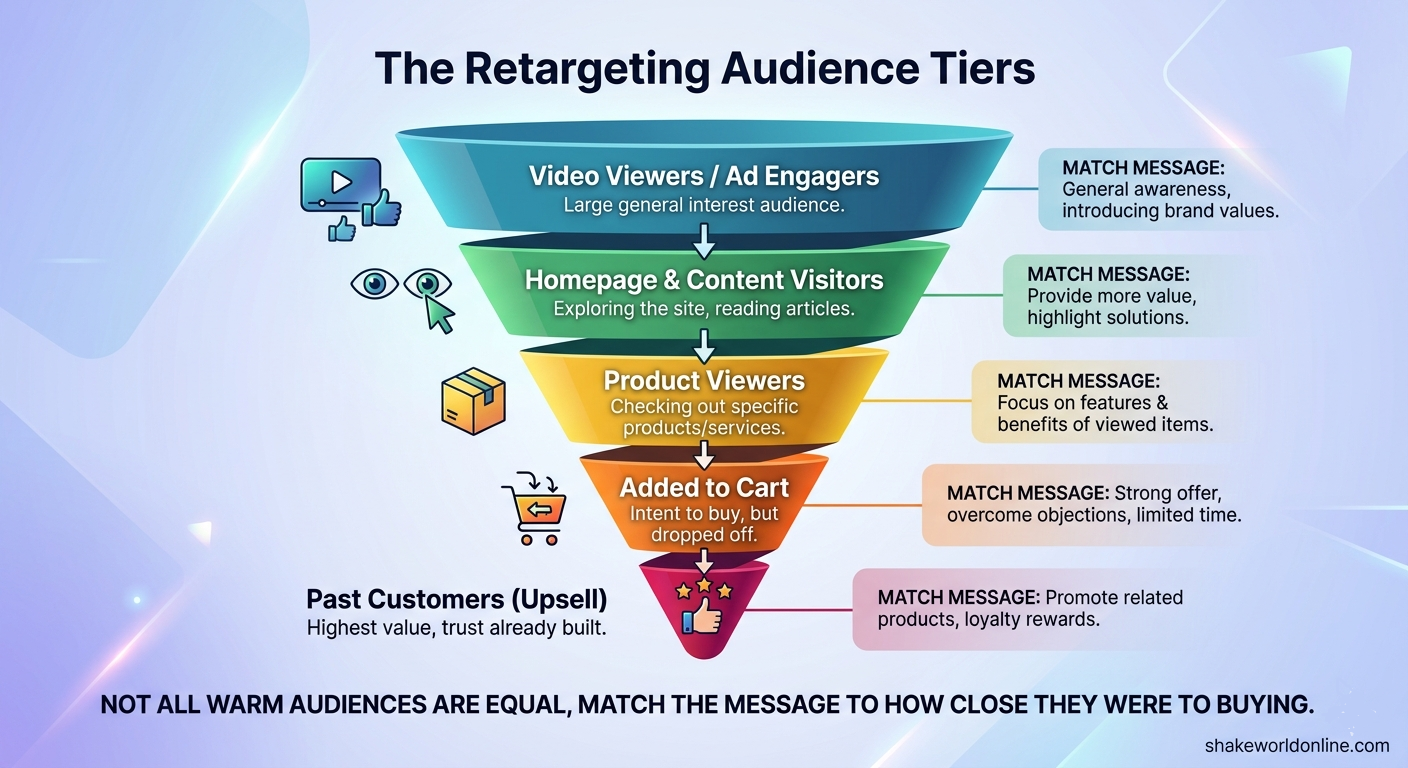
Don't treat everyone the same. Someone who added an item to their cart is much closer to buying than someone who glanced at your homepage. Split your warm audience into tiers and speak to each differently.
A simple ladder: video viewers and ad engagers (coolest), then content and homepage visitors, then product viewers, then add-to-carts, then past customers (warmest). The closer someone got to buying, the stronger and more direct your offer can be. The further away, the more you focus on building trust. Matching the message to the stage is what separates retargeting that converts from retargeting that irritates.
3. Break the Real Objection, Don't Just Say "Come Back"
This is where retargeting creative quietly wins or loses. People rarely fail to buy because they "forgot." They fail to buy because of a specific doubt: "this probably won't work for me," "it's too expensive," "is this brand even legit," "I'll do it later."
So build retargeting ads that each tackle one specific objection head-on. One ad answers the trust doubt with testimonials and proof. Another answers the "will it work for me?" doubt with a relatable example. Another removes risk with a guarantee. This belief-breaking approach dramatically outperforms the generic "still thinking about it?" reminder, because it actually addresses the reason the person hesitated. Pair it with social proof, a clear demo, or a time-limited offer for the warmest tiers.
4. Keep It Lean and Cap the Frequency
Retargeting is a scalpel, not a fire hose. Because the audience is small, restraint is the skill.
Keep your windows tight, recent visitors (say the last 7 to 14 days) are far more valuable than someone who wandered by two months ago. Cap how often the same person sees your ad; a handful of times a week is plenty, and pushing past that just burns goodwill and money. And always exclude people who already bought (unless you're deliberately upselling them), there's nothing worse than paying to advertise something to someone who just purchased it. Lean, recent, and frequency-capped beats big and relentless every time.
5. Don't Expect Retargeting to Be Your Growth Engine
Here's an honest truth that surprises people: retargeting is a profitable pocket, but it's rarely where the real growth comes from. Your growth comes from prospecting, finding new people. Retargeting can only convert the people prospecting brings in; it can't create new demand.
This has two implications. First, your retargeting pool is only as big as your prospecting feeds it, so the way to "scale" retargeting is actually to scale the cold campaigns filling the top. Second, don't pour budget into retargeting expecting it to grow your business; a common, sensible split is to put the large majority into prospecting and a smaller slice (often around 10 to 20%) into retargeting. Retargeting cleans up and converts. Prospecting grows. You need both, but don't confuse their jobs. This connects directly to your media buying and budget and channel mix.
6. Build on Data You Own, Because Tracking Keeps Shrinking
The ground under retargeting has shifted. Privacy changes, cookie restrictions, and ad blockers have made the old "pixel everyone who visits" approach leakier every year. The fix isn't a clever workaround; it's building on sturdier ground.
Lean on signals that don't depend on fragile browser tracking: engagement that lives on the platform (video views, people who interacted with your ads or page) and, above all, your own customer data, your email and messaging lists. A list of people who gave you their contact details is a retargeting audience nobody can take away from you, and you can re-engage them by ads and by email directly. Feeding the platforms your own clean first-party data (through proper server-side tracking) is now the durable edge. The businesses winning at retargeting aren't the ones who found a tracking loophole; they're the ones who built an audience they own.
Want retargeting that pays, not annoys?
Profitable retargeting takes a quality audience, objection-breaking creative, and tight frequency working together. We build and run retargeting for businesses every day.
Work With Shakeworld →A Few Honest Truths About Retargeting
Let me give you the balanced view.
Retargeting isn't dead, but lazy retargeting is. You'll hear people say retargeting "doesn't work anymore" since the privacy changes and the rise of automated campaigns. What's actually true is that the old, rote version, slap a 30-day site-visitor campaign on everything, works far worse now. Thoughtful retargeting, good pool, tiered audiences, objection-breaking creative, still delivers some of the best returns in marketing.
Automation may already be retargeting for you. Modern AI-driven campaigns often reach your recent visitors automatically as part of their normal hunting. That means a clumsy separate retargeting campaign can overlap and bid against your own ads. The honest move is to retarget deliberately, with tight, distinct audiences and different creative, rather than blindly bolting on a generic retargeting campaign out of habit.
Don't trust the platform's retargeting numbers blindly. Retargeting ads love to take credit for sales that would have happened anyway, the person was already going to buy; the ad just happened to be the last thing they saw. Judge retargeting by whether your overall, blended results improve when it's running, not by the rosy figure the platform reports. Measure the lift, not the last click. This is the heart of marketing analytics and attribution.
The message matters more than the targeting now. In the old days, precise tracking did the heavy lifting. Today, with targeting blurrier, what you say carries the weight. A warm audience seeing a sharp, objection-breaking message beats a perfectly-tracked audience seeing a lazy "come back" ad.
Frequently Asked Questions
Almost nothing; the terms are used interchangeably. Both describe showing ads or messages to people who already interacted with your brand but did not convert. Some marketers use 'remarketing' specifically for email-based re-engagement of existing contacts and 'retargeting' for ads that follow people around the web and social platforms, and Google confusingly uses 'remarketing' for what others call retargeting. Do not get stuck on the label, the principle is identical: re-engage people who already showed interest, because they are far warmer and convert far more cheaply than total strangers.
A small piece of code called a pixel on your website notes when someone visits and what they did, viewed a product, added to cart, and so on. The ad platform builds an audience from those tagged people, and you then show ads specifically to that audience later across the platform's network. The same idea works from engagement that lives on the platform itself, such as people who watched your video or interacted with your posts, and from your own customer lists uploaded to the platform. Because privacy changes and ad blockers have made browser pixels leakier, engagement-based and first-party (your own data) audiences have become more reliable than pixel tracking alone.
Usually a minority, often around 10 to 20% of your ad budget, with the large majority going to prospecting that finds new people. This surprises beginners, but retargeting is a profitable pocket rather than a growth engine: it can only convert the people prospecting brings in, it cannot create new demand. Your retargeting pool is also finite, only as big as recent interactions, so over-funding it just shows the same people your ad too often, spiking frequency and fatigue. The way to genuinely 'scale' retargeting is to scale the cold campaigns feeding the top of your funnel.
Two things: a quality audience and objection-breaking creative. For the audience, build your pool from people the platform already identified as likely buyers (for example, viewers of a purchase-optimized video campaign) rather than just anyone who visited, which also filters out bots. For creative, stop running generic 'you forgot something' reminders, because people rarely fail to buy from forgetfulness. They hesitate over a specific doubt: trust, price, 'will this work for me,' or 'I'll do it later.' Build ads that each tackle one objection directly with proof, a relatable example, or a guarantee, and tier your audiences so the message matches how close each person got to buying.
Yes, but lazy retargeting is not. The old approach of slapping a 30-day site-visitor campaign on everything works far worse now that cookies, privacy rules, and ad blockers have shrunk pixel audiences, and modern automated campaigns may already reach your visitors, so a clumsy separate campaign can overlap and bid against your own ads. Thoughtful retargeting still delivers some of the best returns in marketing: build on durable signals (platform engagement and your own email and customer lists), keep audiences tight and frequency-capped, use objection-breaking creative, and judge it by whether your blended results improve when it runs, not by the platform's flattering last-click numbers.
The Bottom Line
Retargeting is how you win back the people who almost bought, and it's some of the highest-return spend in marketing, when you do it right.
Build a quality pool, not just "anyone who visited." Tier your audiences by how close they got to buying, and match the message to the stage. Break the real objection instead of just nagging people to come back. Keep it lean, recent, and frequency-capped. Don't expect it to grow your business, that's prospecting's job, retargeting converts. And build on data you own, because browser tracking only gets leakier.
Get this right and retargeting stops being an annoying afterthought and becomes a quiet, reliable profit center, turning the people who almost bought into the people who did. That's the whole point.
This is one piece of the bigger picture. To see how it all fits together, start with the complete guide to online marketing, then pair this with media buying (the discipline this sits inside), Meta Ads and Google Ads (where you'll run it), the marketing funnel (the journey you're moving people through), landing pages and conversion optimisation (where the click becomes a sale), email marketing (the audience you truly own), and marketing analytics and attribution (so you measure the real lift).
And if you'd like a team to build and run retargeting that turns near-misses into customers, that's exactly what we do at Shakeworld Digital. Get a free marketing audit and we'll show you who you're losing and how to win them back.
Written by Popmati Samson, Founder of Shakeworld Digital, systems builder, and AI entrepreneur. I help businesses turn the people who almost bought into the people who did.
Ready to win back near-misses?
You have the playbook. If you would rather have a team build and run retargeting that turns near-misses into customers, that is what we do at Shakeworld Digital.
Get Your Free SEO Audit →