

Google Ads and PPC: Real Results From Paid Search
 By Popmati Samson
10 min readUpdated 2026
By Popmati Samson
10 min readUpdated 2026Google Ads is how you put your business in front of people at the exact moment they search for what you sell. PPC, pay-per-click, means you only pay when someone clicks your ad.
That's the magic and the danger. Done right, you reach buyers with their hand already up, ready to act. Done wrong, you hand Google your money and get clicks that never turn into customers.
The good news: the difference between those two outcomes comes down to a handful of principles that don't change, no matter how many times Google updates the platform. Let me walk you through them in plain terms.
What Google Ads Actually Is (and Why Intent Is Everything)
Here's the simplest way to understand it. When someone types "emergency plumber near me" into Google, that person isn't browsing. They have a burst pipe and a wallet open. Google Ads lets you appear right at the top of that search, the instant the need is real.
That's the whole point of paid search, and it's what makes it different from almost every other channel. Other channels interrupt people who weren't thinking about you. Search ads meet people who are actively looking. You're not creating demand; you're catching demand that already exists. This idea, matching the buyer's intent, is the thread that runs through everything that follows.
I'm Popmati Samson, founder of Shakeworld Digital. I've run paid search for businesses from tight local budgets to large accounts, and the lesson never changes: the winners aren't the ones who spend the most or know the most tricks. They're the ones who get the fundamentals right and refuse to let the platform spend their money carelessly. Let me show you those fundamentals.
Why Most Google Ads Budgets Get Wasted
Before the how-to, understand the trap, because almost every failed account falls into one of these.
The platform's goals are not always your goals. This is the honest truth most guides won't say plainly. Google makes money when you spend money. So many of its built-in "recommendations" and default settings gently push you toward spending more, not necessarily toward more profit. That doesn't make the platform evil, and its tools genuinely can help. But it means you can never blindly accept what the platform suggests. Treat every recommendation as a hypothesis to test, not an order to follow.
Most accounts optimise toward the wrong thing. If you tell Google that "someone filled out a form" is your goal, Google will go find you people who fill out forms, including tyre-kickers, the curious, and outright junk. It does exactly what you asked. The problem is you asked for the wrong thing. You wanted customers, not form-fillers.
Spreading a small budget too thin. Trying to advertise every product, every feature, every service at once shatters your budget into pieces too small to do anything. Each campaign starves. None gathers enough data to improve.
Avoid these three and you're already ahead of most advertisers. Now here's how to do it right.
Paying Google but not getting customers?
Find out exactly where your paid search budget is leaking and what to fix first. Get a free audit and we will review your account end to end.
Get My Free SEO Audit →How to Run Google Ads That Actually Convert
Here's the practical playbook. Follow these in order; the sequence matters.
1. Get Your Conversion Tracking Right Before You Spend a Naira
This is the single most important thing in this entire guide, and it's the step most people skip. If you take nothing else away, take this.
Conversion tracking tells Google what a "win" looks like for your business, a sale, a qualified lead, a booked call. Without it, you're flying blind and so is Google's automation. With it set up correctly, everything else works better. I've seen a fifteen-minute tracking fix produce a bigger improvement than weeks of tweaking keywords and ad copy, because the system was finally optimising toward the right signal instead of the wrong one.
So before you launch: install the tracking, test that it actually fires when someone converts, and make sure it's counting real business outcomes, not page views or junk. Get this wrong and nothing else you do will save the account.
2. Tell Google What a GOOD Customer Looks Like, Not Just Any Action
This is the next level of the tracking principle, and it's where the real money is. Don't just track "a lead." Track a good lead.
If you can, feed the better signals back to Google: which leads became actual paying customers, which sales were high value. When you do this, often by importing your real sales or revenue data, Google's automation stops chasing cheap junk leads and starts hunting for people who look like your best customers. One business cut its cost per real, booked job dramatically just by feeding back which leads turned into revenue, instead of counting every form fill the same. Remember: clicks are easy to get and often worthless; customers are the only thing that matters. Optimise accordingly.
3. Start Narrow: One Use Case, Tight Keywords, One Great Landing Page
When budget is limited, focus is everything. Don't try to win every keyword. Win one pocket first.
Pick the single use case with the clearest buying intent and the strongest payoff, the thing people search for when the pain is real right now. Build a tight set of keywords around just that. Send every click to a dedicated landing page built for that exact need, not your generic homepage. Lean beats complex. A focused account gathers clean data fast and gets profitable; a sprawling one bleeds money while "learning" nothing. Once that one pocket is winning, use the profit to expand into the next. This is the same start-narrow discipline behind your whole budget and channel mix.
4. Make the Search, the Ad, and the Page All Say the Same Thing
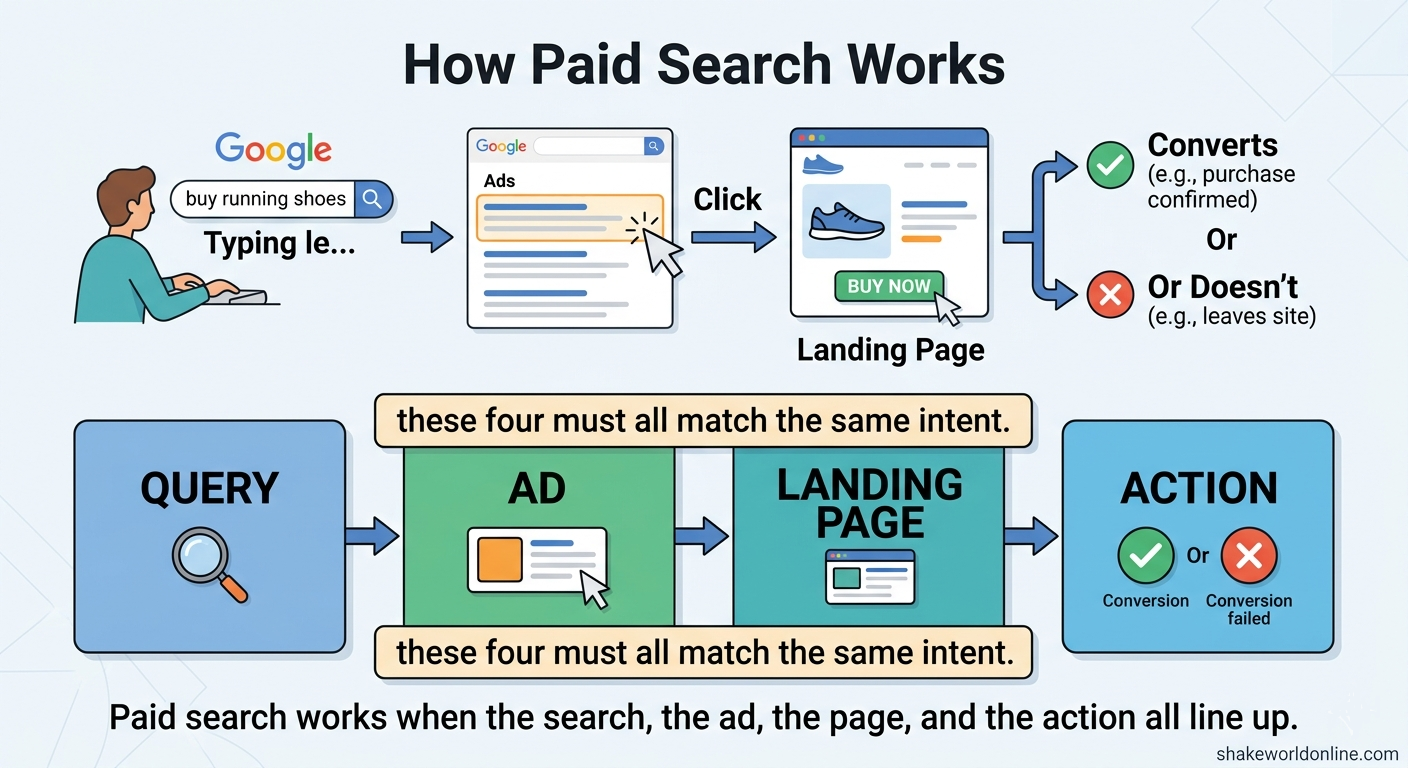
This is the rule that quietly decides whether you win or lose: the search query, your ad, your landing page, and the action you ask for must all line up around the same intent.
If someone searches for a specific solution, your ad should echo that exact need, your landing page should deliver on that exact promise, and the next step should be obvious. When these four match, your costs drop and conversions rise, Google rewards ads and pages that clearly belong to the query. When they don't match, you pay for clicks that bounce. Write your ads to speak to how people actually search, in their real words and questions, not in clipped keyword fragments. Your search-term report is a goldmine of the exact language your customers use; mine it.
5. Make Sure Your Budget Can Buy Enough Conversions to Learn
Here's a hard truth about paid search: it needs a minimum amount of data to work, because the automation learns from conversions.
A widely used rule of thumb is that a campaign wants somewhere around 30 conversions a month before the system can optimise reliably. Below that, results get jumpy and hard to trust. So the real budget question isn't "what's the magic number", it's "can I afford enough clicks to produce enough conversions to learn?" If your cost per click is high and your budget only buys a handful of clicks a day, paid search may not be the right channel yet, and that's worth knowing before you spend, not after. A small budget can absolutely work in a low-cost niche with patience; it struggles in an expensive, crowded one. Be honest with yourself about the maths.
6. Use Automation, But Keep Your Hand on the Wheel
Modern Google Ads runs largely on automation: the system sets bids and finds queries far faster than any human could. Used well, with clean conversion data feeding it, this is genuinely powerful and saves enormous time. The current direction of the platform rewards giving the automation good signals and room to work, rather than micromanaging every tiny setting.
But automation optimises tactics; it does not fix strategy. It won't question whether your tracking is right, your targets are realistic, or your structure makes sense. If those are wrong, it will faithfully optimise toward the wrong outcome. So let the machine do the heavy lifting, but you stay responsible for the strategy, and you watch it. Which brings us to the ongoing work.
7. Prune the Waste Every Week
Paid search is not "set and forget." The single highest-return habit is regularly reviewing where your money actually went and cutting the waste.
Each week, look at the real search terms that triggered your ads. You'll find irrelevant ones draining budget, add those as "negative keywords" so you stop paying for them. This matters more than ever now that the platform reaches broadly to find queries; broad reach without tight exclusions will happily spend your money on junk. A short, regular pruning session protects your budget better than almost anything else you can do.
Want paid search that pays back?
Profitable paid search takes the right tracking, intent match, and signals working together. We set up and run Google Ads for businesses every day.
Work With Shakeworld →A Few Honest Truths About Google Ads
Let me give you the balanced view.
Don't panic over short-term swings. Performance will bounce around. A bad day, even a bad week, is usually noise, not a crisis. Before you assume the platform "broke," check the boring suspects: did your tracking break, did a bid target change, did consent settings shift, did a competitor pile into your auction? Diagnose calmly and systematically. Knee-jerk changes do more damage than the swing itself, and every big change restarts the automation's learning.
Automation is a tool, not a strategy, and it has a bias. The platform's AI features can help a lot or quietly waste money, depending on whether you feed them good data and watch them. And remember the built-in incentive: the platform profits from your spend, so its defaults lean toward spending more. Stay skeptical of "just turn this on" advice. Test it in a controlled way over a few weeks; keep what proves itself, drop what doesn't.
Paid search isn't always the right channel. If your customers don't actively search for what you sell, or the clicks are simply too expensive for your margins, your money may do better elsewhere, on social platforms, content, or building an audience you own. Paid search is brilliant for capturing existing demand. It's poor at creating demand that isn't there yet.
Clicks lie; conversions tell the truth. It's easy to get hypnotised by clicks and click-through rates. But a click is just a visit, and plenty of clicks are bots, mistakes, or browsers. The only numbers that matter are the ones tied to real business: cost per qualified lead, cost per sale, return on what you spent. Judge everything by those.
Frequently Asked Questions
Google Ads lets you show ads to people at the exact moment they search for what you sell, and PPC (pay-per-click) means you only pay when someone clicks. The power of paid search is intent: unlike channels that interrupt people who were not thinking about you, search ads meet people who are actively looking, so you are catching demand that already exists rather than creating it. When someone searches an urgent, high-intent query, you can appear right at the top at the moment the need is real, which is why paid search can convert so well when it is set up properly.
Conversion tracking, without question, and you should set it up before you spend anything. Conversion tracking tells Google what a real win looks like for your business, a sale, a qualified lead, a booked call, so its automation can optimize toward the right outcome. Get it wrong and you fly blind: the system may chase cheap clicks or junk form fills. Get it right and everything else works better. A simple tracking fix often produces a bigger improvement than weeks of keyword and ad-copy tweaking, because the platform finally has the correct signal to optimize toward.
There is no universal number; it depends on your cost per click and how many conversions your budget can produce. A common rule of thumb is that a campaign wants roughly 30 conversions a month before the automation can optimize reliably, so the real question is whether your budget can buy enough clicks to generate enough conversions to learn. If clicks are cheap in your niche, a small budget can work with patience; if you are in an expensive, crowded market and your budget only buys a few clicks a day, paid search may not be the right channel yet. Know that before you spend, not after.
Usually one of three reasons. First, you may be optimizing toward the wrong goal: if you told Google that 'form submitted' is success, it will find form-fillers, including junk, rather than buyers, so feed back which leads become real customers. Second, your search, ad, and landing page may not match the same intent, so clicks bounce; make all four (query, ad, page, and the action you ask for) line up. Third, you may be spreading a small budget across too many products or keywords, so nothing gets enough data. Clicks are easy and often worthless; judge everything by cost per qualified lead or sale.
Use them, but keep your hand on the wheel. Modern Google Ads automation sets bids and finds queries faster than any human, and fed with clean conversion data it is genuinely powerful. But automation optimizes tactics, not strategy: it will not fix wrong tracking, unrealistic targets, or a poor account structure, it will faithfully optimize toward the wrong outcome instead. And remember the platform profits when you spend more, so many built-in recommendations gently push toward higher spend rather than higher profit. Treat every suggestion as a hypothesis to test over a few weeks, keep what proves itself, and drop what does not.
The Bottom Line
Google Ads rewards discipline, not cleverness. The advertisers who win aren't the ones with secret tricks; they're the ones who get the fundamentals right and protect their budget.
Set up conversion tracking before you spend anything, and teach Google what a good customer looks like, not just any action. Start narrow with one use case, tight keywords, and a dedicated landing page. Make your search, ad, and page all match the same intent. Make sure your budget can buy enough conversions to learn. Use the automation, but keep your hand on the wheel and prune the waste every week. And never forget that the platform profits when you spend, so every recommendation is a hypothesis to test, not an order to obey.
Do that, and paid search stops being a money pit and becomes what it should be: a reliable way to put your business in front of people the moment they're ready to buy. That's the whole point.
This is one piece of the bigger picture. To see how it all fits together, start with the complete guide to online marketing, then pair this with your budget and channel mix (where paid search fits), ideal customer profile and positioning (so you target the right searches), the marketing funnel (what your clicks feed into), landing pages and conversion optimisation (where clicks become customers), retargeting (to win back people who didn't convert), and marketing analytics and attribution (the tracking foundation it all rests on).
And if you'd like a team to set up and run paid search that actually pays back, that's exactly what we do at Shakeworld Digital. Get a free marketing audit and we'll show you where your paid search budget is leaking and how to fix it.
Written by Popmati Samson, Founder of Shakeworld Digital, systems builder, and AI entrepreneur. I help businesses turn paid search from a money pit into a steady source of customers.
Ready to stop burning budget?
You have the playbook. If you would rather have a team set up and run your paid search the right way, that is what we do at Shakeworld Digital.
Get Your Free SEO Audit →