

Meta Ads (Facebook and Instagram): Reach Buyers While They Scroll
 By Popmati Samson
10 min readUpdated 2026
By Popmati Samson
10 min readUpdated 2026Meta Ads are the adverts you run across Facebook and Instagram from one place: Meta's Ads Manager. They put your business in front of people while they scroll, even when they weren't searching for you.
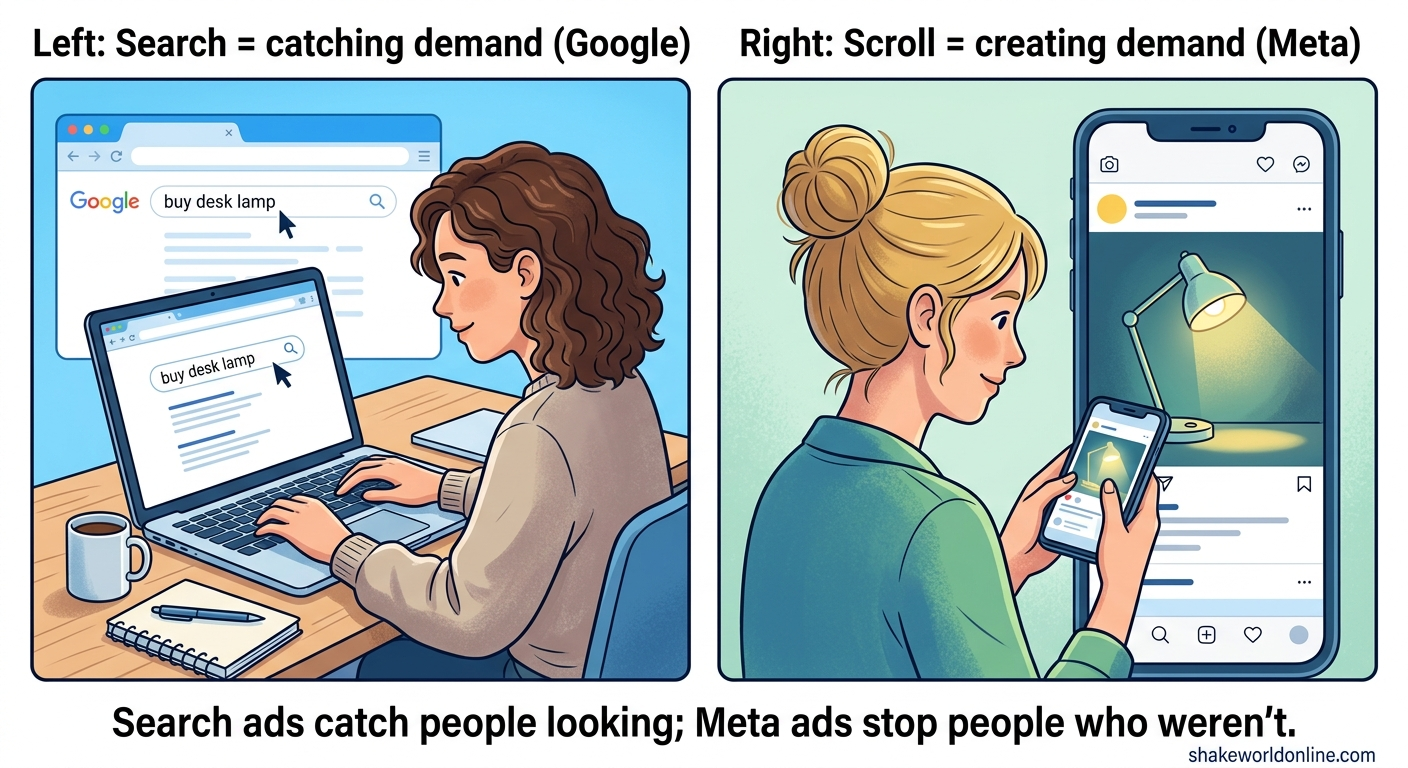
That's what makes Meta different from search ads. On Google, you catch people who are already looking for what you sell. On Meta, you create the want. You interrupt a scroll with something so relevant or compelling that a person who wasn't thinking about you suddenly is.
Done well, this is one of the most powerful ways to grow, especially for visual products and for reaching people before they even know they want you. Done badly, it quietly drains your budget on clicks and followers that never buy. The difference comes down to a few principles that don't change no matter how often Meta updates the platform. Let me walk you through them.

What is Meta Ads
Here's the simple version. Facebook and Instagram are owned by the same company, Meta, and you run ads on both from a single dashboard called Ads Manager. One campaign can show your ad on Facebook feeds, Instagram Reels, Stories, and more.
The key thing to understand is that Meta is an interruption channel, not a search channel. Nobody opens Instagram to buy a lamp. But if they're scrolling and a beautiful video of that lamp glowing in a cosy room stops their thumb, you've created a customer who didn't know they wanted one. That's the magic of Meta: it reaches people based on who they are and how they behave, not on what they typed into a search box.
This also means the burden is on you to earn the stop. On search, the intent is already there. On Meta, your creative has to manufacture the interest in the first second or two. Keep that in mind, because it shapes everything that follows.
I'm Popmati Samson, founder of Shakeworld Digital. I've run Meta ads for product brands and service businesses across very different budgets, and the lessons repeat so reliably that I can almost predict where a new advertiser will lose money before they start. Let me help you skip those mistakes.
Why Most Meta Ad Budgets Get Wasted
Before the how-to, here are the traps that catch nearly everyone. Avoid these and you're already ahead.
Choosing the wrong campaign goal. This is the single most expensive mistake on Meta, and it's brutally common. When you set up a campaign, Meta asks what you want: traffic, engagement, followers, or sales. Whatever you pick, Meta goes and finds the cheapest people who'll do that thing. Tell it you want "traffic" and it finds cheap clickers, often low-quality or bot-like accounts that will never buy. I've watched a brand run a "traffic" campaign for a week, rack up junk followers with bizarre profiles, and waste the whole spend, then switch to a "sales" goal and immediately start reaching real buyers. Optimise for what you actually want. If you want sales, choose the sales goal.
Boosting instead of advertising properly. That tempting "Boost post" button is not the same as running a real campaign. Boosting is simple and gives you reach, but almost no control, and it tends to chase cheap engagement that can flood your account with followers who never interact again. Useful for testing what content grabs attention; poor for actually growing a business.
Trying to out-think the algorithm on day one. New advertisers love to hand-pick every setting: this exact age, this exact placement, Instagram only. Usually that just starves the system of the data it needs to find your buyers.
Forgetting that the creative is the whole game. People obsess over targeting and placements and ignore the thing that actually decides success: the ad itself. On Meta, your creative is your targeting.
Burning budget on junk clicks and followers?
Find out why your Meta ads attract browsers instead of buyers, and what to fix first. Get a free audit and we will review your campaigns and creative.
Get My Free SEO Audit →How to Run Meta Ads That Actually Work
Here's the practical playbook, in order. The sequence matters.
1. Pick the Right Goal So Meta Finds Buyers, Not Browsers
Start here, because this one decision shapes everything. Before any creative or targeting, choose the campaign objective that matches what you truly want.
If you want sales, pick the sales (conversion) objective, even if it costs more per result, because those results are real customers, not cheap clicks. If you genuinely want leads, pick the lead objective. Avoid "traffic," "engagement," or "followers" as your goal unless you specifically want cheap attention and nothing more, because Meta will deliver exactly that: lots of clicks or follows, almost no business. The platform always optimises for the thing you ask for, so ask for the right thing.
2. Let Meta Decide Placements (At First)
When you start, resist the urge to force "Instagram only" or "Facebook only." Use Meta's automatic placements and let the system spread your ad across Facebook, Instagram, Stories, Reels, and more, then learn where it performs.
Here's why. Your assumptions about where your audience lives are often wrong. A younger audience you "knew" was on Instagram may convert more cheaply on Facebook, and vice versa. Meta optimises in real time on actual conversion data, which beats your guesswork early on. Give it a week or two, then open the breakdown report and see where your sales actually came from. If one platform is clearly winning, then you shift budget. Decide with data, not assumptions.
3. Put Most of Your Energy Into the Creative
This is the real lever, so spend your effort here. On Meta, the ad creative, the video, the image, the hook, matters more than any targeting setting. The algorithm is good at finding the right people if you give it something worth showing them.
A few timeless creative truths. Grab attention in the first two to three seconds or you've lost the scroll. Make it mobile-first and vertical, because that's how people hold their phones. Show your product in real life, in use, in a real setting, not just a sterile shot on a white background, especially for anything visual. And design for sound-off: most people watch with no audio, so your message must land through visuals and captions alone. Authentic, slightly raw content often beats polished, corporate-looking ads, because it feels like a real person, not an advert.
4. Test Several Different Creative Angles, Not Just Tweaks
Don't bet everything on one ad. Launch several genuinely different creative angles at once and let the winners reveal themselves. The key word is different: not the same video with a new caption, but real variety in approach.
Proven angles worth testing include a customer talking about their experience, a clear before-and-after, a side-by-side of you versus the usual alternative, a myth-versus-fact, a behind-the-scenes of how it's made, or a simple "reasons why" list. Run a handful of these, and the platform will quietly find which one resonates. Variety also fights fatigue (more on that below), because the system has more to work with than near-identical copies.
5. Start Small, Don't Touch It, Then Scale the Winner
With a fresh campaign, begin with a modest daily budget and a few creatives, then leave it alone for several days. This is hard for beginners, but crucial.
Every time you change a campaign, budget, audience, creative, you reset the system's learning, and it stumbles around again. So resist tinkering. Give it five to seven days to gather enough data to find a pattern. Then read the results, kill the losers, and put more budget behind the clear winner. Validate cheaply first; pour fuel on what's already burning. This is the same discipline behind your whole budget and channel mix.
6. Use Ads Manager for Growth, Boosting Only for Quick Tests
Know the difference between the two tools. Boosting (the easy button on a post) is fine for a quick, cheap test of which piece of content grabs attention. Ads Manager is where real growth happens: proper objectives, audience building, retargeting, and the optimisation that lowers your cost per customer over time.
A smart rhythm: boost to test which content people respond to, then take your winning posts into Ads Manager and run them as proper conversion campaigns. Boost for exposure; Ads Manager for growth. And a warning: never optimise for followers as your goal, the follower count you buy that way is often hollow, full of accounts that never engage or buy, which can even hurt your reach later.
7. Refresh Your Creative Before It Burns Out
Meta ads wear out. The same ad shown over and over to the same people stops working, your costs creep up and results fade. This is "creative fatigue," and it's not a sign you did something wrong; it's normal.
The fix is a steady pipeline of fresh creative. The cheapest refresh is often a new hook: keep the body of a winning video, but change the first few seconds. Keep feeding the system new and varied angles so it always has something fresh to test. The brands that win on Meta aren't the ones with one perfect ad; they're the ones that keep producing.
Want Meta ads that actually sell?
Profitable Meta ads take the right goal, strong creative, and patient testing working together. We build creative and run Facebook and Instagram ads for businesses every day.
Work With Shakeworld →A Few Honest Truths About Meta Ads
Let me give you the balanced view.
The platform profits when you spend, so it nudges you to spend. Like any ad platform, Meta's defaults and prompts lean toward more spending and easy buttons like Boost. Its automation genuinely helps when you feed it the right goal and good creative, but stay in the driver's seat. Don't just click "boost" because it's there.
Targeting isn't the magic it once was, and the audience is shifting. Privacy changes have made precise targeting harder, which is exactly why creative now carries the load. On top of that, Meta has rolled out paid, ad-free subscriptions in some regions, meaning some of your highest-value, highest-income users may simply opt out of seeing ads at all. The honest takeaway: don't rent your entire audience from Meta. Build an organic presence and an audience you own (your email and messaging list) so you're never fully dependent on the platform. This is the heart of brand versus performance.
AI tools can help, but they won't save a weak offer. You can use AI to draft campaign steps and spin up creative variations quickly, and that's a real time-saver for testing. But AI can't fix a product nobody wants or an offer that isn't compelling. The fundamentals come first.
You'll probably pay some "tuition." If it's your first time, expect part of your early budget to teach you what doesn't work. That's normal. Go in knowing the creative and the setup are where money is won or lost, start small, and treat the first weeks as learning, not a verdict. If the stakes are high, it can be worth getting experienced help for the initial setup and creative rather than learning entirely on your own naira.
Frequently Asked Questions
Meta Ads are the adverts you run across Facebook and Instagram from one dashboard called Ads Manager. The key difference from Google is intent: Google search ads catch people who are already looking for what you sell, while Meta ads interrupt people who are scrolling and were not thinking about you. That makes Meta an interruption channel that creates demand rather than just capturing it, which is powerful for visual products and for reaching people before they know they want you. It also means your creative has to earn the stop in the first second or two, since the intent is not already there.
When you start, let Meta decide. Use automatic placements and let the system spread your ad across Facebook, Instagram, Stories, Reels, and more, then learn where it performs best. Your assumptions about where your audience lives are often wrong: a younger audience you 'knew' was on Instagram may convert more cheaply on Facebook, and the reverse happens too. Give it a week or two, then open the breakdown report and see where your sales actually came from. If one platform is clearly winning, shift budget there. Decide with data, not assumptions.
Almost always because you chose the wrong campaign goal. Meta optimizes for exactly what you ask for, so if you pick a 'traffic,' 'engagement,' or 'followers' objective, it finds the cheapest people who will click or follow, which often means low-quality or bot-like accounts that never buy. Switch to a sales (conversion) objective and Meta starts finding people likely to purchase instead. The same applies to boosting posts and optimizing for followers: the reach is cheap but hollow. Optimize for what you actually want, which is customers.
The creative, by a wide margin. On Meta, your creative is your targeting: the algorithm is good at finding the right people if you give it something worth showing them. Grab attention in the first two to three seconds, make it mobile-first and vertical, show your product in real life rather than on a sterile white background, and design for sound-off viewing with captions since most people watch without audio. Test several genuinely different angles (a customer talking, a before-and-after, behind-the-scenes, a myth-versus-fact) rather than the same video with a new caption, and keep fresh creative coming because every ad eventually fatigues.
Use Ads Manager for real growth and boosting only for quick tests. Boosting (the easy button on a post) is simple and gives you reach but almost no control, and it tends to chase cheap engagement that can flood your account with followers who never buy. Ads Manager gives you proper objectives, audience building, retargeting, and the optimization that lowers your cost per customer over time. A smart rhythm is to boost to test which content grabs attention, then take your winning posts into Ads Manager and run them as proper conversion campaigns. Boost for exposure; Ads Manager for growth.
The Bottom Line
Meta Ads reach people while they scroll, creating demand rather than just capturing it. That power is real, but only if you respect how the platform actually works.
Pick the right goal so Meta finds buyers, not browsers. Let it choose placements at first, then decide with data. Pour your energy into creative, because on Meta the creative is the targeting, and test several genuinely different angles. Start small, leave it alone to learn, then scale the winner. Use Ads Manager for real growth and boosting only for quick tests. And keep fresh creative coming, because every ad eventually burns out.
Do that, and Meta stops being a slot machine and becomes a reliable engine for putting your business in front of exactly the right people, at the moment their thumb is ready to stop. That's the whole point.
This is one piece of the bigger picture. To see how it all fits together, start with the complete guide to online marketing, then pair this with Google Ads and PPC (the demand-capture counterpart), your budget and channel mix (where Meta fits), ideal customer profile and positioning (who your creative should speak to), landing pages and conversion optimisation (where the click becomes a sale), retargeting (to win back people who didn't convert), and marketing analytics and attribution (so you know what's truly working).
And if you'd like a team to build the creative and run Meta ads that actually sell, that's exactly what we do at Shakeworld Digital. Get a free marketing audit and we'll show you where your Meta ads are leaking and how to fix them.
Written by Popmati Samson, Founder of Shakeworld Digital, systems builder, and AI entrepreneur. I help businesses turn Facebook and Instagram ads from a money pit into a steady source of customers.
Ready to stop feeding the slot machine?
You have the playbook. If you would rather have a team build the creative and run your Meta ads the right way, that is what we do at Shakeworld Digital.
Get Your Free SEO Audit →