

Marketing Budget and Channel Mix: Where Your Money Should Actually Go
 By Popmati Samson
9 min readUpdated 2026
By Popmati Samson
9 min readUpdated 2026Your marketing budget is how much you spend to grow. Your channel mix is where you put that money: ads, email, content, social, and the rest.
Get these two right and every naira works harder. Get them wrong and you'll do what most businesses do: spread cash thinly across too many channels, learn nothing, and quietly wonder why marketing "doesn't work."
It does work. You just have to spend with focus. Let me show you how to decide how much to spend and where, in plain terms, with no fluff.

What "Budget and Channel Mix" Really Means
Two simple questions sit underneath all of this.
How much should I spend? That's your budget. It can be a fixed monthly figure or a percentage of your revenue.
Where should I spend it? That's your channel mix: the specific blend of marketing channels you put your money and time into.
Most people obsess over the first question and barely think about the second. That's backwards. A modest budget spent on the right channel beats a big budget scattered across the wrong ones. As one saying in the industry goes, allocation discipline matters more than the size of your spend.
I'm Popmati Samson, founder of Shakeworld Digital. I've watched businesses with small budgets win by being precise, and businesses with big budgets lose by being vague. The difference is almost never the money. It's the focus. Let me walk you through how to get both right.
How Much Should You Actually Spend?
Let's answer the money question first, because it's the one everyone asks.
There's no magic number, but there are useful guideposts. As a rough rule, established small businesses often spend somewhere around 7 to 10% of their revenue on marketing. Newer businesses chasing fast growth frequently spend more, sometimes 15% or higher, because they're building from zero and need momentum.
But here's the honest truth: those percentages matter far less than people think. If you're just starting, you might have a fixed amount you can afford, say a few hundred dollars a month, and that's your budget, percentages aside. The real question isn't "what's the perfect number." It's "how do I make whatever I have work hardest."
And here's a lesson most guides skip: a small budget is a gift in disguise.
When you only have a little to spend, you can't hide behind vague "brand awareness." You feel every wasted naira immediately. A weak ad, a confusing offer, a clunky landing page, you see the damage at once. That pressure forces you to learn the things that actually matter: a strong hook, a clear offer, real differentiation. Marketers who start small often become far better than those handed big budgets, because small budgets teach respect for conversion. So don't envy the big spenders. Use your constraints to get sharp.
Not sure where to put your marketing money?
Find out which channels are most likely to pay back fast for your business. Get a free audit and we will map your budget to the right mix.
Get My Free SEO Audit →How to Choose Your Channel Mix
This is the part that really decides your results. Here's how to build a channel mix that works, step by step.
1. Start Where Your Customer Already Is
You did the work in your ideal customer profile. Now use it. The single most important rule of channel choice is to go where your people already gather, not where you wish they were.
If your customers actively search for a solution when they need one, like a plumber or a lawyer, search channels (SEO and Google Ads) belong at the center of your mix. If they discover things while browsing and your product is visual, social channels fit better. If you sell to other businesses, search, professional networks, and email tend to win. And if your audience lives on WhatsApp, as so many do, that's a core channel, not an afterthought. The honest answer to "which channel is best?" is always "it depends what you sell and who you serve." Start from your customer, not from a trend.
2. Pick Two or Three Channels, Not Ten
This is the mistake I see most often, and it's costly. A business spreads itself across Facebook, Instagram, TikTok, Google, email, LinkedIn, and a blog, does a weak job on all of them, and gives up.
Don't do that. Pick two or three channels you can actually execute well, and go deep. Consistency on a few beats a thin presence on many, every time. You learn faster, your effort compounds, and you can tell what's actually working. You can always add a channel later, once one is humming. Focus first. Expand second.
3. Understand the Trade-Off: Fast vs. Compounding
Every channel falls somewhere on a spectrum between "fast but rented" and "slow but owned." Understanding this is the key to a smart mix.
Paid channels like Google and Meta ads are fast. You can launch today and have results tomorrow. But the moment you stop paying, the traffic stops. You're renting attention. Owned channels like content, SEO, and email are slow to start, often taking six to nine months to gain real traction, but they compound. Content you publish can bring in customers for years after you wrote it. The cheapest channel in any given year is often the one you built the year before.
A healthy mix usually blends both: enough paid to get fast feedback and early customers, plus steady investment in owned channels that build a lasting asset. A common starting split is to lean the majority of your effort toward owned channels (content, SEO, email) and a smaller portion toward paid, but adjust based on how fast you need results. For more on the two paid giants, see Google Ads and Meta ads; for the owned powerhouses, see email and content.
4. On a Tight Budget, Validate Before You Scale
If you only have a few hundred dollars, here's the hard truth: don't blow it on ads first. With a small budget, paid ads burn through your cash in days and often teach you little, especially before you know your message even works.
Instead, start with low-cost channels that prove your idea: organic social, genuinely helpful participation in the communities where your customers gather, direct outreach, and building a small email list. Use these to learn what message converts. Then, once you know what works, put paid money behind the winners to scale them. Validate cheaply, then pour fuel on what's already burning. This is also where high-intent, low-cost tactics shine: owning a handful of specific, high-intent search terms is predictable and cheap, even if it caps out in volume.
5. Use a Simple Allocation Framework
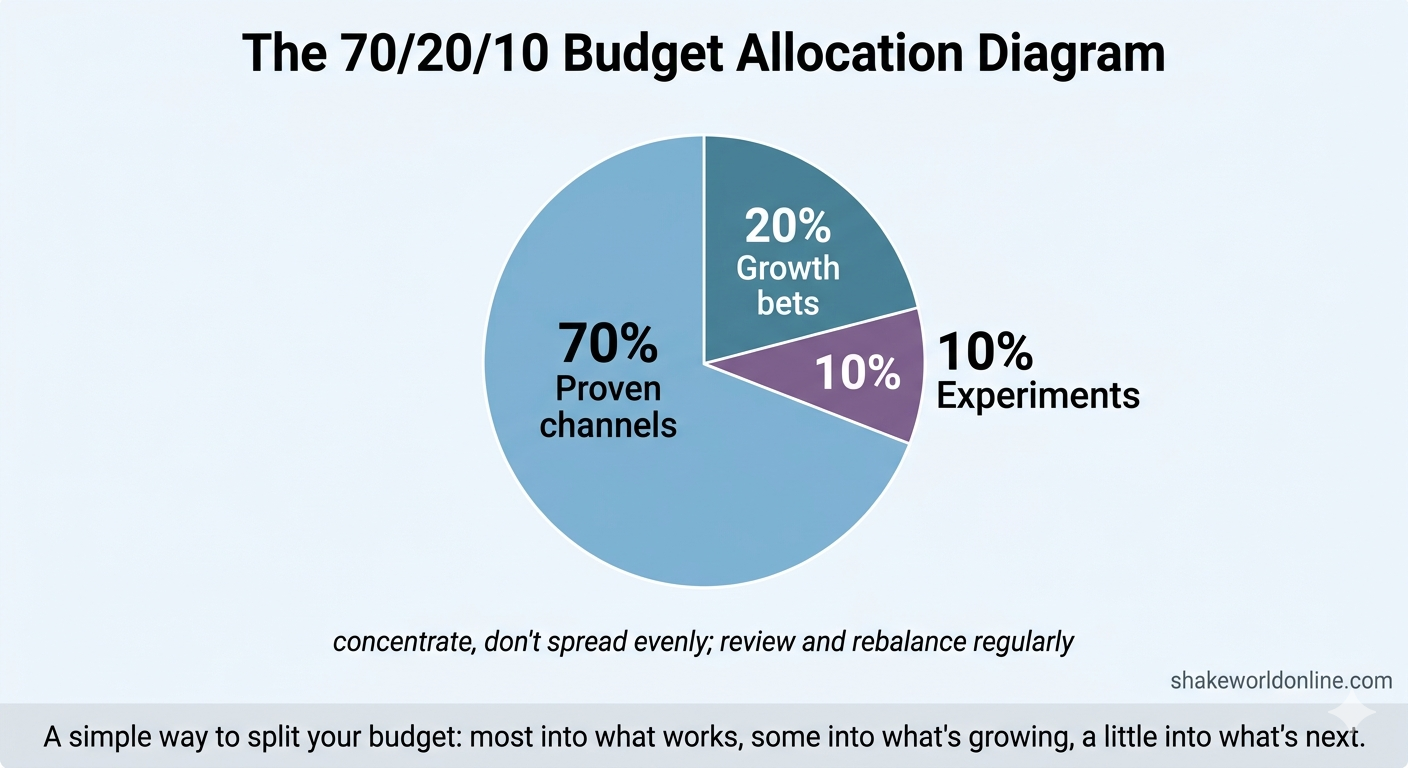
Once you have a budget and a shortlist of channels, split the money with intention rather than evenly. A framework many growing businesses use is 70/20/10: put about 70% of your budget into the channels you know work, 20% into promising channels you're growing, and 10% into pure experiments. This keeps you grounded in what's proven while still testing the next thing.
The other key principle: don't spread evenly across everything. Concentrate. If a product launch or a big campaign is coming, front-load spending where it matters most. Reserve a slice for testing, but put the bulk behind your proven winners.
6. Measure, Then Move the Money
Your channel mix should never be set in stone. The whole point is to learn and shift.
Track the cost of a result (a lead or a sale) for each channel. Then steadily move money away from channels with rising costs or weak returns, and toward the ones that are working and have room to grow. Review this regularly, monthly when you're small, quarterly as you grow. Allocating budget well is less like chess, where you plan every move, and more like a game where you probe, learn, and adjust as real results come in. The businesses that win aren't the ones with a perfect plan on day one; they're the ones that rebalance fastest. This depends entirely on solid measurement and attribution, so get that foundation right.
Spreading your budget too thin?
A focused channel mix takes the right channels, a smart split, and honest measurement working together. We help businesses concentrate spend where it earns the most every day.
Work With Shakeworld →A Few Honest Truths About Budgets and Channels
Let me give you the balanced view, the things I make sure every business understands.
There is no universal "best" channel. Anyone who tells you "email is best" or "ads are best" without asking what you sell or who you serve is guessing. The best channel is the one where your specific customers are, that you can execute consistently, and that pays back. It changes by business, and it changes over time as channels get more crowded and expensive.
Distribution is a separate skill from building. This catches people out. You can have a great product, a beautiful website, perfect pricing, and still fail, because not enough of the right people see it. Getting your offer in front of people, repeatedly, is its own discipline. Don't assume "if I build it, they'll come." Budget real time and money for distribution.
Traffic without conversion is a deeper problem than channel choice. If you're getting visitors but no sales, switching channels won't fix it. That's usually a message, offer, or fit problem, not a channel problem. Before you spend more to get more traffic, make sure the traffic you already have is converting. This connects back to your funnel and positioning.
You will waste some spend, and that's the cost of learning. No one allocates perfectly from the start. Some of your budget will teach you what doesn't work. That's not failure; that's tuition. The goal isn't zero waste. It's learning fast and shifting money toward what works before the waste adds up.
Frequently Asked Questions
There is no magic number, but useful guideposts exist. Established small businesses often spend roughly 7 to 10% of revenue on marketing, while newer businesses chasing fast growth frequently spend more, sometimes 15% or higher, because they are building momentum from zero. That said, the percentage matters far less than how well you spend it. If you are just starting, a fixed affordable amount, even a few hundred dollars a month, is a perfectly valid budget. The real question is not the perfect figure; it is how to make whatever you have work hardest, which comes down to focus.
Start where your customers already gather, not where you wish they were. If they actively search when they need a solution, prioritize search (SEO and Google Ads); if they discover things while browsing and your product is visual, lean into social; if you sell to businesses, search, professional networks, and email tend to win; and if your audience lives on WhatsApp, treat it as a core channel. Then pick just two or three channels you can execute well and go deep, rather than spreading thin across many. The honest answer to 'which channel is best' is always 'it depends what you sell and who you serve.'
It depends on your budget and timeline. Paid channels like Google and Meta ads are fast but stop the moment you stop paying, so you are renting attention. Owned channels like content, SEO, and email are slow to start but compound into a lasting asset. On a tight budget, validate your message cheaply first with organic social, community participation, outreach, and a small email list, then put paid money behind whatever is already working to scale it. A healthy long-term mix blends both: enough paid for fast feedback, plus steady investment in owned channels.
It is a simple framework for splitting your budget with intention rather than evenly. You put about 70% into the channels you already know work, 20% into promising channels you are growing, and 10% into pure experiments. This keeps most of your money grounded in proven performers while still testing the next opportunity. The companion principle is to concentrate rather than spread evenly: front-load spending where it matters most, reserve a slice for testing, and review regularly so you can move money toward whatever is paying back best.
Often it is not a channel problem at all. Three common causes: you are spreading a small budget too thinly across too many channels and doing none well; you are treating distribution as automatic when getting your offer in front of people is its own skill that needs real time and money; or you are getting traffic but it is not converting, which is a message, offer, or fit problem that switching channels will not fix. Before spending more to get more traffic, make sure the traffic you already have converts, and that you are focused on a few channels rather than scattered across many.
The Bottom Line
Your marketing budget and channel mix come down to one principle: spend with focus, not with hope.
Don't agonize over the perfect percentage of revenue. Whatever you can spend, make it work hard. Choose your channels by starting where your customers already are, then pick just two or three and go deep instead of spreading thin. Blend fast-but-rented paid channels with slow-but-compounding owned ones. On a tight budget, validate your message cheaply before scaling with paid. Split your money with intention, most into what works, and review often, moving cash toward whatever's paying back.
Above all, remember that precision beats budget. A focused small budget, spent where your customers are and measured honestly, will out-earn a big one thrown at everything. That's the whole game.
This is one piece of the bigger picture. To see how it all fits together, start with the complete guide to online marketing, then pair this with your ideal customer profile and positioning (so you know where to spend), the marketing funnel (so your spend moves people toward a sale), brand versus performance marketing (the balance behind your mix), and marketing analytics and attribution (so you know what's actually working).
And if you'd like help deciding exactly where your marketing money will earn the most, that's exactly what we do at Shakeworld Digital. Get a free marketing audit and we'll map your budget to the channels most likely to pay back fast.
Written by Popmati Samson, Founder of Shakeworld Digital, systems builder, and AI entrepreneur. I help businesses spend their marketing budget where it actually drives revenue.
Ready to spend with focus?
You have the framework. If you would rather have a team plan and manage your budget and channels for you, that is what we do at Shakeworld Digital.
Get Your Free SEO Audit →